


Review: BBC PROMS: RATTLE CONDUCTS SCHUMANN, Royal Albert Hall
The Freiburg Baroque Orchestra place Robert Schumann in the spotlight

Robert Schumann, musician and composer of the German Romantic era, generated a huge amount of work in his short lifetime, with some 40 volumes of manuscript being assembled for the New Schumann Complete Edition in 2023.
Tonight's conductor Sir Simon Rattle has a long association with the composer, serving as a champion for his work across multiple ensembles from the Orchestra of the Age of Enlightenment to the Berlin Philharmonic Orchestra.
The Freiburg Baroque Orchestra, a major period instrument ensemble, were natural collaborators for this Rattle Conducts Schumann Prom, with Isabelle Faust joining them as soloist on the Violin Concerto in D minor. The programme concentrates on examples from Schumann's final creative decade, with the overture for his only opera, Genoveva and the Symphony No 2 in C major joining the concerto.
Composed in 1847-8, Genoveva tells the story of the medieval saint Geneviève, whose legend was informed by Genoveffa of Brabant and Marie of Brabant, both virtuous wives accused of adultery. The overture is tumultuous and passionate, eventually resolving itself into something of a happy ending.
The Violin Concerto has something of a chequered history. Composed in 1853 in the middle of Schumann's final and major mental collapse, it was received poorly and dismissed as an example of his erratic and morbid state of mind. It has moments of great beauty in its fragile, understated, and technical complexity.
With its warm sense of balance and lyricism, this is a real gift to a soloist and a perfect example of how an accomplished work can rise through the prism of creative exhaustion, pressure, and collapse. Finally premiered in 1937 by the Berlin Philharmonic and then in New York by Yehudi Menuhin with the St Louis Symphony Orchestra, it now holds its rightful place as a rediscovered major work.
Finally, the Symphony No 2 of 1845-6 continues to delve into Schumann's dark thoughts and depression. The four movements are vastly different in style, with the first the most conventionally appealing. The fast-paced scherzo, the stately adagio, and the wise and tragic allegro are captured by the Freiburg period instruments, given a woody and potent flavour.
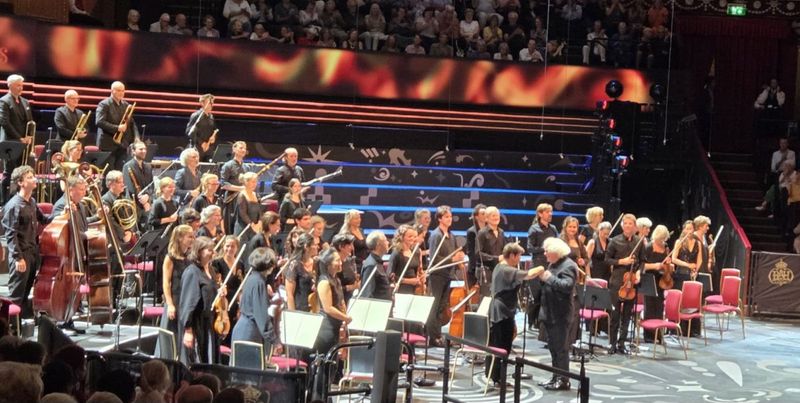
Rattle stands close to the orchestra without a podium, allowing an intimacy to develop between conductor and musicians. His movement becomes almost its own instrument in itself, and his passion for the material comes through with ease.
This is not easy material to perform: there is a definite sense of the man behind the music cracking open his soul in sharing his compositions. The woodwind and strings are strong throughout the night, with the double basses doing sterling work in the Symphony. This Prom is a definite treat, and Schumann's poetic and elegant works shine in this Baroque orchestra treatment.
The BBC Proms continues at the Royal Albert Hall until 12 September
Photo credit: Louise Penn
Sign up for all the news on the Fall season, discounts & more...
.jpg?format=auto&width=300)





Reader Reviews
To post a comment, you must register and login.