Interview: 'Everyone Has A Story To Tell: Director Chloe Salmon on Community and Celebrating a Decade of THE MOTH
"It's reinforced to me how much we all have in common and how you are not really alone"
The Moth is an acclaimed, international, nonprofit organisation dedicated to the art and craft of live, unscripted, first-person storytelling. Storytellers share personal, true-to-life experiences without notes or props to ensure a strong connection between storyteller and their audience.
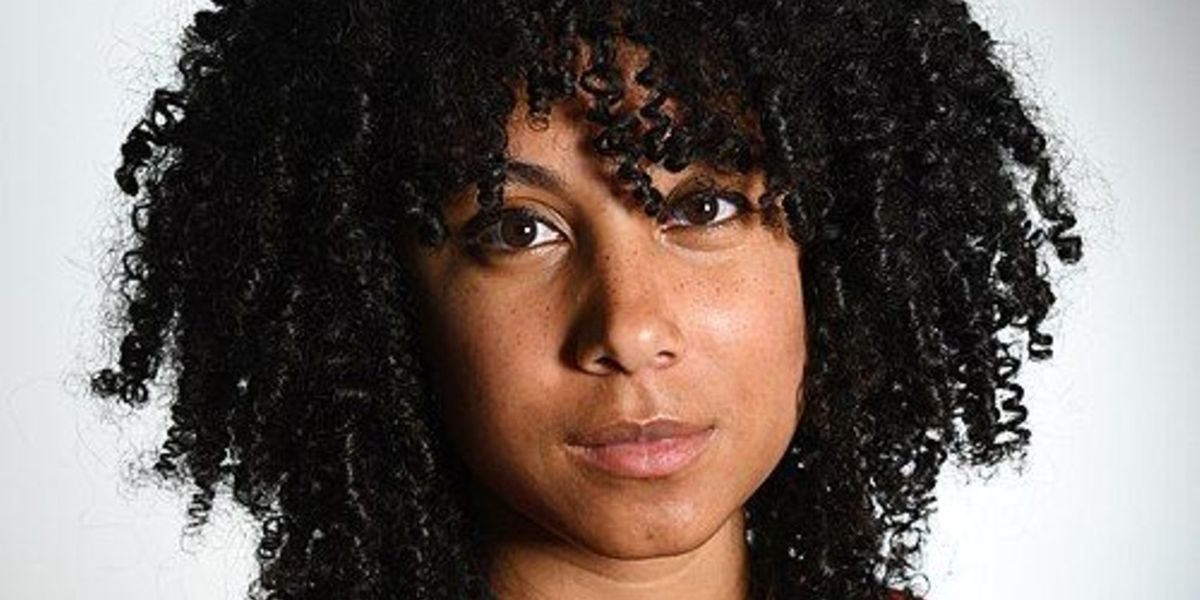
Director at The Moth Chloe Salmon is celebrating the 10-year anniversary of their first London GrandSLAM show. Chloe began working on live event production, and is now on the artistic team, directing for their main stage and coaching acts for their GrandSLAMs. Chloe is also one of the hosts of the Moth Podcast and the Moth Radio Hour. BroadwayWorld met with Chloe to talk about the community spirit of storytelling and to learn a little about Chloe's very own Moth niche, as she also celebrates 10 years with the organisation.
Chloe, you’ve helped shape The Moth into a global storytelling force, what first drew you to personal storytelling as a medium?
I came to The Moth first as a fan. I live in New York now. It's where The Moth is headquartered, but I grew up in Kansas and I started listening to The Moth podcast and just absolutely fell in love with it, I tuned in constantly. When I was ready to move to New York, The Moth happened to have a position open and it felt like a dream.
What does your role as a producer and director actually look like behind the scenes, especially for something as high-stakes as a GrandSLAM?
Story Slams are open mic, and there's a winner at the end of every night, and that winner goes on to compete in a GrandSLAM with nine other winners, 10 folks total. In the Story Slams, people just come with what they have prepared. We have no idea what they're going to get up on stage and say. It makes the nights very fun and magical. For the GrandSLAMs we acknowledge everybody's already a winner, and this is a little bit of a step up. It's a bigger venue usually.
We offer coaching calls with Moth story directors to offer extra support to the storytellers as they prepare for the GrandSLAM. They still choose their own story, work on it themselves ahead of time, but in the lead up to the event, I will have a phone call with each of the storytellers to hear their story. I offer feedback or any notes that I think could maybe help sharpen it. It's a very storyteller-led process.
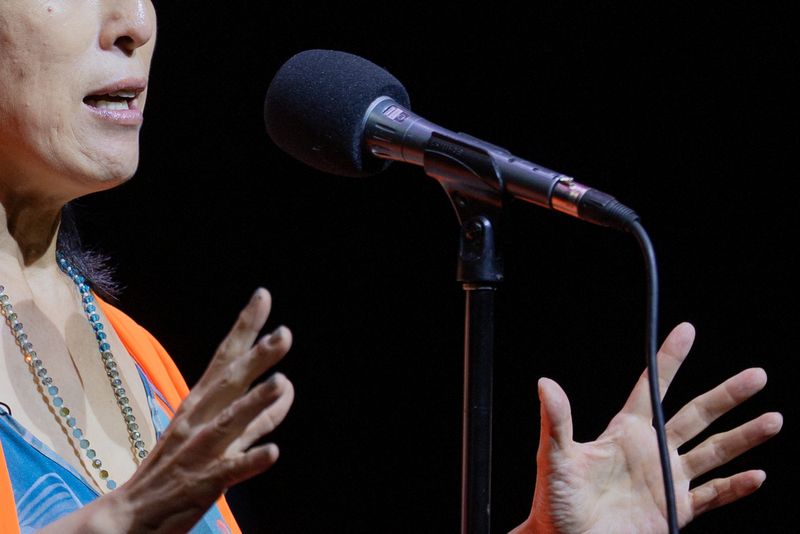
The Moth's GrandSLAM
Photo Credit: Salma Ali
Was there a moment early in your career where you realised storytelling could genuinely change people, not just entertain them?
Yes, the other part of my role is that I work on the main stage, which is our curated live event series. We do one or two of those in London a year. We have one coming up in September. I work a lot more intensively with those storytellers. We help them pick the story and really work with them on it. It's a collaborative process up until the show. It's transformative for the storytellers, but it's also so transformative for the audience, I feel they really are community events. Whether you're the person up on stage telling your story, or you might be a person, or if you have your name in the hat, you don't know if you're going to get up there.
The audience are just there to listen to what people have to say. You don't really know what you're going to get as an audience member before you go in. You just know that you're going to hear somebody share something true to them. It might be funny, it might be sad. It's always going to be a little bit vulnerable.
The Moth is built on the idea of connecting humanity through personal storytelling. In 2026, when people are more digitally connected, but often emotionally disconnected, why does that mission feel urgent?
I feel like it gets more urgent every year. I think there are a lot of spaces where it feels like the only way to be heard, is to shout, shout the loudest and to not have any space to sit back and listen. Those kinds of polarising spaces exist more with the internet, and the ways that we communicate with each other.
I think that telling a story, listening to a story, really connects with people in a way that I just don't see in a lot of other forms of communication. If you're listening to a speech, if you're listening to a presentation, or you go to see a play or another kind of scripted performance, there's always a little bit of waiting to be sold on something. Maybe the person has an agenda. I find again and again that when people get up on stage and they share something true from their lives, of a moment that shifted them or changed them in some way, the people listen in an open way because it doesn't feel as if they're being spoken at or that they have to have a rebuttal or a response.
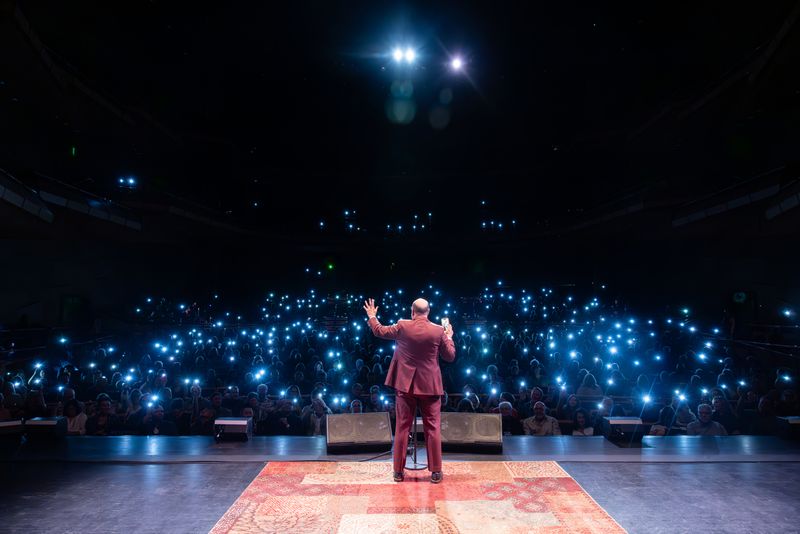
The Moth's Between Worlds
Photo Credit: Salma Ali
With over 65,000 stories told globally, what patterns or shared human experiences keep emerging for you?
We have a pitch line where people can call and leave a two-minute pitch of a story they might like to tell us. The thing that my work has really reinforced for me is that often I'll hear pitches from people or I'll see somebody tell a story at a slam or at a live event where I can tell that that person feels very alone or lonely in what they're experiencing. They want to share because they want other people to know that they're not the only one. Two or three stories in the same day are often kind of similar, perhaps that might have to do with the death of a parent or a health issue or even something fun, but it's reinforced to me how much we all have in common and how you are not really alone, I can guarantee you that somebody else is going through that too.
The GrandSLAM is described as ‘a battle of wits and words.’ How do you balance competition with vulnerability on the stage?
It comes down to the person telling the story, right? I think the Story Slam and the GrandSLAM spaces, as I've experienced them, are supportive spaces. Often the storytellers themselves are very supportive of each other, too. People obviously like to win, but there is less of kind of a cutthroat energy about it than you might expect in a competition. As the (perfomers) are sharing something that's important to them. People might be honest and say, ‘I'd really like to win’, but that's not the point for people, which is nice.
I always say the way to succeed on a Moth stage is to be as much yourself as possible, to put as much of yourself as you can into the story. And obviously there's craft to the story and there's the artistry of crafting the story, but there also has to be honesty and vulnerability in it. It’s a story first philosophy.
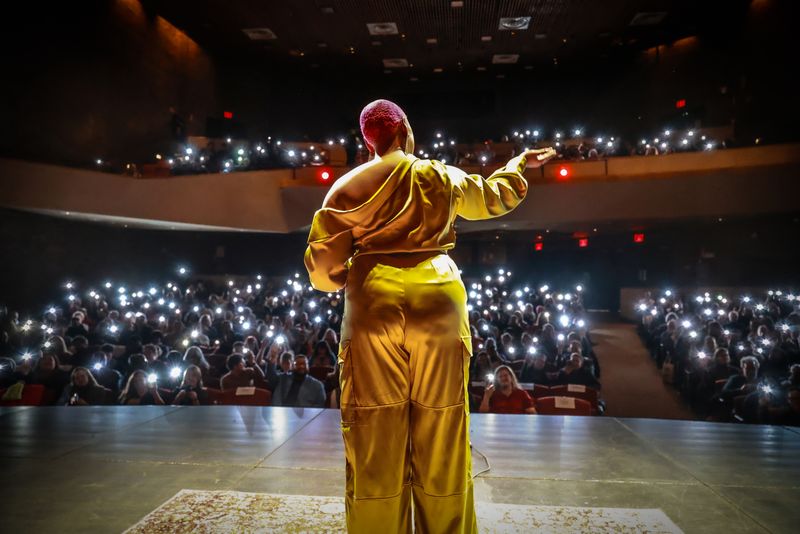
The Moth in Harlem
Photo Credit: Dan Henry
Have you noticed differences in how UK audiences engage with stories compared to the US or global audiences?
Our StorySLAMs are in 28 cities across the US, In London, Sydney and Melbourne as well. All of the shows are produced by that local team who live locally. It's always really cool to see how the personality of the city, informs what the slams end up growing into. A Slam in Boston feels as different to a slam in San Francisco as the slam in London feels. They all develop their own kind of local flair and local personality
Tellers perform without notes. Why is that rule so central to the Moth experience?
Giving a speech or a presentation feels different than telling a story, reading a story is very different from telling a story.
It's how they would tell it to a friend over a cup of coffee. It does take practice and work to get to that point. I think sometimes people think just because storytellers on The Moth stages often sound so natural, it can be easy to think, oh, they just kind of stumbled up there and opened their mouth and that's just what came out. Generally, it takes quite a bit of work to get to the point where you feel comfortable enough to really be yourself on stage and not be worried that you're going to forget anything.
I find when people are reading something, they're not feeling their way through it. They're just reading what's in front of them on the page. It stiffens up the way they tell. Suddenly they're not in their body anymore. They're just reading the words on the page. Versus if you're telling a story from memory, even if you've worked out the beats of it ahead of time, there's room for flexibility [...] I think if you have a page in front of you, that is like a barrier between you and the story in a lot of ways, or at least in the specific way we like to tell stories.
Have you ever had a story completely surprise you, either in how it was told or how the audience responded?
The thing I really love about live storytelling, is that it is full of surprises. There have been times that I've worked on a story with somebody and they get up on stage and I'm just waiting for that line that always makes me laugh, so that the audience will roar in laughter and the line comes and suddenly in the room with all these people, people take it in a different way than you're expecting, or vice versa.
Sometimes I've had stories where what I thought was something very serious, the audience ends up laughing at. So the surprise is often in the varied ways in which people can respond to things, because I'll be so sure that, oh, this part's going to go this way, and then in the room on stage, but suddenly it's funny when I didn't think it was, or suddenly it's sombre when I thought it was funny. I think that those moments in the live space are the ones that often surprise me in a great way.
What do you hope someone walking out of a live moth show takes with them?
I hope they take with them a feeling of community. It's funny because it's a collective experience, but it's not necessarily an interactive experience.
But I think often the magic of experiencing something in community with people that you don't know, but who live in your community, I think it's special. I think it's easy to feel increasingly lonely. I hope that people can come and feel heard if they get up on stage and that if they don't want to get up on stage, that they can come and listen and feel like they have connected to something really human.
The next Moth London event takes place on 8 June at RichMix with a theme of 'A Holiday Gone Wrong'