


Review: INDECENT at 1st Stage
1st Stage delivers a nuanced and emotional hit with Indecent
Paula Vogel’s Indecent is an incredibly powerful story about the real-life early-20th-century playwright Sholem Asch, who writes a groundbreaking play in his native Yiddish about two young women who fall in love while working and living at a brothel. He wrote the play God of Vengeance in 1906, and it’s not hard to imagine just how revolutionary these themes would have been compared to the titles typically produced at the time.
Based on Asch’s real-life story and actual commercial success and eventual controversy, with God of Vengeance, the play is a hit. The show tours throughout the European continent, mainly through the many Yiddish-speaking Jewish communities that populated the area at the time. While the themes were controversial and feelings mixed on how it portrayed Jewish communities, it was still a masterpiece by a Jewish writer experiencing success. It becomes so successful that Asch immigrates to the United States and takes the play, and several company members, with him.
However, in the 1920s, antisemitism and fatigue from the immigration boom of the early 20th century were rampant in the United States. Additionally, traditional, conservative values were taking root. The company has no choice but to confront this head-on. Not only is this a show considered indecent because of the homosexual love affair, but also because this play is Jewish culture sneaking into a mostly Christian country. As Asch reflects on in one scene, it’s one thing to have a Jewish-produced play downtown, but on Broadway, the mainstream, it’s another thing entirely.
Therefore, as God of Vengeance continues to be produced throughout the 1920s and into the 1940s, it does so against a drastically changing background each time. Ellis Island was the gate to the new world and a new hope for so many during this time, but this new land of opportunity was in reality rife with racism, Anti-Semitism, and xenophobia. All of these things grew in the decades that followed the mass immigration.
Vogel’s play creatively lets the audience experience this climate indirectly. For instance, we watch the play being rehearsed or performed throughout the decades, with subtle changes each time. During the US rehearsals in the 1920s, one of the main actresses with a thick Yiddish accent and broken English was replaced by an “All-American” white woman with a Southern drawl and no acting experience. In another scene, the show’s key conflict and “indecent” material are removed entirely, seemingly in order to make it more palatable to the mainstream, more conservative sensibility of the time.
With each performance and each subsequent year that goes by, a little more of the show’s identity is erased, Americanized, and whitewashed. The resistance also grows over time. Still, the play perseveres and continues to be produced even in sometimes dire circumstances. It doesn’t take much to see the parallel to the immigrant experience of the time and the play itself. Wrapped up in themes of identity and survival, both ideas exist together in this piece.
Vogel’s Indecent does a tremendous job of balancing competing truths like this throughout. For example, Asch’s work has led him to this new country to achieve unimaginable success for him and his wife. On the other hand, they are clearly not embraced by their new country. Ironically, his success as a playwright and author also coincides with horrifying atrocities happening to the Jewish people across the world. In the old country, pogroms began to sweep the continent, and anti-Jewish sentiment swelled to a fever pitch that resulted in the genocide of the Jewish people during World War II. It’s these kinds of paradoxes that Vogel masters in this play.
One piece that I found particularly interesting was that when they play heads to New York, the audience's objections are mostly about the lesbian relationship, but inevitably layered with anti-Semitism. It’s almost as if the new audiences in the new country can’t decide which is more objectionable - the lesbian themes, the brothel itself, or the fact that it’s a Jewish story by Jewish people permeating the American mainstream.
The bigger the play gets in the US, the bigger the objections. There’s definitely an underpinning theme here that American (white) audiences were comfortable hearing immigrant stories, but only certain kinds of stories and only when told by certain kinds of people in the spaces that Americans felt comfortable hearing them. It’s a fascinating context that audiences must reckon with while watching the play.
Shifting to the technical side of the production, I am admittedly pretty skeptical about the use of projections in the modern theatre, mainly because I have seen a wide variety (mostly poor) of executions. Some projections, like Ford’s The American Five, utilized the technology well and swept audiences between vastly different settings with ease. Other productions, who will remain nameless, fumble with the technology and try to use projections as a lazy substitute for a set. They don’t end up adding anything and, in fact, distract.
1st Stage’s production falls into the former. In fact, the projections (more like upgraded subtitles, really) are used as critical, effective guideposts throughout. Indecent’s characters use a combination of English, Yiddish, and German throughout the production, often in rapid succession. In this production, and I’m not sure if Vogel has written it this way in the script, the characters speak mostly in English, with the projections indicating which language the dialogue is being spoken in (ie - Yiddish, German, etc.).
The quirk here is that the players speak in plain, easy-to-understand English only when they’re speaking Yiddish, or their native tongue, to each other. It’s when they speak English that they sound foreign and othered. It’s a brilliant way to illustrate how different the immigrant experience is when perceived in the native language.
In an otherwise flawless production, the only real weak point is the musical numbers. While I can see how these numbers could serve as creative interludes that break up the very heavy action of the scenes, they don’t really work well in this production. Each song felt like a round peg trying to fit into a square hole. The numbers themselves aren’t the issue. They’re creative, smoky Cabaret-like numbers that look fresh out of 1920s Berlin. However, the actors don’t seem comfortable in this medium, which could have been a factor in having seen the production while still in previews. Either way, the lackluster execution of these musical numbers stands out because everything else around them is incredibly strong.
Outside of this, I have nothing but good things to say about this ensemble and this company of players, all of whom are asked to portray several characters of varying nationalities throughout. The real standout performance is Ethan J. Miller’s Lemml, our narrator who also plays Asch’s most ardent and earliest believer from the old country. A devoted champion of the Jewish playwright, Lemml feels a sense of great pride that a Yiddish artist writing in Yiddish is making it in America. Miller’s evolution in the back half of the play from hope to disillusionment is expert, and Miller shows breathtaking nuance in the more dramatic moments of the play’s climax.
Ben Ribler (Avram) is equally as brilliant as Sholem Asch, and he also skillfully handles a difficult character arc. He begins as a principled and ambitious young writer of novels and plays and devolves into a damaged and scarred artist who’s sold his dignity for what he thinks will be security and safety.
These two are complemented well by an incredibly talented ensemble. In particular, Lily Burka (Chana) is exceptional as one of the leading characters of the play within the play. She is at her best when she plays the Yiddish actress in the new country when the show transfers to Broadway. She breaks the audience's heart with her portrayal of an immigrant, skilled as an actress but poor at speaking English for this new audience. Her skill is perfectly matched by her co-star, Lauren Hart (Halina). The two are captivating as the lovers of God of Vengeance, and they weave in and out of a half-dozen characters with ease throughout as well.
Stephen Russell Murray (Mendel) inhabitants many likable and unlikable characters throughout, as do both Zach Brewster-Geisz (Otto) and Nicole Halmos (Vera). This multi-faceted ensemble is led under the skillful hand of Director Alex Levy, who has been given quite a palette to create with both players and material. There are so many powerful moments handled with subtlety and care here, and it’s a real achievement for all involved. This is a piece that could easily lean into melodrama, but luckily Levy understands that silence and stillness matter just as much. The result is an incredibly moving piece of theatre with honesty in spades.
In the end, Indecent reminds us how fragile and how resilient art can be when it’s asked to survive the weight of history. 1st Stage’s production honors that legacy with clarity, compassion, and a deep respect for the people who first carried this story across continents. Even with a few musical misfires, the heart of this piece beats strongly. What Levy and this ensemble have created is a moving, beautifully rendered testament to the artists who insisted on telling their truth, even when the world tried to sand it down. It’s the kind of theatre that lingers.
Additional members of the creative team include the following: Ethan Balis (Sound Design), WIlliam K. D’Eugenio (Lighting Design), Rakell Foye & Maria Bissex (Costume Design), Kathryn Kawecki (Scenic Design), Pauline Lamb (Props Design), Lorraine Ressegger-Slone (Intimacy Coordinator), Deidra LaWan Starnes (Associate Artistic Director), Sarah Usary (Stage Manager), Joe Walsh (Music Director), Marika Anne Countouris (Music Director), Deborah Jacobson (Music Director), Susan Lynskey (Dialect Coach), Robert Bowen Smith (Choreographer), Rocky Nunzio (Assistant Director), Naida Kuffar (Assistant Costume Design), Terrence Griffin & Rah Matthews (Assistant Stage Manager).
Indecent runs from now until June 21, 2026, at 1st Stage in Tysons, VA. The show runs approximately 95 minutes with no intermission.
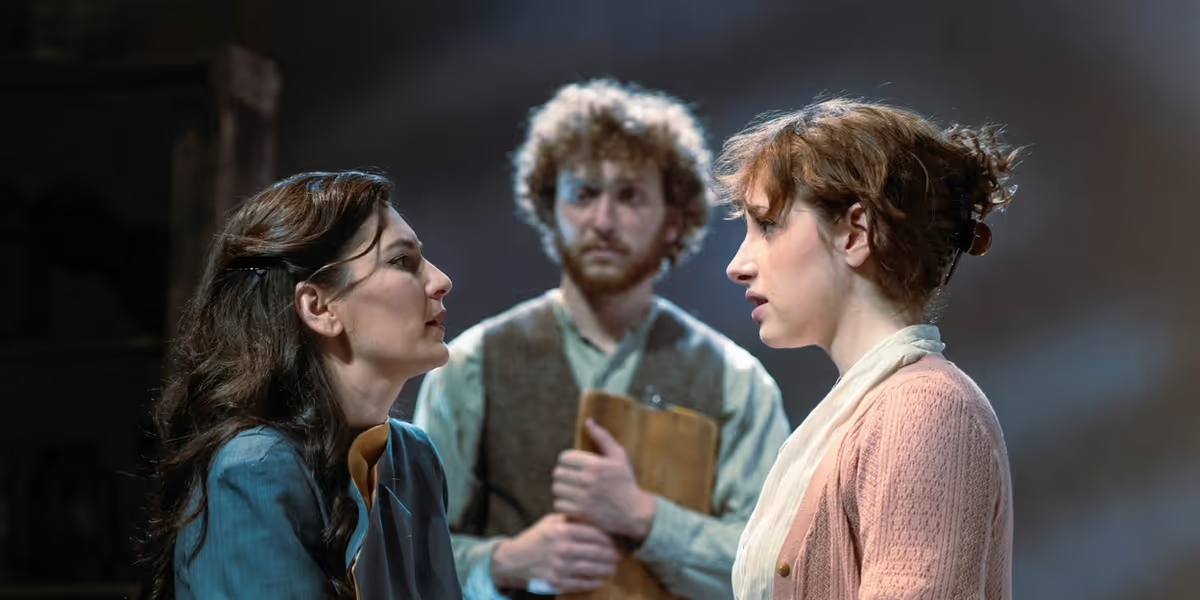
Photo Credit: (l-r) Lauren Hart, Ethan J. Miller and Lily Burka in Indecent, June 4 - 28. Photo by Teresa Castracane Photography.

Sign up for all the news on the Fall season, discounts & more...

|
Brian Henson's Puppet Up! Lincoln Theatre (9/30-9/30) |

|
GARBO: EL ACTOR QUE SAVÓ AL MUNDO (Garbo: The Actor Who Saved The World) GALA Hispanic Theatre (9/03-9/27) |

|
Mr. Burns: A Post-Electric Play Clarice Smith Performing Arts Center (10/09-10/18) |

|
Special Event: ARTS By George!: Jeff Goldblum and the Mildred Snitzer Orchestra Center for the Arts (10/03-10/03) |

|
The Second-Best School Shooting NextStop Theatre (9/17-10/11) |

|
Coming to America: An Immigrant Cabaret ExPats Theatre (9/30-10/18) |

|
Some Like It Hot Bernard Family Theatre, Olney Theatre Center (9/18-11/08) |

|
Stonewall's Bust The Writers Center (10/09-10/25) |

|
Mamma Mia! National Theatre (10/27-11/15) |

|
The Dinner Detective Murder Mystery Dinner Show The Dinner Detective Washington DC (9/26-9/26) |

Reader Reviews
To post a comment, you must register and login.