


Interview: AFTER REHEARSAL: A CONVERSATION WITH MARSHA MASON
The celebrated veteran of film and stage acting reflects on directing THE ROOMMATE at Arizona Theatre Company.

Marsha Mason has long been defined by her film work in the 1970s and ’80s, and by her storied marriage to the late Neil Simon. Their collaboration nurtured a distinct sensibility, shaping a kind of American comedy rooted in idiosyncratic behavior: how people talk, misread each other, and circle back.
In The Goodbye Girl and Chapter Two, Mason played women who seemed, at first glance, entirely familiar—smart, self-sufficient, double-edged. And yet something in them never quite settled. As Paula McFadden and Jennie MacLaine, she created characters who were always in motion, thinking and recalibrating in real time. Those performances helped shape the way modern urban women were seen on screen.
But if you only know the films, you’re seeing one register of her work. The theatre is where her instincts fully land. It always has been.
In recent years, Mason has built a directing career without much noise around it. No grand declarations, no imposed signatures. Just work. Her collaborations with Broadway titan Jack O'Brien, and her presence across regional stages, point to an actor's director more invested in genuine behavior than in mere psychology. It’s about what an actor does, moment to moment, when nothing is being “indicated.”
You can sense that immediacy in the way Marsha Mason describes her rehearsals for The Roommate at Arizona Theatre Company. The production doesn’t seem to push; it waits. Scenes appear to find their shape rather than chase an effect. The two women at the center aren’t arranged so much as observed. What builds isn’t conventional tension, but something quieter. It’s the sense of real life moving just beneath the language.
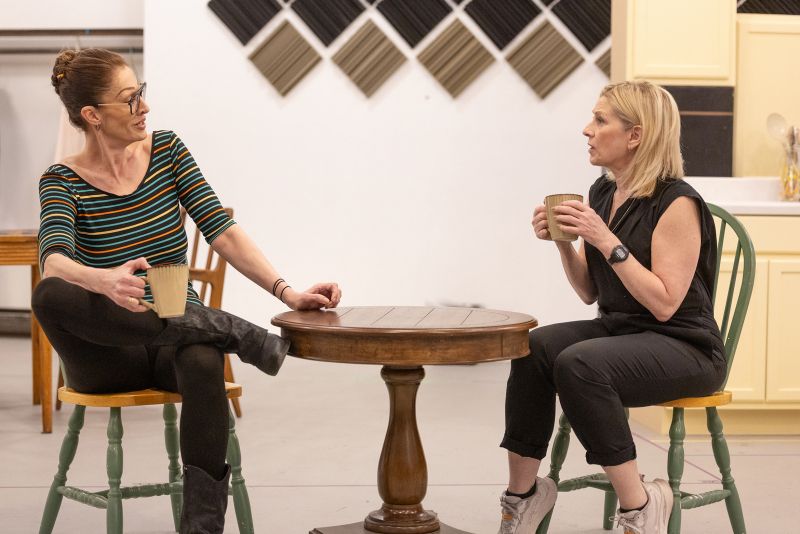
That same quality carries into conversation.
Interviews usually move with a kind of internal clock, even at their most cordial. There’s always a sense of where things are headed, how much time is left, or when to pivot. With Mason, that pressure falls away. I had been told her time would be tight. It never registered. No glances elsewhere. No subtle steering. She stays.
And that quality defines the exchange.
If her years of meditation have shaped anything, it’s not something she names. It’s something she does. She listens without preparing a response. She allows space without filling it. You’re no longer performing the conversation. You’re in it.
What follows is an edited version of our conversation. Our time together began with the discovery of a mutual friend from the 1980s, a shared history that immediately dissolved the typical distance of an interview. While that personal detour remains off the record, the warmth of that connection stayed in the room. The following transcript has been edited for clarity and focus.
Given how much has been written about your work as an actress, I’d like to focus our conversation on your work as a director, an area the general public may know less about. You spent time with THE ROOMMATE on Broadway as an associate to Jack O’Brien. What felt new or different to you stepping into this production as the primary director?
MARSHA: Jack O’Brien is just phenomenal. I learned a lot under him. This was our second time together. I had directed before, so I felt very good about the relationship and I was learning a lot. It was an interesting play to work with, and the two Broadway leads (Mia Farrow and Patti Lupone) were fascinating to work with. Mia is even a friend of mine. I consider her a spiritual sister.
It was different because I had two different women and a completely different idea for the set. It was very exciting to make it my own, and I had a wonderful time. It turned out that the designers and I got along wonderfully, as did the actors. It was a positive experience for everybody.
In a play this intimate—just two people, nowhere to hide—what becomes your primary focus? Is it rhythm, behavior, chemistry? They’re all part of the work, of course, but in a piece like this, with no intermission, what rises to the surface?
MARSHA: Yeah, there’s no intermission. But we put in an intermission in Arizona because the audience is much older there, and the artistic director, Matt August, felt that the audience would need a break. And it worked okay.
So continuity was not a problem.
MARSHA: No, I chose a really good place where it’s interesting. It leaves the story hanging, where you don’t know what’s going to happen next, kind of on the edge of a cliff. And then you come back and it moves into some of the funnier and more complex relationship issues between the two women.
What is something that’s come up in a rehearsal process that may have surprised you? Something you didn’t fully see in the play before?
MARSHA: What’s interesting about it is that it depends, as you say, on chemistry. The two people have to have a kind of chemistry – and you don’t even know what that chemistry is. They just have to be very opposite and of different mindset, as the play requires. These two people come together in an unusual and very intimate way. You have to make sure the actors are in a safe place and feel confident, and they trust the situation. It’s going to be different with every actor. The play is so solid that it can take very different personalities and even different approaches to the work.
I’m curious how much of your film work informs the way you direct actors on stage. It’s a classic challenge for student actors, after all, negotiating the differences in approaches. With top-notch actors, I suppose that’s not a conversation that comes up?
Marsha: It’s a bit of a mystery to me because all the time I did the film work, every television work, I applied the same technique as the theatre. This idea of learning film acting – it’s a bit of a mystery to me. But I started in the theatre.
Let me try a different angle. Are there moments in rehearsal, for instance, where you found that less is actually more? That pulling back reveals more than pushing?
MARSHA: Oh, it’s true all the time! You have to be totally truthful. You have to believe what you’re saying. That’s really the biggest barometer. And a person can approach it from the outside in, or the inside out. And I don’t care, you know what I mean? As long as I believe what it is they’re doing, that they’re being truthful to themselves. Thay’re embodying the characters. So there’s that; and of course, pacing. Of course there’s rhythm.
I mean, it’s a comedy. So you have to have specific techniques to know when to hold, when to take a beat, to wait for the audience. You have to draw them in and the audience then becomes a third character in the play. And you can feel (at least I can) what the psychic energy of the audience is. You have to be able to bring them along.
And not all audiences go along, necessarily. Especially when it comes to two-handers.
That’s one of the interesting things about subscriptions. They can be the worst audiences because they’ve bought a subscription for six plays, and they come in with the attitude of, well, “Entertain me!” You know what I mean? And maybe they took a subscription because they wanted to see two of the six, or they did it for the musicals and not the plays. In which case, then, the energy and the audience is different. And actors have to work with that.
THE ROOMMATE deals with reinvention and late-in-life disruption. Do you think the industry makes enough room for stories about transformation after 65 years of age?
Why, isn’t that the truth. You know, it’s hard. You’re hard-pressed to find stories for older people. But I find it more in the theatre than I do in film. But there are exceptions…like what Scarlett Johansson made this season (Eleanor the Great), which was really, really good. I mean, the idea of 65 years old – I mean, Jane Fonda breaks that rule majorly. But so do all of us, you know what I mean? I’m a very functioning, energetic person. I mean, if you tell somebody that you’re 80 years old, their idea is, well, “you’re on a walker.” And how can you direct a play at 83? Right, exactly. Oh my gosh!
This would be your third time directing for ATC. What keeps you coming back, artistically?
For the opportunity. And for a good play. I was very excited to direct CHAPTER 2. And ACT OF GOD, which was fun because it was the first time since the Broadway show that God was a female character in Paige Davis (Broadway lead in CHICAGO and SWEET CHARITY). So yeah, it depends on the material. It’s the same with acting, right? It just depends on the material for me.
I’m aware of your time crunch, so I’ll get to the final question. What is one theatre lesson – or life lesson, for that matter – that you gained from working with Jack O’Brien?
Always look for the positive. And let people do their jobs. He has great respect for people he works with – actors, designers, and the producers. He is the kind of individual that tries to lead a ship, you know, with a positive crew, and bring it to fruition. He doesn’t really come from a place of ego. I mean, he has an ego, but he knows what he can do and does it really, really well. His experience is humongous because of all those years at the Old Globe in San Diego. He created the whole idea of pre-Broadway in regional theatre. So he’s a visionary that way. I don’t know that I’m a visionary, but at least I know he trusts me. He wants me to come and see his shows very early on because he feels that I can look at them quite objectively and see the truth.
Photo credit: Tim Fuller
The Roommate, by Jen Silverman, continues in Tucson at the Temple of Music and Art through April 4. Phoenix shows are April 11-26 at the Tempe Center for the Arts. For tickets, visit www.atc.org
Prefer BroadwayWorld in Google Search?
Add us as a preferred source so our stories show up more often in Top Stories and Google’s AI answers — for you.

Sign up for all the news on the Fall season, discounts & more...

|
Proof Temple of Music and Art (9/27-10/17) |

|
EUREKA DAY Stray Cat Theatre (10/09-10/17) |

|
Much Ado About Dinosaurs Beaver Street Theatre (10/16-10/25) |

|
JEKYLL & HYDE Emerald City Players (10/02-10/11) |

|
Alison Krauss and Union Station Pepsi Amphitheatre at Fort Tuthill (9/28-9/28) |

|
Catch Me If You Can: The Musical Hale Centre Theatre - Arizona (8/21-10/03) |

|
A Doll's House Part 2 The Scoundrel and Scamp Theatre (4/15-5/02) |

|
Tucker Wetmore Mesa Amphitheatre (10/23-10/23) |

|
Fiddler on the Roof Chandler Center for the Arts (3/12-3/14) |

|
Hi-Fi Holiday Concert Hale Centre Theatre Arizona (12/04-12/19) |
