


Review: THE CRUCIBLE at Desert Theatre Works
An examination of the devastating effects of the abuse of power

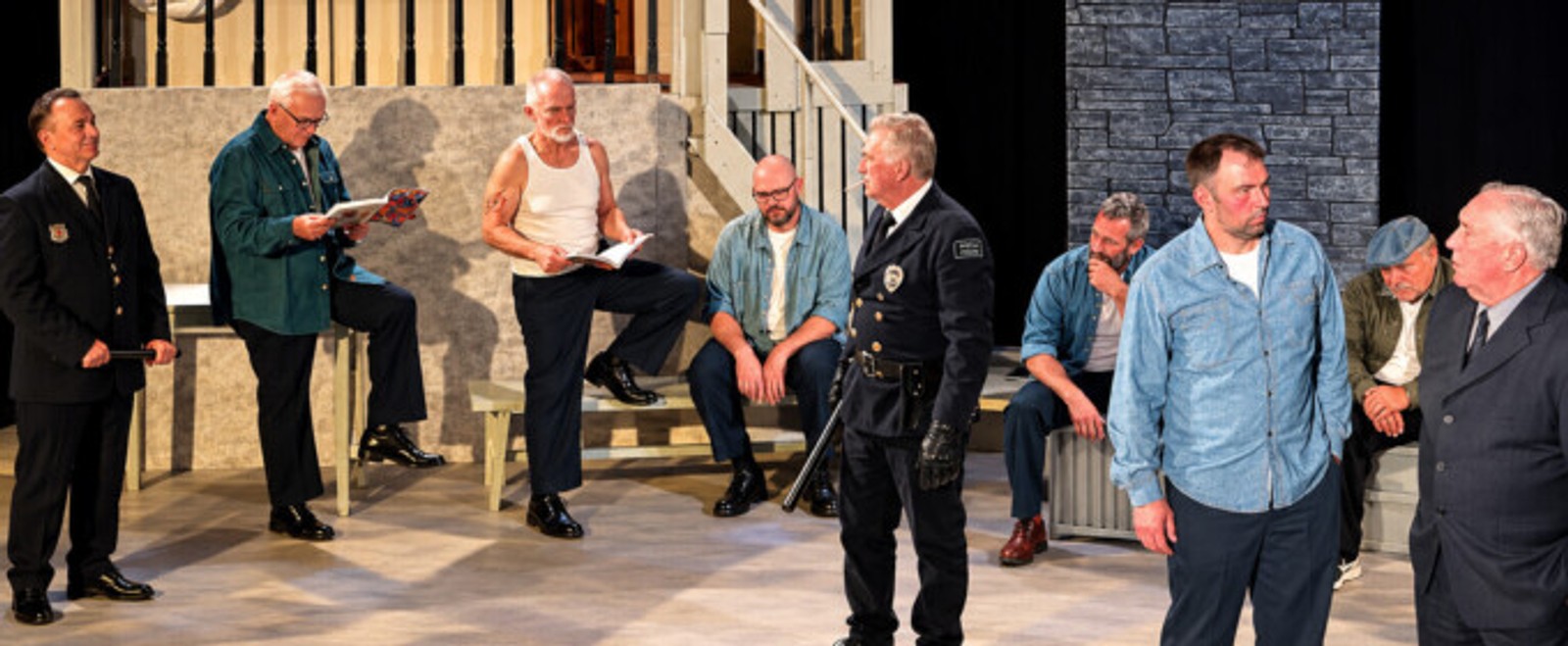
Thank you, Desert Theatre Works, for presenting thoughtful, inspiring. and timelessly relevant productions year after year. Currently on stage through May 3 is Arthur Miller's historical drama and tragic allegory The Crucible. Besides the opportunity to see Miller's brilliant work, audiences will leave the theater with a critical reminder of the way the abuse of power gets into the guts of a community and suppresses truth, creates mass husteria, and destroys the social order. Your conscience and social awareness will be reawakened.
To rewind, in 2024 DTW presented To Kill a Mockingbird, an adaptation of Harper Lee's classic novel about the pervasive racism in 1930s Alabama, which led to the corruption of the legal system. In 2025, an adaptation of The Diary of Anne Frank focused on the inhumanity of Naziism that created the Holocaust.
In The Crucible, Miller uses the 1692 Salem, Massachusetts witch trials as an allegory for the "Red Scare" and McCarthyism of the 1950s when people saved their own lives and careers by incriminating others. The play demonstrates how "good people" get caught up in an untenable situation over which they have no control. Think of that when you see or hear the terms "abuse of power" and "witch hunts" in today's media.
First, I commend the cast for accepting the challenge of learning dialogue written in stylized 17-century Puritan English. While modernized for contemporary audiences, the language Miller chose was the result of extensive research. He wanted to retain its flavor while sounding authentic. Director Lance Phillips skillfully elicited the cadence and quirks of a language spoken three centuries ago. By and large, his coaching made the lines sound real. It isn't easy to memorize dialogue with an unfamiliar rhymn.
Before I go further, kidos to Lance for designing this creative black box production. He is the master of logistics when confronted with with moving a large cast in a limited space.
Second, bouquets a few brickbats. Let's begin with bouquets. Kevin Mann (Reverend Parris) embodies the very evil he professes to deplore. Kevin is a big man. In this role he is scary. He projects Parris's meanness, greed, and hypocrisy. Parris' obsession with golden candlesticks seems to symbolize the installation of gold toilets in certain residences.
Tess Phillips-Martinez (Abigail Williams) give an intense, engaging performance. You don't quite know whether to detest her or sympathize with her. As Abigail, Tess is able to demonstrate her wide range of acting talent. At the outset, she appears to be a simple house maid and an influencer of other teenage girls. But why is she dancing in the forest? Is she really an innocent who was lured into an affair, or a manipulative liar, a vindictive lover, a callous opponent? What can we make of her relationship with a married man? During her journey, Tess advances seamlessly through each transition.
Tanner Lieser (John Proctor) creates the sympathetic. tragic hero caught in a web of dramatic irony. His portrayal of John is well delivered. John is a good husband and father, a good citizen, a good Christian. But is he that good? Was he tempted by Abigail or was he the instigator of their affair? Perhaps his wife's distance turned him into an opportunist and Abigail, a victim. Yet he is one who suffers. He is the one who is not forgiven (neither is the girl). He is the one who faces the ultimate music. At times, I wanted him to project his emotions without shouting. On the other hand, John's scenes with his wife are loving, tender, and graceful. Their dynamic is partly due to the wonderful performance by Katrina Dixon (Elizabeth Proctor).
Katrina and Tanner work very well together. She brings a certain light to this production, which it sorely needs. Elizabeth never screams or shouts though we know the screams and shouts are in her heart. She stands as the pillar of the drama without flinching or self-pity. As hysteria causes the pillar to crumble, she never wavers. It is a lovely performance.
Christine Gold (Ann Putnam/Cheever) releases the arrows that penetrate the heart of the tragedy. Christine successfully portrays Ann as an overwhelmed, superstitious mother who has not recovered from the mysterious deaths of seven newborns in a row. Ann tries to mitigate her pain by accusing Rebecca Nure (played by Bonny Link) of conjuring the devil to kill the infants. Whether Ann believes her story or not, we know what's going to hasppen to Rebecca. As Cheever, Christine transforms into an ordinary little man who simply obeys orders. You'll be hard-pressed to detect that efficient Cheever and overwrought Ann Putnam are played by the same actor.
Fuz Edwards (John Willard) gives us the character of a harsh guard who has a change of heart but is helpless to do anything about it--a small but important role. Frank Catale (Thomas Putnam/Francis Nurse) and Jim Rogers (Reverend Hale) are well cast but occasionally slow on the uptake between lines, which tends to slow the pace of a scene.
Ron Young (Giles Corey) is a DTW veteran who always delivers a solid performance. He is convincing as the helpless, devastates husband of an accused wife--accused because of an innocent comment he made without realizing its impact. His pain highlights the cruelty of a justice system searching only for proof, not truth.
Mark Cowell (Deputy-Governor Danforth) personifies the corrupt, authoritarian, self-righteous judge at John Proctor's trial. While not inherently evil, Danforth reflects the madness of ther period. His strong performance could be stronger by modulating his volume from time to time.
Adriana Iglesias (Mary Warren) does a fine job simulataneously expressing her fear and holding back her desire to tell the truth at the risk of her own life. Kari Lu Cowell (Tituba at the performance I attended) did a great job of communicating her terror. I have the feeling that she has already been given the note to avoid talking toward the floor while she's on her knees. Kari Lu will appear again on April 30. Ayanna Wilson will play Tituba at all other performances.
Emily Corson (Mercy Lewis), Aalina Aguilar (Susanna Wolcott). and Emma Solis-Holguim were believable as Abiligail's "posse." Their unison rocking in court was well choreographed.
In the performance I attended, Judge Hawthorne, Danforth's sidekick, was played by Aaron Hadley. His porayal shattered the epected image of the impartial judge and gave us a sniveling, rigid prosecutorial type. On April 24 and 25, Stephen Blackwell will play that role.
One note in closing. Arthur Miller's original play is divided onto four acts. I've seen it performed in three acts. I believe the author correctly recognized the audience's neds for more breaks in so heavy a drama.
Sign up for all the news on the Fall season, discounts & more...

|
Dancing Queens Plaza Theatre (11/04-11/04) |

|
Mizell Center Presents - Stephanie J Block Live In Concert Palm Springs Cultural Center (11/12-11/12) |

|
Into The Woods Rancho Mirage Amphitheater (10/23-10/25) |

|
DRACULA A Comedy of Terrors Revolution Stage Company (10/22-10/22) |

|
AN EVENING WITH VALERIAN: Art Songs, Arias & Broadway Revolution Stage Company (10/17-10/17) |

|
DRACULA A Comedy of Terrors Revolution Stage Company (10/25-10/25) |

|
DRACULA A Comedy of Terrors Revolution Stage Company (10/15-10/15) |

|
DRACULA A Comedy of Terrors Revolution Stage Company (10/30-10/30) |

|
DRACULA A Comedy of Terrors Revolution Stage Company (10/29-10/29) |

|
DRACULA A Comedy of Terrors A hit, 90-minute gender-bending stage farce blending gothic horror with Monty Python-esque humor! Revolution Stage Company (10/31-10/31) |

Reader Reviews
To post a comment, you must register and login.