


Featured
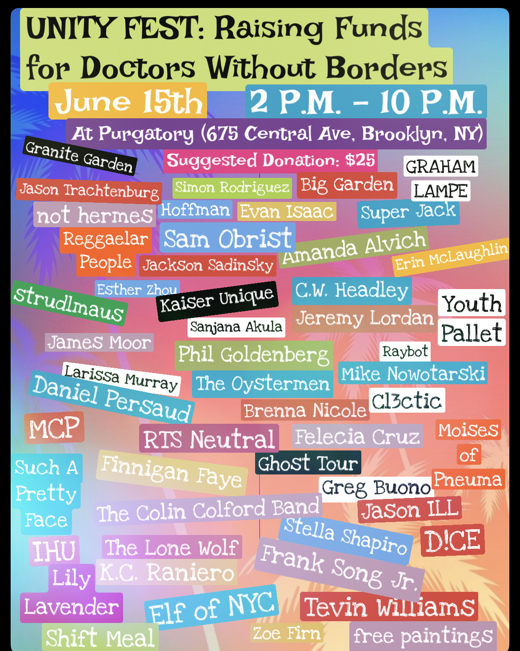
Dates: 6/15/2024
📍 Theatre: Purgatory
ROGUE arts
675 Central Ave BK
New York, NY 11207
Phone: 6105474070
Tickets: Suggested Donation of $25

Join us on Sat Jun 15 2024 at 2:00 PM at Purgatory for a day of music, poetry, comedy, film, art, and community. Entry is pay-what-you-can with a suggested donation of $25, and all proceeds will be donated to Doctors Without Borders.
Unity Fest is a twice-per-year Brooklyn-based music and arts festival for charity, and this upcoming Unity Fest will be the third ever Unity Fest! Unity Fest was originally created in January 2023 as a response to the Club Q shooting in Colorado, as a means of raising funds for the victims' families. Unity Fest remains a charity festival at which everyone is welcome, and our aim is to foster and nurture an ever-expanding community of artists and art enthusiasts based on inclusivity, resilience, positivity, and progress.
Stop Prompting. Start Delegating. That's What Agentic AI Actually Means
There's a moment most people hit when using AI tools — you get a useful answer, you act on it, and then you come back to ask the next question. And then the next. And the next. The AI is helpful, but you're still the one connecting all the dots.
That's not a flaw in how you use it. That's just how most AI tools were designed. They respond. They don't move.
Agentic AI is built differently. And once you see what it actually does, the old way of working with AI feels strangely slow.
Imagine you ask an AI to help you research competitors before a sales call. The classic AI response: a summary, maybe some bullet points, a few company names. Useful. But now you still need to check their pricing pages yourself, pull their recent news, update your CRM notes, and draft a prep document.
An agentic AI doesn't stop at the summary. Given the same goal, it can open those pricing pages, pull recent press releases, cross-reference what it finds, and hand you a finished briefing — formatted the way you want, ready to read five minutes before the call.
That gap — between an answer and a completed task — is exactly what agentic AI is designed to close.
The key difference isn't intelligence. It's initiative. An agentic system has the ability to plan a series of steps, use tools to carry them out, check whether the output looks right, and keep going until the job is actually done. It doesn't wait for you to bridge every step.
Most real tasks aren't single-step. They involve a chain of actions that depend on each other.
Think about filing a legal request. You might need to identify the right regulation, check relevant case precedent, draft the document, cross-reference it against current statutes, and format it for submission. If you hand each of those steps to a reactive AI assistant, you're still doing the coordination yourself.
Agentic AI systems can take on the whole chain. Tools like MyClaw apply this approach to legal work directly — handling multi-step legal tasks so that getting proper legal help doesn't require spending hours learning the process yourself. The system figures out the steps; you get the outcome.
This pattern shows up across industries. An AI finance agent at a company like Ramp doesn't just flag a suspicious transaction — it can trace it, categorize it, draft an explanation for the accounting team, and queue it for approval, all in sequence. A software agent like Devin doesn't just suggest a fix — it reads the codebase, writes the fix, runs the tests, and tells you what it changed and why.
The shift is from AI as a capable tool you operate to AI as a capable collaborator you direct.
Here's something worth understanding: agentic AI systems don't always get it right. And that's not just a caveat — it's an important part of knowing how to use them well.
When you hand a goal to an agentic system, it has to make a lot of small decisions along the way. Which sources to trust. How to handle ambiguous results. When to stop and ask for clarification vs. when to make a judgment call and keep going. These are genuinely hard choices, and current systems make mistakes.
The most common failure mode isn't dramatic — it's drift. The agent starts on the right path and then gradually solves a slightly different problem than the one you actually needed. It completes the task it interpreted, not the one you meant.
This is why the human-in-the-loop design that most serious deployments use isn't just a safety checkbox — it's practical. You stay in the loop at key decision points, not because you don't trust the system, but because your judgment on what actually matters is still part of the process. The agent handles volume and speed. You handle direction and edge cases.
Rather than speaking in abstractions, here's what this actually looks like in practice today:
Legal research that used to take half a day now takes minutes. A lawyer gives an agentic system a legal question, and it develops a research plan, searches case databases, identifies relevant precedents, and drafts a research memo. The lawyer reviews; the agent did the digging.

Customer refund flows that used to require three handoffs now run in one agent session. The system checks purchase history, verifies the return policy, processes the refund, and sends the confirmation — without a human touching it unless something unusual comes up.
Cloud infrastructure costs that required a dedicated ops person to monitor are now managed by AI agents from AWS and GCP that automatically scale workloads up and down, optimizing spend in real time without manual intervention.
Procurement workflows that used to require back-and-forth across departments can now be run by an agent that researches vendors, drafts the purchase order, and routes it for human sign-off.
In every case, what changed isn't that humans stopped being involved. It's that humans stopped being required at every small step.
The part of agentic AI that gets less attention than the exciting use cases is what happens when agents have access to your systems and data.
Because an agent that can do things — send emails, access databases, execute transactions — is also an agent where mistakes have consequences. A chatbot that gives a wrong answer is annoying. An agent that takes a wrong action can create work to undo.
Security researchers have raised specific concerns about "prompt injection" — scenarios where malicious instructions get embedded in data the agent is processing, effectively hijacking its behavior. It's a real attack vector, not a hypothetical one.
The organizations getting agentic AI right tend to be explicit about two things: what the agent is and isn't allowed to do, and who reviews outputs before anything permanent happens. Treating these as afterthoughts is where things go wrong.
Agentic AI isn't going to make every job disappear or transform everything overnight. But it is going to make some things that used to require expertise or significant time much more accessible.
Getting a well-researched legal answer used to mean hiring a lawyer or spending hours figuring out where to even look. Monitoring your company's cloud costs used to mean having a dedicated person watching dashboards. Preparing a thorough competitive brief used to mean a few hours of your own research time.
Each of those is becoming something an AI agent can handle, at least at the first-pass level — with you checking the output rather than doing the whole thing yourself.
That's not a threat to what you're good at. It's a reallocation of where your time actually goes. The tasks that needed a human mainly because they were tedious and multi-step? Those are the ones shifting. The work that needs real judgment, context, and accountability? That's still yours.
Understanding that distinction clearly is the most useful thing you can do with agentic AI right now — whether you're building with it, working alongside it, or just figuring out what to make of it.
QW





|
|
Blue Gum, Brooklyn Matthew Corozine Studio Theatre (10/09-10/25) |
|
|
54 Below DUELS Volume III: Halloween Edition 54 Below (10/25-10/25) |
|
|
Broadway Magic Hour Broadway Magic Hour: Magic Show (7/25-1/02) |
|
|
Falling Into Now Greenroom42 (10/24-10/24) |
|
|
Finishing School Hampton Theatre Company (10/15-11/01) |
|
|
Frankenstein Manes Studio Theatre of Long Island (10/09-10/31) |

|
Kate, Allie and the '86 Mets Asylum (11/05-11/10) |

|
No nos merecemos soñar Teatro LATEA (10/28-10/30) |

|
Professor Lammergeier's Evening of Poe's Poetry & Prose Stag & Lion Theatre (10/31-11/01) |
|
Trump and Melania american theatre of Actors (10/28-11/01) |
