


Interview: Maria Catarina Copelli on Costuming ANTIGONE: IN THE LANGUAGE OF KINGS at Getty Villa Outdoor Stage
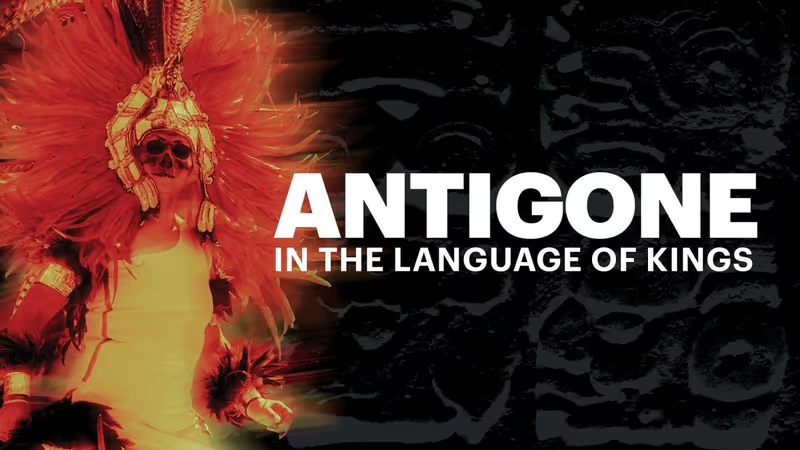
The Getty Villa Museum and Latino Theater Company are presenting Antigone: In the Language of Kings for their 20th annual Outdoor Classical Theater production on Thursdays through Saturdays, Sept. 10 to Oct. 3 at 8 p.m., with previews on Sept. 3-5 at 8 p.m. An American Sign Language (ASL) interpreted performance will take place on Thursday, Sept. 24. The adaptation is written by Evelina Fernández and directed by José Luis Valenzuela.
The ancient story of Antigone, originally set in fifth-century B.C. Greece, confronts themes of loyalty, familial duty and the clash between divine law and state edict. Latino Theater Company’s presentation sets the story in pre-conquest Tenochtitlan, Mexico, weaving in pre-Hispanic music and poetry and bringing Aztec mythology into Sophocles’ timeless story. The result is a rich historical tapestry that resonates across cultures, pitting love and defiance against tyranny.
The play is performed in English, Spanish, and Nahuatl, and all performances feature supertitles in both English and Spanish.

I spoke with Costume Designer Maria Catarina Copelli (pictured), an award-winning Brazilian Costume Designer whose career spans film, theater, opera, commercial campaigns and music videos, on her vision for creating a variety of Aztec costumes for 23 actors and how she researched designs to base her creations on authenticity for them to reflect the social structure of Aztec society. And since she brings passion, creativity, and meticulous attention to detail to every project, no doubt the hundreds of costumes for Antigone: In the Language of Kings will be quite spectacular!
Thanks for speaking with me today, Maria Catarina, as I know you have had your hands full designing and creating costumes for 23 actors for quite some time. Please tell me about your initial vision for the costumes.
My philosophy for this design was to honor the historical evidence, while also serving the living needs of theatre. José Luis told me from the beginning that he wanted the audience to have the feeling of entering the real Aztec/Mexica world. That became the starting point for everything: rooting the production in historical Mexica life, while still creating costumes that could work theatrically.
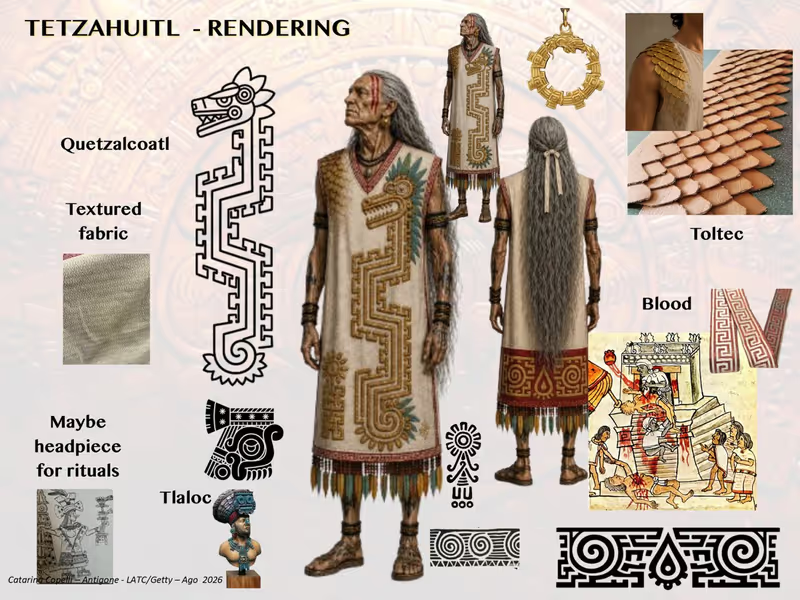
All costume renderings created by Maria Catarina Copelli
How did you begin researching Aztec clothing, and what sources guided the design?
Because so few pre-Hispanic codices survived, my research drew heavily on the surviving codices, archaeological and historical sources, and Patricia Rieff Anawalt’s work on pre-Hispanic clothing.
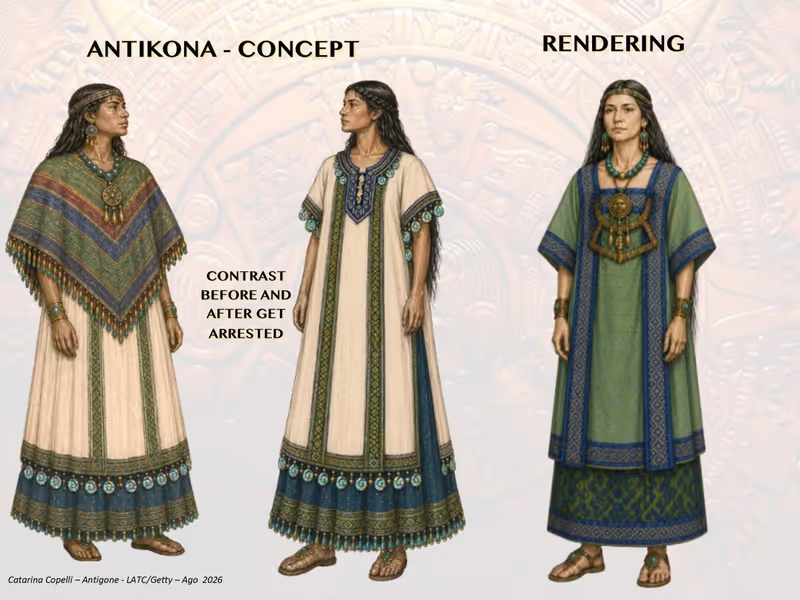
Antigone
How did that research influence the silhouettes, fabrics, and construction of the costumes?
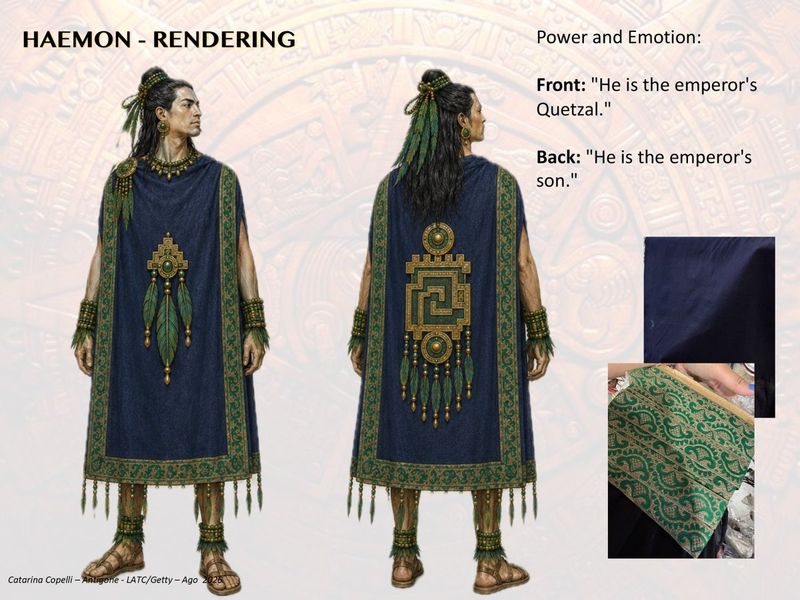
One of my main concerns was preserving the feeling of garments created from loom-woven textiles - the geometry, structure and weight of the fabric. I deliberately avoided very drapey or stretchy fabrics, and made the decision not to create the look through printed motifs. This made sourcing fabrics much more challenging, because I needed to find woven materials with the right patterns, texture, weight and structure.
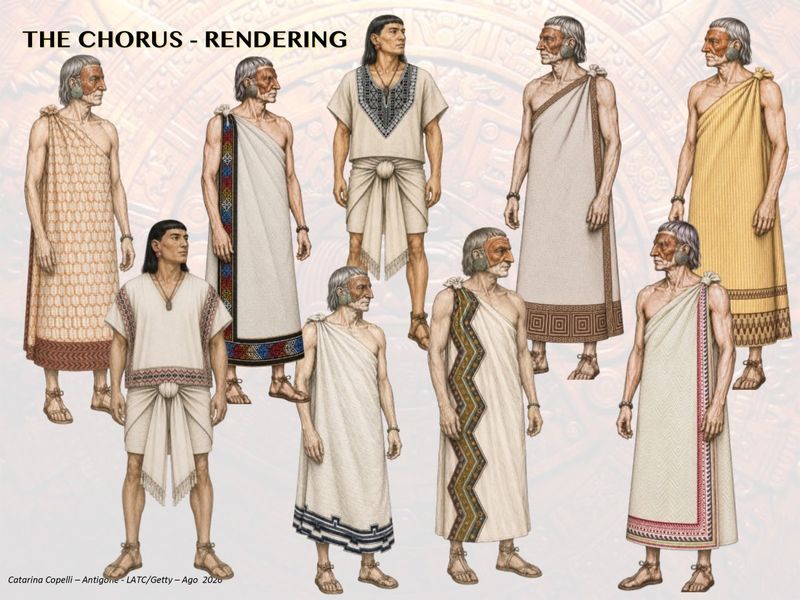
The Men of the Chorus
Many people think they recognize an “Aztec aesthetic.” How did your research compare with the imagery we commonly see today?
This was actually something José Luis and I talked about quite a bit. Modern fashion has blended motifs from many different Indigenous cultures and marketed them broadly as “Aztec.” Because of that, I knew that some historically informed patterns and silhouettes might not immediately look “Aztec” to an audience accustomed to that contemporary visual language. One of the most surprising parts of my research was seeing the gap between what is popularly marketed as “Aztec” and what the surviving historical sources actually show about Mexica clothing.
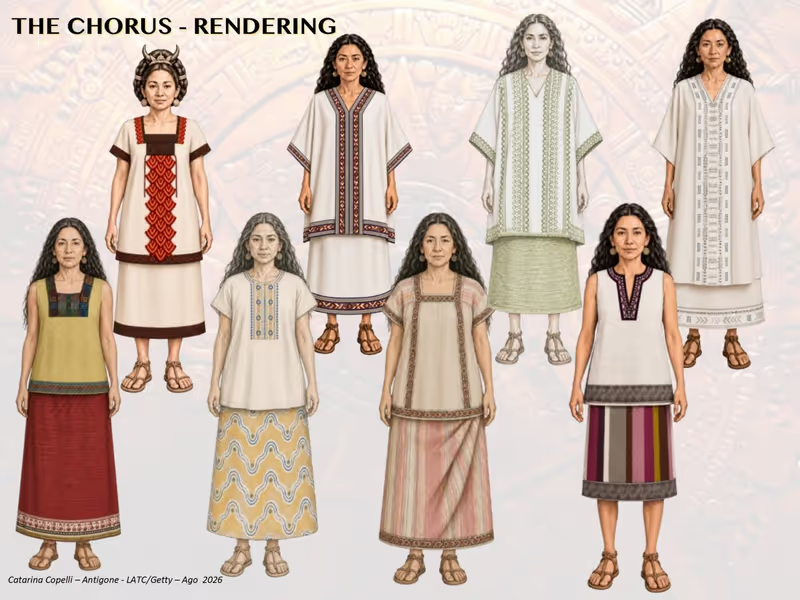
The Women of the Chorus
The production includes both historically inspired costumes and contemporary Mexica dance traditions and trajes. Why was it important to include both?
For me, it allowed the production to bring together two different visual languages: the historical Mexica world within the play and a living cultural tradition that continues to honor that heritage today. It was important to honor not only the historical world, but also the living communities that continue to carry and celebrate this heritage. We brought real danzantes into the production, and the opening battle between the Eagle and Jaguar warriors draws from that living tradition. Having the actors learn and perform this dance was a really beautiful part of the process.
How did you use costumes to communicate the social structure of Aztec society?
I want the audience to immediately feel how stratified Mexica society was and how clothing, adornment and materials could communicate status.
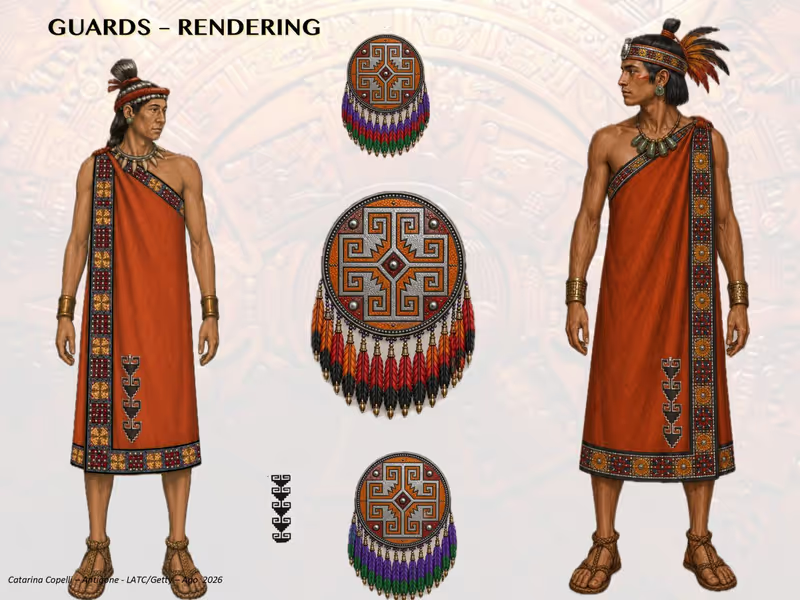
The royal and elite characters have gold, shine, feathers, jewelry, richer embellishments, and dimensional details. I also developed techniques using padded, faux leather to create raised patterns and surfaces so that light and shadow bring more life and dimension to the garments.
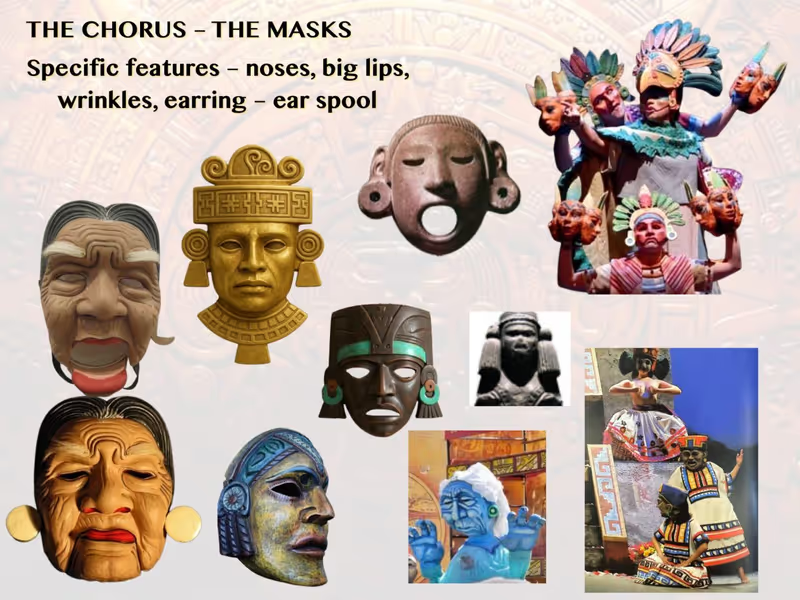
In contrast, the Chorus - the people who help tell us this story - wear much simpler fabrics and details. Their masks also have very specific features and become another part of that visual language.
What were some of the challenges of translating historically inspired garments into costumes that actors could actually perform in onstage?
Because of the movement, floor work, kneeling and ceremonial choreography, the structure of several costumes evolved throughout the rehearsal process. Sometimes I had to adjust a silhouette, construction method, closure, or even a fabric choice so that the original design could survive the physical needs of the performance. That balance, between respecting the visual language and allowing the actor’s body to move, became a constant conversation throughout the build.
What was the most technically challenging costume to realize? How so?
Definitely La Muerte whose costume could be called an engineering-meets-art project. It became even more complicated because this is an outdoor production. Some of the solutions we tested inside the theater simply didn’t translate to the Getty Villa - fans, air movement, wind, restrictions of the space, entrances and exits, etc. José Luis’s wonderful “let’s make this happen” approach kept me going every time another challenge appeared.
There are so many fun details to talk about here:
•The cape is currently around 360" long × 390" wide—and growing!!! Yesterday José Luis asked me to make it even longer!
•The actress performs on stilts and also has to manage costume changes.
•We had to think about safety as part of the costume itself: IFR fabric, a body harness, aluminum poles, weight distribution, movement, and how this enormous cape interacts with the outdoor environment.
The goal is for La Muerte to sweep through the space and transform it with her movement, so the costume really has to function almost like scenery as well as clothing.
What were the logistical challenges of designing and building costumes for 23 actors in such a short period of time?
With such a large cast - and some actors playing multiple roles - the challenge wasn’t only designing the individual costumes. It was also creating a system that allowed us to build, fit, alter, organize, and eventually manage all those costumes within the time constraints of the production schedule.
Tell me about how your team worked with you in creating such a large assortment of garments.
I worked with two stitchers at a time throughout the build, with three wonderful stitchers contributing over the course of the process. I feel incredibly fortunate because they really understood my ideas and the concept behind the designs. A costume can exist beautifully on paper, but it takes incredibly skilled hands to translate that vision into something real. They brought their knowledge, creativity, problem-solving, and, I always say, their magical hands to every piece. This production simply would not have been possible without them.
We also had a wonderful collaboration with a group of students from the Costume Design program at Los Angeles City College, who worked on the warriors’ costumes as part of their program. That was particularly meaningful to me because LACC is where I started my own journey in costume design. Having the opportunity to now welcome students into a professional production and share that experience with them felt like a beautiful way of giving back to the place that gave me so much.
And it comes full circle because these same students will be working as dressers during the performances. They had the opportunity to participate in creating the costumes, and now they will experience another essential side of costume work by helping bring those garments to life backstage every night.
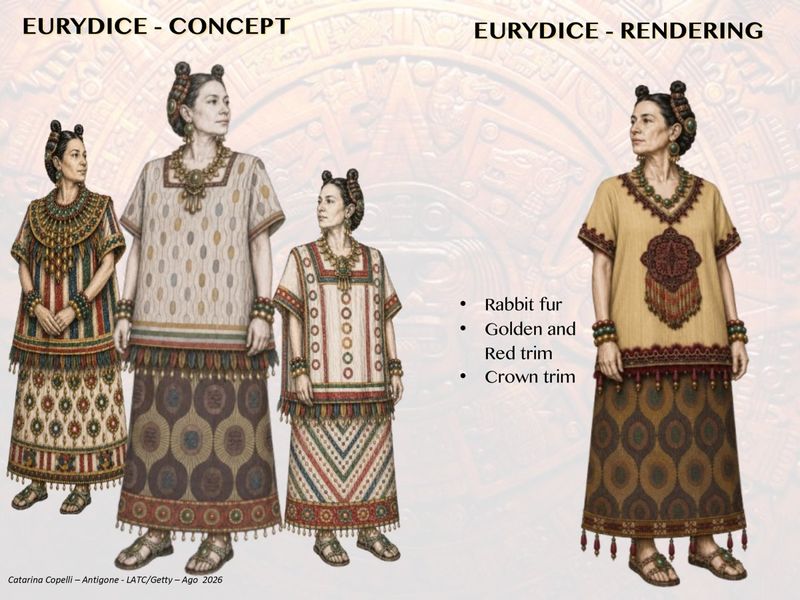
When you see this many costumes onstage, you are really seeing the work of many hands. I may have created the designs, but it was the talent, dedication, and care of this entire team that made them possible.
Anything else you would like to add about costuming the show?
I should add that, in addition to all the actors, there will also be three musicians who will be performing live onstage using traditional Mesoamerican instruments. I loved creating costumes for them as well.
Thanks so much!
Thank you so much for the opportunity to share this process!
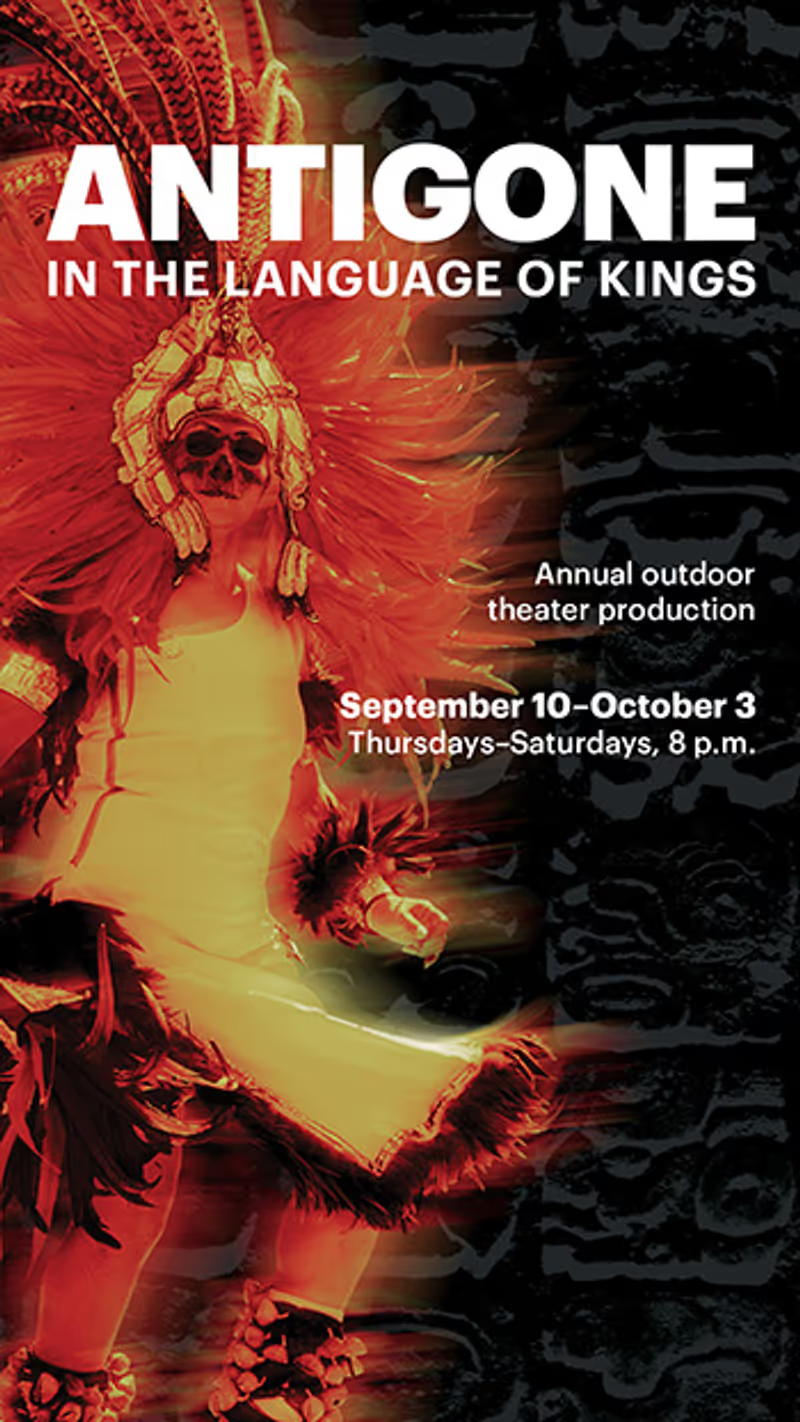
Antigone: In the Language of Kings is directed by José Luis Valenzuela, artistic director of Latino Theater Company, and adapted by Evelina Fernández, associate artistic director of Latino Theater Company. Along with costume design by Maria Catarina Copelli, the production features set design by François-Pierre Couture, lighting design by Xinyuan Li, sound design by John Zalewski, music by Christopher Garcia, projection design by Yee Eun Nam, and movement and choreography by Urbanie Lucero.
Antigone: In the Language of Kings is not recommended for those under the age of 13. Run time is 90 minutes, no intermission.
Ticket prices for the previews are $30. Thursday night performances are $45 ($40 for students and seniors), Friday night performances are $50, and Saturday night performances are $60. Student and senior discounts are available for Thursday night performances only. All tickets are for all general-admission seating, available on a first-come, first-served basis. We recommend arriving early to make your seat selection.
Tickets must be purchased in advance at https://www.getty.edu/calendar/oct-antigone/ or by calling (310) 440-7300. Tickets must be purchased for event entrance and are non-refundable. Your event ticket will also serve as your Villa entrance reservation. Please note, there is an additional fee for parking.
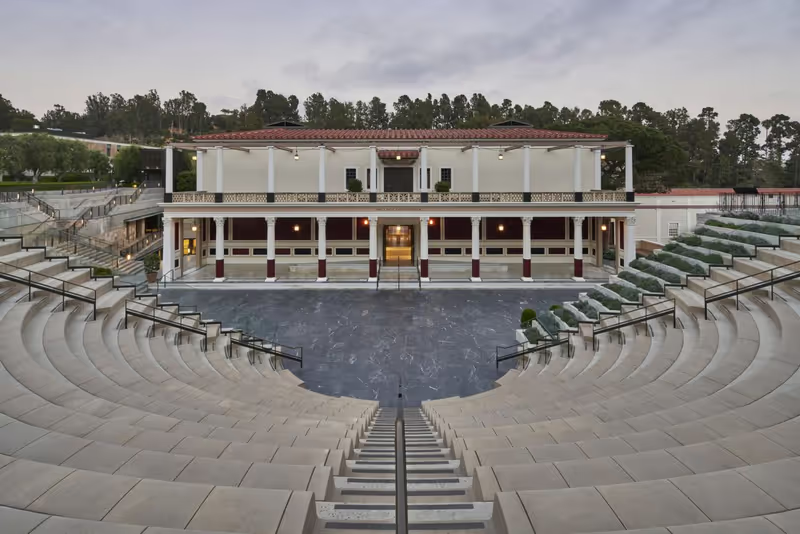
The Getty Villa Museum and Outdoor Theater are located at 17985 Pacific Coast Highway, Pacific Palisades, CA 90272. Check in begins at 6pm, with seating starting at 7:15pm for the 8pm performance. It is recommended to arrive at least 30 minutes prior to show time to park, go through security, and make your way to the theater. Since the theater is outdoors near the ocean, patrons are reminded to bring a sweater or light jacket and blankets as it can get chilly after dark. Seat cushions are available for performances.
Prior to the performance, guests will be able to purchase a variety of food and drink options, including a specialty cocktail and a sit-down prix fixe dinner for $110 without wine; $135 with wine (space limited; Fridays and Saturdays only during the run), inspired by and featuring ingredients from the pre-conquest period, or purchase items from the onsite café or coffee cart.
Theatre patrons are welcome to visit the Villa prior to the performance, which requires a separate general admission ticket to the Getty Villa Museum, which closes to the public every day at 5pm. Antigone patrons will be asked to wait in the Entry Pavilion or leave and come back when the site reopens for event check-in at 6pm.
Sign up for all the news on the Fall season, discounts & more...

|
CLUB27 Jaxx Theatre (10/01-10/30) |
|
Crone Creed El Portal Theatre (9/30-10/17) |
|
Good Night, Oscar North Coast Repertory (9/16-10/11) |
|
A Killer Night in Studio City Vitello's (9/06-10/31) |
|
Catch Me If You Can Colony Theatre (9/17-10/18) |

|
Dinner with Friends Santa Monica Playhouse (9/26-9/27) |

|
Gershwin and the Golden Age The Soraya (10/11-10/11) |
|
Melt : The Play The Marilyn Theatre at the Lee Strasberg Institute (9/24-10/02) |
|
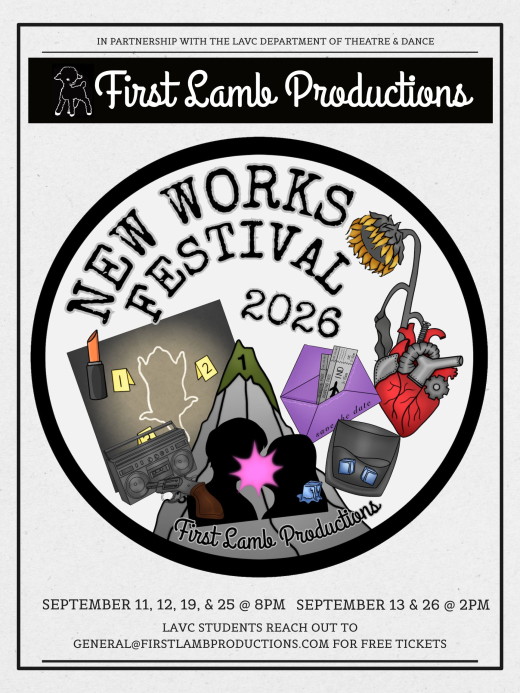
New Works Festival Shoebox Theatre (9/11-9/26) |

|
Worthy The Un-Erasable Solo Festival - Willie Agee Playhouse (9/12-9/25) |
