


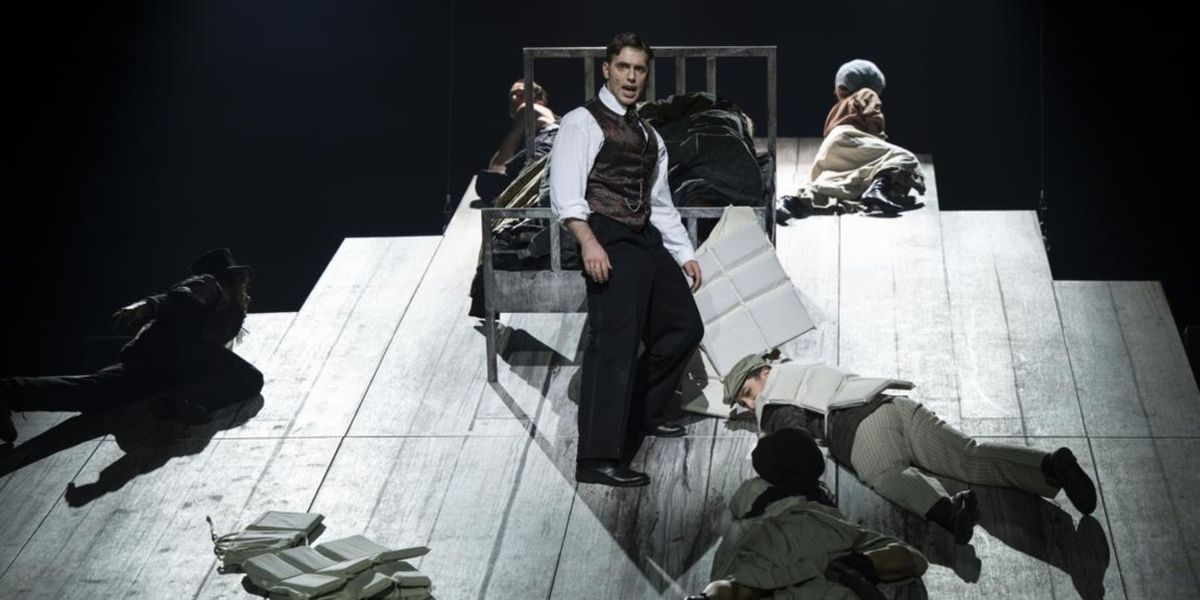
Maury Yeston’s musical epic “Titanic” arrives in Erfurt as a visually and acoustically imposing piece of theatre in a widely acclaimed and award-winning production at the Theater Erfurt. Through clever cuts and tightly focused character direction, amplified to great effect by choreography and set design, the production delivers the tension between human ambition and human tragedy in an intensely moving way.
Owing to the immense success of Stephan Witzlinger’s production, the Theater Erfurt has seen numerous completely sold-out performances of “Titanic” – hardly surprising considering how frequently this musical is staged throughout Germany, proving itself even more unsinkable than its tragic title heroine. This is thanks to the extraordinary visual sophistication and sheer theatrical force that successfully set the Erfurt production apart from the flood of other “Titanic” stagings. Together with dramaturg Larissa Wieczorek, Witzlinger succeeds in drawing fresh impulses from the material. Numerous cuts streamline the evening. Some reduce the number and complexity of the passengers aboard the doomed liner; others trim Peter Stone’s sprawling book or shorten sections of Yeston’s score. For “Titanic” fans who want to mentally follow the piece in its full length from memory, this may require some adjustment, but for the dramaturgy of the work it is an absolute gain. There is a much clearer focus on the piece’s most complex characters, on the dramatic progression of the catastrophe, and on the still relevant questions surrounding the limits of human striving.
The stage concept is extraordinary: the iron curtain of the proscenium is staged as the Titanic’s colossal stern, appearing infinitely high, with the ship’s name emblazoned across it in weathered lettering that already prophesies the wreck, while dull underwater sounds that make the auditorium tremble establish a sense of dread before the show even begins. The completely emptied orchestra pit is transformed into a lifting stage, used for the production’s most striking scenes: through clouds of fog, the frozen victims of the disaster emerge from this vast stage pit, while the red-lit coal bunker or the party-driven third-class deck beneath the promenade levels and lounges of the wealthier passengers is represented there. The lowering of the lifeboats and the dramatic separation scenes of families are likewise illustrated on this exceptionally effective playing level – and the horrifying seconds of the final people clinging to the nearly vertical ship, seemingly plunging into doom through the stage chasm, are rendered with devastating intensity. From the orchestra pit, the crow’s nest is also raised above the audience, so that by the end of the first act – with the main stage as the first-class guest deck, the apron stage for the ship’s collision zone, a liftable grandstand walkway for the captain’s bridge, and the rear stage showing the bow and funnels of the steamer – the illusion of the gigantic ship is complete. Through set pieces such as an ornate dining table, mirrored walls, or railing elements, the perspective of the ship before its maiden voyage, the various onboard spaces, and the entire sinking process across all levels of the vessel become almost cinematic. When the central stage section containing the bed of the Straus couple rises into a vertical position, the sinking itself is rendered visually overwhelming. Life and death aboard perhaps the most famous ship in human history become tangible through the design. The costumes, too, are perfectly chosen, representing the early twentieth century and all classes and professions aboard the crossing flawlessly. The special touch lies in the fact that most characters – namely those who actually perished in the sinking – receive a second costume portraying them as frozen, ghostly figures. Gradually, the stage fills with the frozen dead, dominating the stage toward the end of the piece before, after the sinking, forming the immense and oppressive mass behind the handful of survivors. Lena Scheerer is responsible for the stage concept, scenic design, and costume design, delivering a true masterwork that defines the entire production. In collaboration, Witzlinger and Scheerer also developed the lighting concept, successfully executed by Florian Hahn: again and again, the mood shifts from celebratory to ominous, reinforcing the cinematic aspect of the production. Perfectly balanced sound design provides exactly the right accents – particularly impressive is the transition from deafening chaos to an ever quieter, empty stage: the cries, at first demanding and desperate, gradually fall silent until not even a pin drop can be heard.
The choreography is equally exceptional. Kerstin Ried introduces expressive movement sequences reminiscent of expressionist dance, lending the production both dynamism and urgency. Much more moving than many other “Titanic” productions, Ried succeeds in placing the entire ensemble – often within their respective class-divided groups – into a skillful balance between movement, dance, and expression. In doing so, the transitions between locations and the simultaneous actions unfolding on the various decks of the ship, including the devastating disparity between protection and helplessness, safety and panic, hope and despair, are presented superbly.
The large orchestra, permanently placed on the rear stage depicted as the ship’s bow, is conducted magnificently by Leonie Bulenda. Yeston’s epic score unfolds here in full splendor, while the opera chorus (prepared by Markus Baisch and symbiotically integrated into the movement direction by Witzlinger) becomes a thrilling wall of sound during the ensemble numbers, at times even moving the audience to tears – especially during the grand melody of “Farewell, Titanic” at the beginning and end of the piece.
Every role is cast to perfection with a mixture of in-house ensemble members and numerous guest performers from the musical theatre world – classically trained opera singers and musical performers work together here without noticeable breaks and elevate the piece with remarkable theatrical precision. The ensemble roles are covered by Andrea Viggiano, Lisa Radl, Milena Galvan Odar, and Edgar Sagarra. The three Kates, portrayed energetically and full of hope by Gioia Heid, Helena Lenn, and Johanna Spantzel, are especially impressive in the dramatic break into survival mode. Björn Christian Kuhn as William Murdoch, ultimately consumed by his own guilt, is haunting. Director Stephan Witzlinger himself takes on the role of the determined chief steward Latimer. William Baugh, portraying crow’s nest lookout Frederick Fleet somewhere between youthful and ghostly, Stefan Preuth as the ship’s highest-ranking officer, and Jörg Rathmann as third officer Herbert Pitman all perform with great dramatic sensitivity. Tobias Gerisch as Jim Farrell offers a small glimmer of hope amidst the catastrophe, presenting his love story with Kate McGowan in touching fashion.
The married couple Edgar and Alice Beane are portrayed by Benjamin Eberling and Katja Bildt, initially in comic fashion but later with heartbreaking tenderness. Alice, whose goal in the first act is to mingle with haute couture society, also shines vocally through Bildt’s performance. Lukas Witzel presents a slightly eccentric yet deeply likable wireless operator Harold Bride with gentle vocals. His perfect counterpart is Daniel Eckert as stoker Frederick Barrett, who throws himself into the role with fierce energy and conviction, while also conveying the courage to rebel and stand up for what is right, delivering a convincing and vocally flawless performance. The Straus couple are portrayed with melancholic lovability by the two musical theatre veterans Kerstin Ibald and Martin Berger, whose final duet before retreating to the bed of their soon-to-be vertical cabin is profoundly moving and brimming with deep acting – in addition, Ibald and Berger deliver outstanding vocals that cut straight to the heart.
Máté Sólyom-Nagy portrays businessman Bruce Ismay as consumed by ambition and, in the truest sense of the phrase, willing to walk over corpses. The way the grandstanding Ismay turns into a small, furtively sneaking shadow of himself aboard a lifeboat is portrayed convincingly by the classical singer. Martin Sommerlatte is likewise compelling as Captain E.J. Smith, shifting from authoritarian self-assurance to desperate dissociation. Sólyom-Nagy and Sommerlatte interpret the trio about the question of guilt in bone-chilling fashion together with Dennis Weissert, who, as shipbuilder Thomas Andrews, is the revelation of the evening. At first he appears self-confident, almost smug – always maintaining the analytical eye for the bigger picture and, despite his pride in his work, remaining humbly in search of flaws in the machinery. His descent into utter despair, when he collapses over the Titanic blueprints and helplessly watches the passengers plunging into the icy void (during the solo “Mr. Andrews’ Vision”), is the evening’s most intense acting performance.
“Titanic” in Erfurt emerges as an impressive Gesamtkunstwerk audiences seemingly cannot get enough of even after the production’s second run – a petition calling for a third engagement has already gathered nearly 400 signatures. This ship refuses to sink for good, and in Erfurt’s case, deservedly so.
Erhalten Sie Broadway-News auf WhatsApp
Erhalten Sie aktuelle Nachrichten, exklusive Berichte und Theaterupdates direkt in der App.

Sign up for all the news on the Fall season, discounts & more...
|
|
Alliteration Am Arsch - Bastian Bielendorfer & Reinhard Remfort LIVE Luise Albertz Halle (12/08-12/08) |
|
Rigoletto Staatstheater Regensburg (6/20-4/27) |
|
|
Heimsuchung Theater der Stadt Diepholz (10/01-10/01) |

|
Outlander In Concert - Echoes Through The Highlands Tour| Gallery Seat Uber Eats Music Hall (2/24-2/24) |
|
|
Die Reimanns - Sabbelstunde mit Manu & Konny Jahrhunderthalle Club (10/07-10/07) |
|
|
Die Reimanns - Sabbelstunde mit Manu & Konny Im Wizemann (Halle) (10/06-10/06) |

|
GIOVANNI ZARRELLA Boulevardtheater Bremen (4/08-4/08) |
|
CAVALLUNA - Die Farben des Lebens ÖVB-Arena (12/27-12/28) |
|
|
Es begab sich aber zu der Zeit… Weihnachtsprogramm mit Dirk Böhling Packhaustheater (12/10-12/23) |
|
|
Die Reimanns - Sabbelstunde mit Manu & Konny Kulturwerft Gollan (10/22-10/22) |

Reader Reviews
To post a comment, you must register and login.