


Review: PIPPIN - DIE KUNST DES LEBENS at Staatsoperette Dresden
A Spectacular Meditation on Life, Desire and Disillusionment
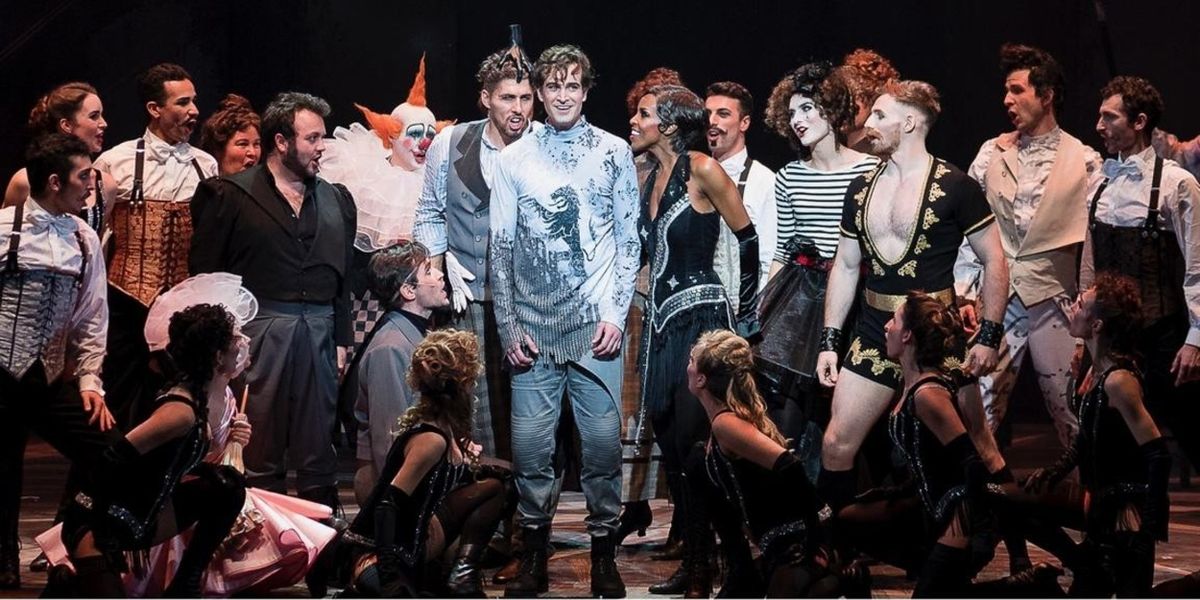
For the Staatsoperette Dresden, the German-language premiere of Stephen Schwartz’s classic “Pippin – Die Kunst des Lebens” is a triumph on every level. Visual opulence, sharply played tragicomedy, a thunderously powerful orchestra, choreography overflowing with highlights, and a vocally formidable cast come together here in perfect symbiosis.
In the United States, “Pippin” is an institution among musicals, though in German-speaking countries Stephen Schwartz’s debut work remains beloved mainly by connoisseurs. In a kind of play-within-a-play, the life of Charlemagne’s eldest son — one of the key figures of European, especially French and German, history — is retold with complete historical inaccuracy. The young man is in relentless search of his place in life and tries out everything that constitutes ‘life’ for him, driven by a troupe of actors led by the so-called Leading Player, who externalize his deepest frustrations and most exalted desires. The overall tone of the story is cheerful and parodistic, while the storytelling, despite the age of the piece, still feels refreshingly dynamic and inventive in both form and pacing, and the ending lands with devastating force. Frank Thannhäuser, Iris Schumacher and Nico Rabenald have done a magnificent job adapting Roger O. Hirson’s script and Stephen Schwartz’s lyrics for a contemporary German audience.
“Wir entfachen Magie,” sings the Leading Player at the beginning of the show, and that becomes the evening’s fitting motto: Simon Eichenberger masterfully succeeds in uniting this inherently German yet in essence hardly more American story onstage in such a way that every department functions in flawless symbiosis. He brilliantly balances focused character direction for the protagonists with grand show numbers built on atmosphere and spectacle. Together with dramaturges Mark Schatsiek and Valeska Stern, Eichenberger creates a production that is equally gripping and entertainingly light-footed, whose structure makes the devastating ending all the more impactful. The audience, trapped in eternal hedonism and dissatisfaction with their own existence, is confronted with a powerful mirror image of itself — when Pippin ultimately refrains from his spectacular suicide as the culmination of all his shattered dreams and instead chooses love, the opulent set is dismantled, the lights dim, and the Leading Player breaks the fourth wall to search among the audience for a new victim whose insecurities and doubts she can inflame — finding one in the form of Pippin’s stepson. A masterful escalation fully achieved by the directing team.
Visually, too, the production impresses throughout: Aleš Valášek’s costumes, simultaneously historically grounded and deliberately out of time, shift between the Middle Ages, Vaudeville, and “Cabaret” aesthetics, opening up several meta-levels at once. Not only are the characters already positioned through their appearance, but quick-changes from drab to glittering attire also reveal their inward and outward selves. The costume elements extending beyond mere clothing are outstanding as well. A puppeteer controlling a marionette in his own likeness who himself, hinted at through a hand-shaped hat, seems to be controlled by a higher entity; absurd little house pigs woven into the choreography with guaranteed laughs, coquettish chickens, and the poor, deathly ill duck Otto all come to life — a wealth of wonderful costume ideas enriching the show on multiple levels. Martin Wingerath’s sound design creates an impressive contrast between overwhelming opulence and oppressive silence. Michael Grundner’s lighting design is cinematic and captures every mood — whether inner monologue, desperate hopelessness, silly farmyard atmosphere, Vaudeville interlude, or dramatic regicide scene — with first-rate precision. Grundner is a master of his craft.
The same applies to Charles Quiggin, who conjures a massive set for the Staatsoperette that inspires complete awe. Suggested is an early medieval throne hall with gigantic stone staircases, Gothic windows, and mirrored walls offering space for micro-scenes while symbolically inviting reflection. Great trees reaching into Charlemagne’s sanctum sanctorum perhaps symbolize the unchristian wilderness surrounding the still-emerging empire, perhaps the longing for a life outside predetermined, constricting spaces, perhaps Pippin’s own anxiety and the crumbling of his inner walls. Oversized movable props, nuanced lighting, and stage effects such as wind, flying leaves, fire, and seemingly magically moving objects enrich the imposing imagery. It proves astonishingly dynamic at the end of the show, when the entire throne hall — staircase, walls, and windows included — vanishes, leaving behind nothing but deep blackness. Outstanding work created in the Staatsoperette workshops under Katrin Falkenberg, Annette Opitz, Franziska Schobbert, Torsten Ulrich, Jörg Danke, Angelika Meinzerhagen, and Avgoust Yankow.
Eichenberger is not only responsible for directing the production, but also for its choreography. What he creates here in terms of sprawling, endurance-demanding, seemingly endless choreography could easily hold its own on Broadway, from which his dance language is visibly inspired. Fosse elements abound, the visual language strongly recalls “Chicago” and “Cabaret,” but iconic stylistic devices associated with works like “A Chorus Line” also appear in abundance. Dynamic, atmospheric, nuanced, and bursting with energy, his choreography fills the entire piece with astonishing intensity and sheer quantity.
Peter Christian Feigel leads his enormous orchestra through Koen Schoots’s masterfully expanded arrangements. Under his virtuosic direction, impressive sonic worlds emerge, drawing nuanced colors and textures from the ensemble — particularly striking are the opulent passages from Schwartz’s score, which inevitably evoke his later works such as “Wicked” or “The Hunchback of Notre-Dame.” Feigel’s conducting and the house orchestra quite deservedly received the evening’s loudest applause.
Since 2023, the production has played with an almost unchanged cast. The 22 ensemble members and eight principal roles are superbly cast, and the combination of opera singers, ballet dancers, stage actors, and musical performers — guest artists and in-house members alike — works unusually well. The opera chorus expands Schwartz’s epically conceived soundscapes, while the melodies reminiscent of Kander and Ebb are carried by the musical theatre voices. The ballet’s dance abilities merge seamlessly with the show dancers, while strong dramatic acting complements the big musical theatre voices. Everything interlocks perfectly.
Sascha Luder plays Ludwig, Pippin’s delightfully hyperactive stepbrother with more courage than common sense. Marcus Günzel breathes life into Emperor Charles (“Krieg ist nicht einfach” [“War is a Science”]) with remarkable diction and commanding Stage Presence, while also imbuing the character with dry, weary, and at times cynical humor. Silke Richter portrays a matronly Fastrada radiating diva-like charisma and proving just as capable of cutting loose in “Etwas Sonne schenken” [“Spread a Little Sunshine”] as Bettina Weichert, who slips into the role of Pippin’s life-affirming grandmother Bertha. Frail at first glance, she suddenly glides across the stage on roller skates during her dream sequence to “Zeit zu Leben” [“No Time at All”], spinning pirouettes and delivering a true showstopper that became the evening’s encore. Sybille Lambrich shines as the passionate yet fate-stricken widow Catherine with refined acting, an excellent sense for both tragicomedy and situational comedy, and delights with her closing gag — the famous “Wicked” riff from “Defying Gravity” woven into her song “Eine Frau wie ich” [“Kind of Woman”] in the second act — while also moving the audience deeply with the profoundly authentic rendition of “Ich glaub, er wird mir fehl’n” [“I Guess I’ll Miss the Man”].
Gero Wendorff’s Pippin is youthful, dreamy, driven, ambitious, and torn apart: dramatically, he fills the role with every required nuance, while vocally impressing with both powerful phrasing and fragile falsetto — through his singing, Wendorff conveys both grand and intimate emotions superbly. His “Mein Platz auf dieser Welt” [“Corner of the Sky”] brings tears to the eyes. The evening’s great star, however, is Kerry Jean in the role of the Leading Player. She makes one completely forget that the role was not originally conceived for a woman and inhabits it so profoundly that one might think she invented the character herself. Radiant, charismatic, and dominating the stage every second she is on it, she guides not only the narrative as raconteuse, but also much of the score with mighty belts and riffs (for instance in “Ruhm und Ehre”, Wir entfachen Magie” or “Der rechte Weg” [“Glory,” “Magic to Do,” or “On the Right Track”]). Jean is the born triple threat — a magnificent singer, dynamic dancer, and accomplished actress. She succeeds in executing the goosebump-inducing transformation of her character from highly likable showmaster to domineering puppet-master to dark, almost disturbing siren seemingly luring her victims to ruin. This performer is a force to be reckoned with.
Sadly, after three years “Pippin” in Dresden has reached its final performance, celebrated with frenzied, never-ending applause from the audience and tears of emotion from the company. Fortunately, this German-language premiere was immortalized by the Austrian label HitSquad with the same cast — even as a complete recording including all dialogue and instrumental passages — available not only on streaming platforms, but also, quite remarkably nowadays, on CD. One can only hope that this unique production has not celebrated its very last closing performance in German-speaking countries — this production has enormous potential to conquer stages across Germany.
Prefer BroadwayWorld in Google Search?
Add us as a preferred source so our stories show up more often in Top Stories and Google’s AI answers — for you.
Erhalten Sie Broadway-News auf WhatsApp
Erhalten Sie aktuelle Nachrichten, exklusive Berichte und Theaterupdates direkt in der App.

Sign up for all the news on the Fall season, discounts & more...

|
ROYAL NATIONAL BALLETT - FIRE OF GEORGIA Boulevardtheater Bremen (11/08-11/08) |

|
MITTERNACHTSBALL 2026 Theater am Marientor (10/31-10/31) |

|
DER HERZOG & ICH - Das Theatermacher-Musical von Titus Hoffmann & Christoph Zirngibl Staatstheater Meiningen (12/05-6/22) |
|
|
Drei Haselnüsse für Aschenbrödel Aula Artland Gymnasium (12/11-12/11) |

|
Sebastian Fitzeks Die Einladung Boulevardtheater Bremen (6/19-6/20) |

|
Sebastian Fitzeks Die Einladung Theater am Marientor (7/09-7/09) |
|
|
Claus Hempler inkl. 3-retters middag Classic Car House (4/30-4/30) |

|
Die Schöne und das Biest - Das neue Musical Boulevardtheater Bremen (2/02-2/02) |
|
|
Die Zeitmaschine - Das Musical Theater Am Dannhalm (12/05-12/05) |
|
|
Sebastian Fitzek: Die Einladung - Die Weltpremiere Live on Stage Boulevardtheater Bremen (6/18-6/20) |

Reader Reviews
To post a comment, you must register and login.