


Review: FURLOUGH'S PARADISE at Curious Theatre
Poetry, movement, and memory collide in an emotionally ambitious but uneven production
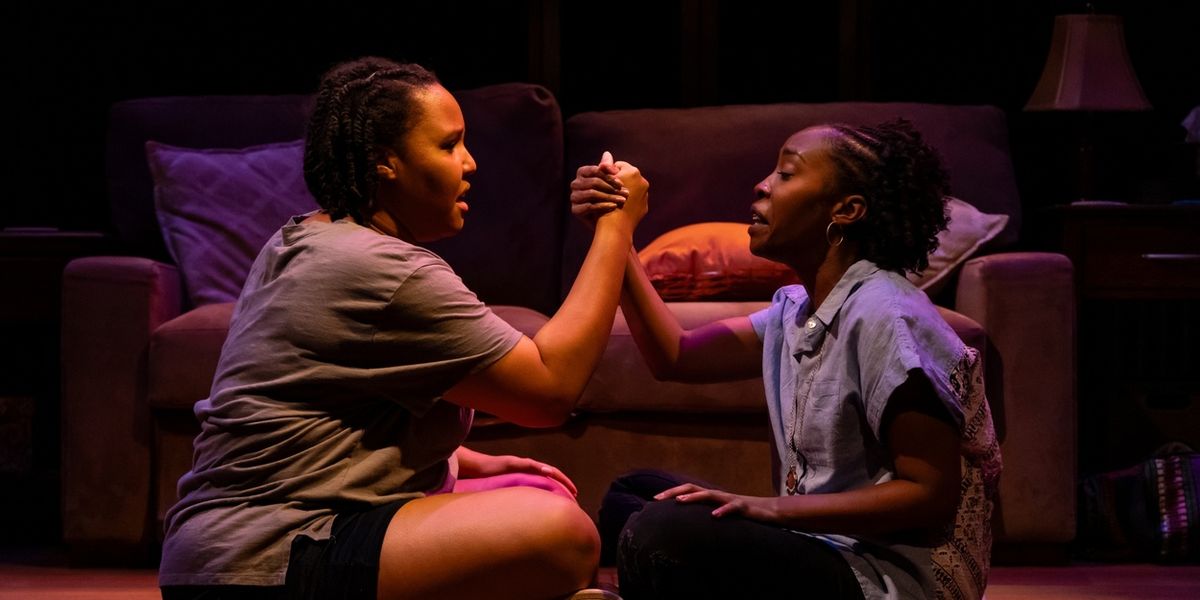
Furlough’s Paradise at Curious Theatre Company examines the strained relationship between estranged cousins Mina and Sade, reunited by grief and forced to confront the divergent paths their lives have taken. Playwright a.k. payne blends naturalistic dialogue with poetry, movement, and memory in an attempt to create a theatrical meditation on Black womanhood, identity, and inherited pain. While the central relationship offers moments of genuine emotional insight, the production ultimately feels under-rehearsed, blunting the precision and intentionality required to sustain such a sparse, emotionally exposed script.
As Mina and Sade, the production’s two performers Tresha Farris and Alex Campell are tasked with carrying nearly the entire emotional weight of the evening, often through long stretches of highly charged dialogue. Both actresses clearly commit fully to the emotional demands of the piece, but the performances frequently feel broad where they need to be exacting. Moments of emotional intensity arrive at such a heightened pitch, and with such frequency, that the production leaves itself little room to build. Wailing, emotional escalation begin almost immediately, causing later climaxes to lose their force. At times, line uncertainty and hesitation also create the sense of a production still searching for its rhythm. In a script so dependent on emotional calibration, the lack of refinement becomes difficult to ignore.
Director Jada Suzanne Dixon also faces the challenge of navigating the play’s shifting theatrical language, which moves between literal interaction and more poetic, impressionistic interludes. However, the distinctions between these modes often remain unclear. Characters alternate between speaking directly to one another and gazing into the middle distance without sufficient visual or tonal differentiation to orient the audience. The result is a production that occasionally feels dramatically untethered, as though scenes are occurring simultaneously on emotional, literal, and symbolic planes without clear transitions between them. Pacing issues further compound this problem. Partial blackouts and extended scene transitions sap momentum from an already contemplative piece, and certain sequences—particularly an extended shadow-play setup—strain the audience’s patience without delivering a commensurate payoff.
The production’s movement sequences, largely used to externalize anxiety, grief, and night terrors, similarly struggle to land. Bathed in harsh red lighting, performers run in place, reach skyward, and lock eyes in ways that feel emotionally demonstrative but insufficiently choreographed. Effective movement work often relies on specificity, surprise, or technical precision; here, the sequences feel more illustrative than embodied. I was left dreaming of a choreographic language that offered deeper insight into the characters, rather than physically uninteresting explanations of what had already been made clear.
Payne’s script clearly situates itself within a lineage established by for colored girls who have considered suicide / when the rainbow is enuf, even referencing that work explicitly. Its interest in the diversity and contradictions within Black identity is compelling, particularly in the differing resentments Mina and Sade carry toward one another. Yet the play often feels constrained by its own repetitive structure. Again and again, the cousins circle the same emotional territory: Mina insisting that outward success masks private suffering, Sade arguing that Mina’s advantages remain undeniable. More frustratingly, the script repeatedly gestures toward movement—literal or emotional—only to retreat from it. “Let’s go outside,” Mina suggests at one point, only for Sade to insist they stay in and eat Cookie Crisp instead. The moment feels emblematic of the play as a whole, which continually threatens expansion without ever fully pursuing it. Over ninety minutes, the characters rarely arrive at new insight or transformed understanding, leaving the audience emotionally stationary alongside them.
There is a version of Furlough’s Paradise that could feel devastating in its intimacy and formally daring in its theatricality. But this production too often feels like a piece still in process, with performers and creatives working hard against the visible constraints of time and preparation. The result is not a failure of ambition, but a production unable to fully realize the complexity already present within the script.
Sign up for all the news on the Summer season, discounts & more...
|
Topdog/Underdog Historic Shorter AME (8/29-9/20) |
|
Hadestown Buell Theatre (6/08-6/13) |

|
Ali Stroker in Concert Lone Tree Arts Center (11/14-11/14) |

|
The Secret Comedy of Women Garner Galleria Theatre (4/21-5/16) PHOTOS |
|
mike. – Mike Stud Red Rocks Amphitheatre (11/14-11/14) |
|
Disney's Beauty and the Beast Buell Theatre (10/20-11/07) PHOTOS |
|
Sixtiesmania Pikes Peak Center (10/20-10/20) |

|
Hank Williams: Lost Highway Aurora Fox Arts Center (12/04-1/03) |

|
Award-winning classical pianist Pallavi Mahidhara at Lakewood Cultural Center Lakewood Cultural Center (10/09-10/09) |
|
The Nutcracker PACE Center (12/10-12/15) |

Reader Reviews
To post a comment, you must register and login.