


Review: Mazzoli/Vavrek LINCOLN Is Alive and Well at Met World Premiere under Nezet-Seguin
Mattei, Goerke, McKinny, Hoskins, Sobers Lead Stellar Blain-Cruz Production
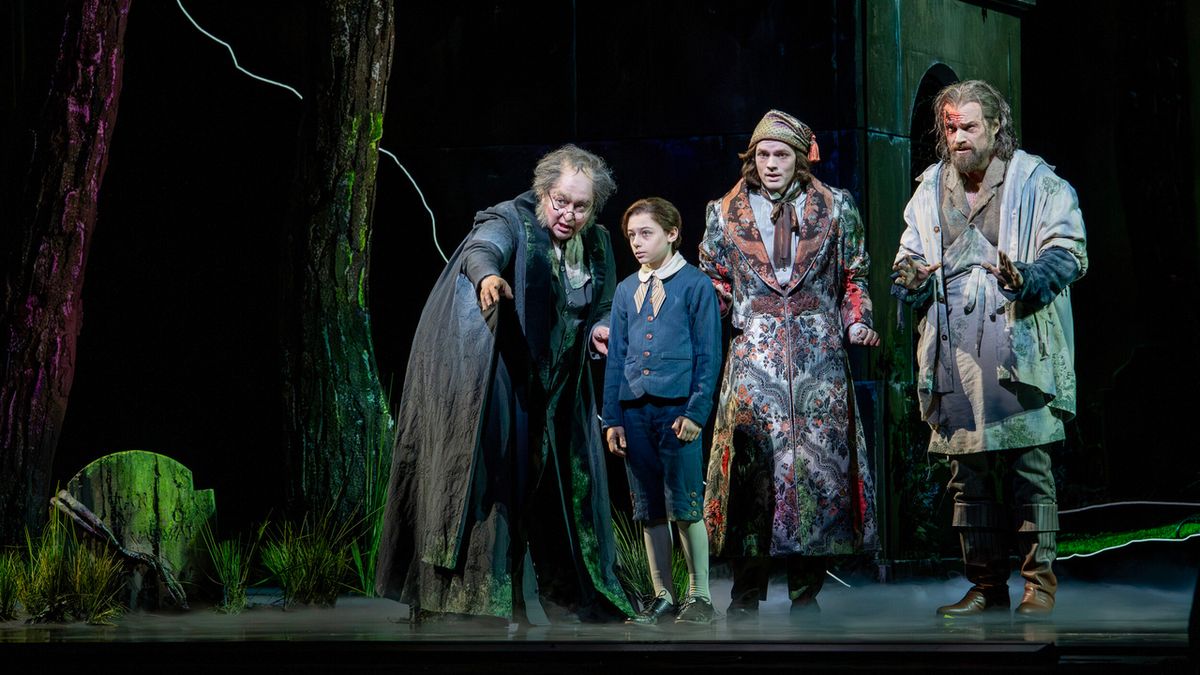
LINCOLN IN THE BARDO, the world premiere work by Missy Mazzoli and Royce Vavrek, came to the Met last night in a stunning production—and not a moment too soon. It held the audience in its thrall from the opening notes of the overture, with the Met Orchestra in stellar form under music director Yannick Nezer-Seguin, and kept them there.
The opera, which takes place in Georgetown, D.C.’s Oak Hill Cemetery, is set in a netherworld (the "bardo") before the inhabitants do a final pass-over to the world of the dead. As portrayed in Lileana Blain-Cruz’s blazing production, it is a place of wonder. The splendid scenic design was by Adam Rigg, projection design by Hannah Wasileski and Hana S. Kim, sound design by Kate Marvin, with lighting by Yi Zhao and Stacey Derosier, smart costumes by Montana Levi Blanco covering a cavalcade of eras and awesome creature suits and puppets by James Ortiz.
Sometimes it felt like a ghostly version of “A Midsummer Night’s Dream,” with the Barons (sung by mezzo Stephanie Blythe and bass-baritone Craig Colclough) as a kind of stand-in for Puck.
Mazzoli’s score is full-fledged “Mazzoli.” You won’t mistake it for anyone else’s, past or present. Her mix of the melodic and magical, mysterious and oddly percussive, brings in elements I’ve heard (and admired) in her previous works (along with some new “tricks” as well), mostly written with librettist Royce Vavrek. She has a voice—which comes from deep in her soul, I presume, and she’s not afraid to come up with either something new or to quote herself, as long as it’s appropriate to what she’s trying to accomplish.
I haven’t read the eponymous George Saunders novel that provides the basis of Vavrek’s colorful, yet deeply felt libretto, but I have the impression that he had his hands full in cutting it down to size for a complex work that runs under three hours. With the help of the skilled cast (and director Blain-Cruz, of course) he has brought the inhabitants of the Oak Hill Cemetery to “life”/death brilliantly and thoughtfully.
My only quibble is that there may still be too many major characters wandering around, not understanding that they are no longer alive, to give enough emphasis to characters we might want to hear more about. For example, despite getting the title role spot, Abraham Lincoln (smoothly and surely sung by baritone Peter Mattei) seemed a bit short-changed.
The fleshing out of his relationship to his now-deceased son, Willie [whose death set the opera in motion, and is sung with amazing poise by the young treble Everett Sobers], doesn’t, for me at least, get enough stage time. He does, however, get the opera’s beautiful “11-o’clock number” (as they say on Broadway), “Dear Little Chap.”
I could have used less of the Barons (the “crude, bickering couple” sung by Blythe and Colclough as comic relief, related to similar character, the Thenardiers, in “Les Miserables”) and of Miss Elise Trainor—who morphs into different forms, sung smartly by countertenor Anthony Roth Costanza. At least as the way she is portrayed in the opera, she might have been snipped out.
On the other hand, I could have had more of bass-baritone Ryan McKinny’s Vollman (with his over-the-top prosthetic) and tenor Jonah Hoskins’s Bevins, who had major parts but still left me wanting a richer experience. These two characters have lost much before moving to the cemetery for their final resting places, and choose to take it upon themselves to convince little Willie Lincoln to move on to the next world.
I also admired the work of tenor Joshua Blue as Thomas Havens, a formerly enslaved man, whom I’ve seen blossom since I first saw him at a master class with Joyce DiDonato.
I wished there had been more of mezzo J’Nai Bridges, who gave much, vocally and dramatically, to the character of Mrs. Frances Hodge, a black woman who vows revenge against those who stole her children.
The one character who is front and center—and I never tired of for a moment—was the Reverand, wonderfully portrayed by soprano Christine Goerke. She portrays a kind of spiritual leader of the bardo, this limbo between life and death, and does a spectacular job of it. Even with her natural dignity, she never gives us a hint for a moment that she’s [SPOILER ALERT!] the only one who actually knows that she and the other inhabitants of the cemetery are dead.
The Met chorus was in fine form, under Tilman Michael and the choreography, for once, didn’t seem out of place, by debut artist Raja Feather Kelly.
Caption: Christine Goerke (Reverend), Everett Sobers (Willie Lincoln), Jonah Hoskins (Bevins), Ryan McKinny (Vollman)
Credit: Karen Almond/Met Opera
Weekly top stories - unsubscribe anytime.

Reader Reviews
To post a comment, you must register and login.