


Review: CINDERELLA at Her Majesty’s Theatre, Adelaide Festival Centre
Rossini's opera buffo gets a lively staging.
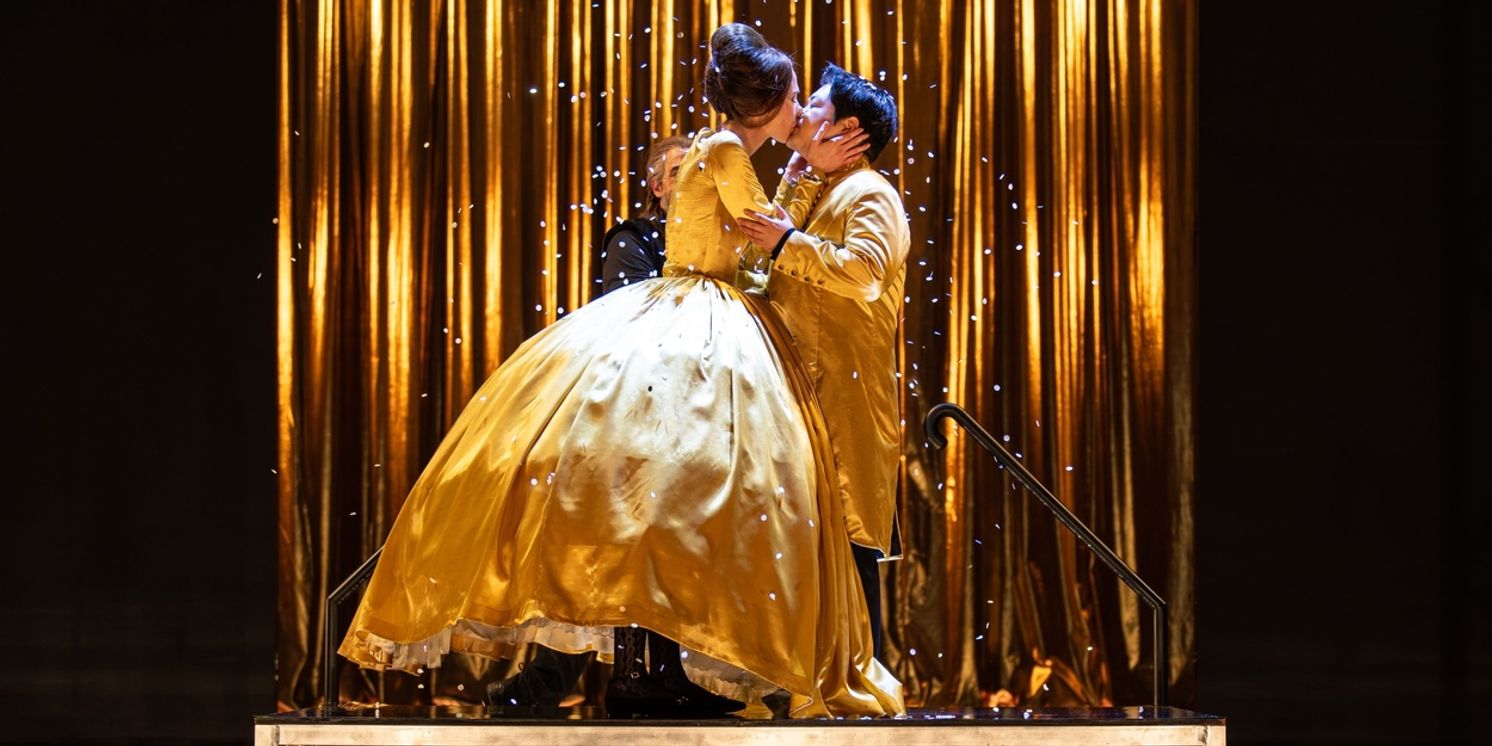
Reviewed by Barry Lenny, Thursday 7th May 2026.
One of the joys of opera is that there are always plenty that you have not seen before. State Opera South Australia, in its Golden Jubilee year, is presenting one that I have not previously seen performed live, Gioachino Rossini’s Cinderella (La Cenerentola) and, as usual, there are limited performances, making urgent booking essential. This is Rossini’s 20th opera. It was written in 1817, and he was still only twenty-five, following shortly after the triumph of The Barber of Seville. The full title is La Cenerentola, ossia La bontà in trionfo (Cinderella, or Goodness Triumphant). His librettist was Jacopo Ferretti, although it was not an easy relationship.
The direction of the production is in the highly capable, experienced, and talented hands of Neil Armfield, and it is conducted by the well-respected Music Director of Scottish Opera, Stuart Stratford. In a nod to the 1970s Designer, Stephen Curtis, references the artistic vision of Don Dunstan, the Premier of South Australia at that time, and the fashions of the era. Wigs abound, recreating that terrible hairstyle, the mullet, and clothing includes Cinderella’s strongly patterned stockings and Don Magnifico’s ruffled dress shirt, among others. Nigel Levings enhances the set with another of his clever lighting designs.
It opens with Pelham Andrews dressed as the stage manager, roaming the stage, organising the male chorus, who are performing the roles of stage hands, all while the overture is played. At the conclusion of the music, they transition into their assigned roles within the opera. It is made clear that this is all about theatre.
As William Shakespeare has Jacques say, in As You Like It,
“All the world’s a stage,
And all the men and women merely players;
They have their exits and their entrances;
And one man in his time plays many parts…”
Don Ramiro, Prince of Salerno, is holding a grand ball. Angelina (Cinderella), who is abused by her stepfather, Don Magnifico, Baron of Montefiascone (replacing the evil stepmother), and her two cruel stepsisters, Clorinda and Tisbe, manages to attend the event in spite of their refusal to permit it, and captures the attention of the Prince.
Unlike the fairytale with which most people are familiar, this opera entirely removes the magical element, thereby also removing all the problems associated with trying to stage the elaborate transformations that occur in the best known version of the story.
Alidoro, a philosopher, and the past tutor to the Prince, is the one who aids Angelina, and it is a silver bracelet, one of a matched pair, not a glass slipper, that reveals her identity. At the time, bare ankles were not permitted to be seen onstage, making trying on shoes a problem. Alidoro first appears disguised as a beggar, seeking a kind and gentle woman suited to become the wife of the Prince. Clorinda and Tisbe treat him badly, but Angelina gives him food.
To then meet her himself, the Prince pretends to be his own valet, and Dandini, the Prince’s real valet, pretends to be the Prince. Angelina falls for the valet, who is really the Prince, whilst the two stepsisters and their father set their sights on the Prince, who is really only the valet. Confused yet? This preference for the humble valet over the prince is another point in Angelina’s favour, by her placing love ahead of wealth and status. We are then back on familiar territory with the ball, and Angelina giving the Prince one of the bracelets, challenging him to find her using the other bracelet to identify her. Unlike the familiar version of the tale, this opera all ends happily, and there is plenty of comedy along the way.
Bass, Pelham Andrews, plays the wise and benevolently manipulative Alidoro, occasionally dropping in and out of the alternative function as ‘stage manager’, directing the others and even physically moving them. He excels in both incarnations.
The role of Angelina is sung by coloratura mezzo-soprano, Anna Dowsley, who is magnificent in the role. She fills her interpretation of Angelina with all of the sweetness and light, the guilessness, that the character requires, while her beautiful voice does full justice to Rossini’s score.
Dowsley is well-balanced by tenor, Jihoon Son, who sings the role of the Prince, Don Ramiro, giving a warm and gentle persona to his character. His performance is riveting, particularly when his voice soars into the powerful high notes with deceptive ease.
Dandini is sung by Nicholas Lester who injects more humour as his character makes the most of his chance to play at royalty, culminating in his reluctance to relinquish his assumed promotion at the inevitable fall back to his menial duties.
As Don Magnifico, the ever-popular Teddy Tahu Rhodes gives us a pompous, and rather foolish patriarch, seeing his own rise through the possibility of the marriage of one of his daughters to the prince. His eventual comeuppance amidst the confusion and disbelief when the valet turns out to be royalty, and whose choice is the step daughter who has been treated like a slave, brings forth great laughter.
The oft misquoted line from Shakespeare’s Hamlet, “Vanity (originally Frailty), thy name is woman”, perfectly describes the sisters, Clorinda and Tisbe, sung by soprano, Helena Dix, and mezzo-soprano, Indyana Schneider, respectively. Dix and Schneider appear to be having as much fun playing their characters as the audience does in watching them. They don’t miss a trick, every move and facial expression used to great effect, and singing up a storm at the same time. Dix could knock down the walls of Jericho with her powerful top notes.
The tenors and basses of the State Opera Chorus need no introduction to Adelaide audiences but, in this instance, they add to their superb singing with a selection of very funny, quirky choreography from Garry Stewart, former Artistic Diector of the Australian Dance Theatre, generating many more laughs. The Adelaide Symphony Orchestra, with added piano, gave yet another of its wonderful performances, for which they can be justly proud.
Regular opera-goers are sure to enjoy this light-hearted and comical work and, if you have never seen a live opera, this would be an excellent introduction. With only three more performances, though, you’ll need to rush to book tickets. The opening night audience filled the theatre, laughing, applauding, and ending with a prolonged standing ovation, so word of mouth is sure to spread quickly. Don’t miss out.
Photography, Andrew Beveridge.
Reader Reviews
Videos