

Chronicles of a Girl Singer, Part 3: A New Dream
On songs, surrealism, love letters, and discovering what an album was about after I had already made it

I love my little letters to BroadwayWorld. I hope you do too, if you’re reading this. I haven’t done one in a while. It’s usually an impulse that I get over a coffee, while travelling, and I think, this is a moment to make sense of—so, I am sitting down at my laptop. Words organize the chaos of an artistic life, or they can. We are all told, as actors, to journal, to process our emotions and the twists that come to us.
I made an album without knowing exactly what it was about. This is perhaps not the recommended way to make an album. There should probably be a concept, a sentence, a pitch—something you can put into a press release before the musicians have even arrived at the studio. I have done that before—landed on an idea like “how to capture film noir” or “what is the New York Sondheim made?” I have always loved recording.
After over two decades of singing together, pianist Tedd Firth and I knew we wanted to make a duo album. Something simple. Why? Because we have stopped many shows, with our trio, and done the one “quiet” number—like “Send In The Clowns”—and it was a meditation. Every Melissa show has one of those moments. No band, nothing. Just Melissa and the piano. Tedd has sheet music but he isn’t looking at it—we take pauses as we wish, we add bars, we get intense or intensely quiet. It’s not planned. Tedd reads me like a book. What if we made a whole album in this mindset?
Tedd liked this idea and sent me a folder of 58 songs he thought we might do well—songs worth looking at, songs that somehow felt like ours. He also thought they were songs that hadn’t been permanently claimed by one definitive recording by the likes of Ella.
Two summers ago, we spent a very long day in my parents’ living room, with Tedd playing all 58 on my father’s piano. We were alone. Every so often I would stop him, or lean in. “Wow, what is this?” I’d say when Tedd taught me “But Beautiful.” It was like shopping at the old vintage flea market in Chelsea—and coming upon something extraordinary, old but full of potential—something you would want to bring home and give new life to. An antique clock you would adore winding each day. We found 18 songs that made me wonder how I had lived without knowing them. Songs that stunned me, songs I wanted to sing. Let’s make it, we decided.
Our songs are by Rodgers and Hart, Irving Berlin, Cole Porter, Jerome Kern and Dorothy Fields, Duke Ellington and Bob Russell. Also, Peggy Lee, the Bergmans, Joni Mitchell. Some were witty, some yearning, some sophisticated, some almost painfully simple.
In the recording studio, Tedd read from old original sheet music, transposing on the spot and improvising everything. I was in a booth next to him but couldn’t really see his face. We just used our ears. We did it the way we wanted—no producer at the session, and our longtime engineer Alex Venguer listening and being amazingly unafraid. Alex had to be ready because we could never repeat anything we had done, as nothing was planned.
Tedd and I let a year go by and didn’t listen to the recordings. We were prepping a fun summer concert and went back to our “When in Rome” recording to learn it, and Tedd said, “That’s really good.” I spent more time listening, and Tedd and I decided to share them. I was so glad we had taken a photo one day which captured us together, winking a little to the wonderful Peggy Lee/George Shearing album cover I’d always loved, Beauty and the Beat. Tedd let me do the graphic design and pull it all together. I called the album I Can Dream, Can’t I? That seemed right. But I didn’t entirely know why. Yes, there is a song by that title, but somehow all of it seemed to fit beneath those words.
An album is a peculiar thing for a singer. You make hundreds of tiny decisions—keys, tempos, introductions, endings, whether to hold a note or abandon it, whether a lyric should be whispered or allowed to bloom—and you can become so absorbed in making the thing that you don’t necessarily see the thing you have made. In truth, Tedd and I barely remember making decisions at all.
We had turned those songs into musical conversations. That much I knew. We have played together long enough that an arrangement can begin with a glance or a slightly mischievous chord. I can giggle in the studio, heard only by Tedd, and he’ll take that in. The songs themselves seemed to be talking to one another too. But about what?
This summer, after singing Michel Legrand with Tedd and a British jazz trio at Ronnie Scott’s in London, I stayed in Europe for a while. I traveled. I looked at pictures. I walked through museums and streets. I was away from the practical machinery of turning our recordings into a unified album, and perhaps distance gave me permission to see it differently.
St-Paul-de-Vence, Madrid, Barcelona, Antibes, Nice, Paris. (I moved around, in part because of my children’s studies.) I looked at a lot of art, and I kept returning in my mind to the years in which so many of these songs were written: the 1930s and 1940s. I’d look at Magritte and Dalí, and noticed the years were exactly those of many of our songs.
We tend to look back at the Great American Songbook through a kind of golden haze—satin gowns, supper clubs, elegant poetry, perfect rhymes. But those decades were anything but serene. The world was unstable. Europe was convulsed. People were separated by oceans and wars. Modernism had fractured the old rules of art, and Surrealism had entered painting, photography, poetry and film. Melting clocks, impossible landscapes, bodies transformed into objects—dreams were not merely pretty things you had at night. They were another territory, a place where desire, fear, memory and reality collided. I felt the paintings carried a feeling of disruption, wildness, desperate hope.
And suddenly I heard my songs differently. “I Can Dream, Can’t I?” is such a charming title that it is possible to miss the desperation hiding inside it. If reality will not give me what I want, the song says, surely you cannot take away my dream. That is not sentimental. That is survival.
The great songs of that era are full of these strange negotiations with reality. Someone is absent, so you imagine him. Someone doesn’t love you, so you construct a world in which he might. You are alone, but you see him dance on the ceiling. You insist you are perfectly fine and then spend thirty-two bars proving that you aren’t. We construct imaginary worlds just to cope with a missing person.
Cole Porter makes desire into wit. Rodgers and Hart can make loneliness sparkle. Irving Berlin can place an entire emotional life inside a melody that seems inevitable. These songs are extraordinarily civilized, yet completely irrational. Which is, of course, love.
Room after room addressed the politics of the time. Fascism had made the real world terrifying. I began to wonder whether this created an urgent psychological need to escape, look away, or build an alternative reality. Freud’s work, meanwhile, was spreading across Europe and America in the 1920s and 1930s. It struck me that when the conscious world seemed to have gone mad with war and fascism, dreams and subconscious desires might have offered another territory in which to search for truth or safety.
All this swirled in my mind on my travels. While Dalí painted melting landscapes against the backdrop of a collapsing Europe, American lyricists were writing about lovers dancing on the ceiling or clinging to an impossible dream. I had never thought of this connection! Both seemed to be using dream-logic to claim a private space where a person could still feel, desire, and construct a world of their own. These art forms—the haunting canvases of Europe and the bittersweet melodies of America—began to seem to me like necessary sanctuaries.
And then another door opened. This September, I began reading the letters between Albert Camus and María Casarès. They arrived just in time. I have a concert to create for the Landmark Theatre for October 9th, in the town where I grew up. I wondered if these letters might help me.
Camus, the philosopher and writer, and Casarès, the great actress, conducted an extraordinary love affair across years of separation. Their letters are intellectual, erotic, funny, impatient, theatrical, practical, jealous, tender. They are full of trains and rehearsals and missed meetings and desire. I had expected them to be tragic. They’re not. What surprised me was how much fun they are.
Casarès in particular startled me. Here was a woman passionately in love who remained fiercely herself. She could adore a man without disappearing into him. She had her work, her appetite, her humor, her theatrical life, her own mind. Reading her, I began to recognize something in the women inside these songs: the woman who says, essentially, I love you. And I am still me.
I heard her in Dorothy Fields’s “Remind Me,” and in Oscar Hammerstein’s “All in Fun.” I added some uptempos for a live concert. Suddenly “The Lady Is a Tramp” didn’t feel like a standard I had sung for years. It felt like a manifesto. “I get too hungry for dinner at eight…” Here is a woman refusing the approved performance of femininity. She likes what she likes. She goes where she goes. She will not behave herself merely to make herself more lovable. And yet a few songs later, that same independent woman can admit that she dreams. Both things can be true.
Perhaps that is what I had been intuitively collecting all along: songs in which people invent ways to speak to someone they cannot quite reach. Sometimes they flirt. Sometimes they joke. Sometimes they complain. Sometimes they dream. Sometimes they lie to themselves beautifully. And sometimes, for the length of a song, the impossible person becomes present.
That realization changed the concert. I stopped thinking of the songs as a sequence of standards and began thinking of them as conversations and letters. The evening now moves through distance, desire, irritation, independence, illusion—and whatever remains when illusion falls away. I began to understand again how rich the inner life of the American Songbook is, and how deeply Sondheim had internalized the intimate, complicated, adult emotional language of these songs.
Even the songs from outside the classic Songbook began to reveal why they had found their way onto the album. Joni Mitchell’s “Both Sides Now” belongs in this world because it understands that experience does not necessarily make anything simpler. “I really don’t know life at all,” she says. We see love from one side and then another. We accumulate knowledge and somehow retain mystery.
And today I added “As Time Goes By,” written in 1931 and immortalized in the 1942 film Casablanca. Suddenly it seems almost like the summation of the whole enterprise. The circumstances change. History changes. The lovers change. The fundamental things apply.
I had thought I was making an album about old songs. I don’t think that anymore. Maybe the Great American Songbook isn’t really a period. Maybe it’s a way of talking about love—a language elegant enough to contain contradiction, a place where sophistication and longing can occupy the same four minutes, where a person can be independent and besotted, comic and devastated, realistic and dreaming.
That is the concert I am building now. And perhaps that is why the album had to come first. Sometimes you choose an idea and make something from it. And sometimes you make something—intuitively, stubbornly, a little wildly, song by song—and much later it turns around and tells you what it means.
I can dream, can’t I?
Apparently, I already had.
Listen to I Can Dream, Can't I? and learn more about Melissa Errico on her website here.
Sign up for all the news on the Fall season, discounts & more...

|
KAREN MASON - ALBUM RELEASE CONCERT - BIRTHDAY BASH at BIRDLAND BIRDLAND (9/28-9/28) |

|
The Beat Goes On Don't Tell Mama (10/08-10/08) |
|
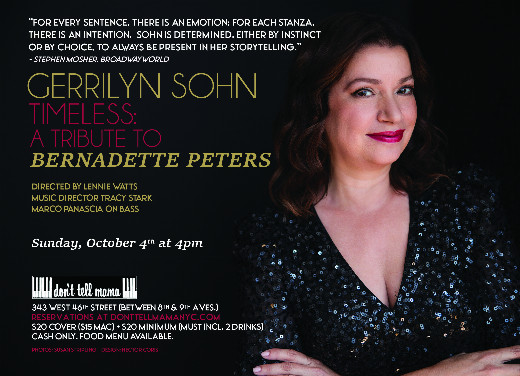
Timeless: A Tribute to Bernadette Peters Don't Tell Mama (10/04-10/04) |

|
54 Gets Away With Murder 54 Below (10/16-10/16) |

|
John Barrowman 54 Below (11/05-11/05) |

|
Justin Vivian Bond Joe's Pub (12/13-12/13) |

|
Brandie Inez Sutton: Miss Sutton, Live! 54 Below (10/08-10/08) |

|
Martin Bonventre: Swingin’ in a New Dimension 54 Below (11/12-11/12) |
|
Isaac Oliver's Very Special Very Early New Year's Eve Joe's Pub (12/31-12/31) |

|
Salty Brine: You'll Never Get to Heaven (The Laura Nyro Show) Joe's Pub (11/20-11/20) |
