


My guest this week is author Deborah Phillips whose new book is titled: AND THIS IS MY FRIEND SANDY — SANDY WILSON’S THE BOY FRIEND, LONDON THEATRE AND GAY CULTURE. Sandy Wilson's The Boyfriend — for which he wrote the book, music, & lyrics — is one of the most successful British musicals of all time.
Can a Dancer Build a Competition Program Between Shows? Iskandar Anvarov Won Gold With One
A medal-winning World Ballet Company soloist lays out the rehearsal plan that got four new classical variations stage-ready in across a season of about 180 performances.
By: Team BWW

Written by Molly Peck
Applications for the USA International Ballet Competition, which returns to Jackson, Mississippi, next June on its four-year cycle, close January 22. Under the 2027 rules, a soloist dances two classical variations in the first round and two more in the third, with contemporary work in between. For entrants who already dance with a company, much of that preparation will overlap with Nutcracker season - the busiest weeks of the ballet calendar.
Iskandar Anvarov, a soloist with the touring World Ballet Company, went through a version of that squeeze this year. He prepared four classical variations he had never performed while the company was on the road, often with about an hour to rehearse before going onstage, and in June took medals at two international competitions. How he broke the work into pieces and kept his body ready for both the stage and a jury offers a working plan for dancers whose competition season has to fit inside a performance calendar.
The Hour Before Curtain
World Ballet Company spends its season on the road across more than 40 states a year. Since joining in September 2025, he has danced the Prince in Cinderella and The Nutcracker and the pas de trois in Swan Lake. Last season those roles added up to about 180 performances in houses of 2,500 to 4,000 seats, more than half of them sold out, in a different city from one night to the next.
“Over time, you get used to stages of different sizes,” says Iskandar Anvarov, now in his second season with the company. “The floor is what you keep an eye on. At many venues it’s quite hard, so you have to be especially careful.”
In a resident company, a dancer with a competition ahead can stay in the studio after the evening’s work, and that was the routine he knew before World Ballet Company. A silver medalist at Moscow’s DanceMoscow competition while still a student at the Bolshoi Ballet Academy, he danced in Kazan after graduating. The Stanislavsky and Nemirovich-Danchenko Music Theatre in Moscow came next, at the invitation of Laurent Hilaire - the former Paris Opera Ballet étoile who then ran its ballet company - and he later became a soloist there.
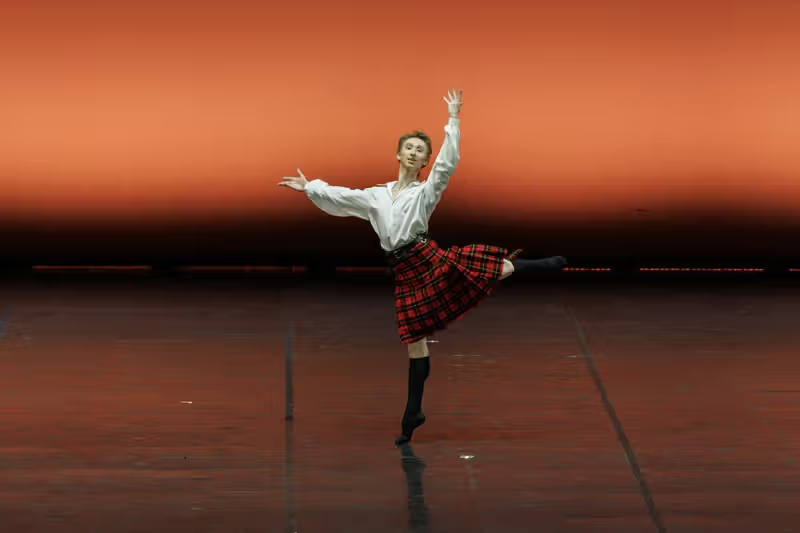
In 2024–25, he was a principal soloist at Samsun State Opera and Ballet in Turkey, performing leading roles in the company’s repertoire. He was also invited by Aysem Sunal, artistic director of ballet at Istanbul State Opera and Ballet, to dance Romeo as a guest principal soloist in the March 15, 2025 premiere of Ricardo Amarante’s Romeo and Juliet. On tour with World Ballet Company, however, his reliable rehearsal window shrank to the hour before curtain, after which he went straight onstage.
All four variations he prepared for the competitions were new to his stage repertoire: Prince Désiré’s from The Sleeping Beauty, Albrecht’s from Giselle, James’s first-act variation from La Sylphide and a variation from the Grand Pas Classique in Paquita.
Four Variations, One Passage at a Time
He and his coach, David Khozashvili, started with parts rather than wholes, taking one variation at a time and drilling its technical elements separately until the dancer had a clear physical sense of how each should feel; only then did they run the variation from start to finish. The method suited the clock as well. With a full performance waiting at the end of each hour, short, focused repetitions of a single passage cost less energy than a string of complete run-throughs.
Once each variation held together, he linked them into longer sessions; about three months after the first rehearsal he could dance all four in a row with only short breaks, which built the stamina to stay clean to the last of them.
Recovery Counted as Rehearsal
A near-daily performance schedule, with competition work on top of it, meant that rest went into the plan as deliberately as rehearsal did. He aimed for at least eight hours of sleep a night and kept a close eye on his protein, and on days off he got a massage whenever the schedule allowed it.
“Sometimes you’re tired, but you have to stay focused on the result you want to achieve. At the same time, you need to listen to your body,” he explains. “Sometimes it’s better to ease up on training and get some rest.”
His wife, Liudmila “Lusi” Savenko, supported him throughout the preparation, including its most demanding stretches. She also choreographed the contemporary solo he performed at both competitions.
Between Istanbul and Korea, One Variation Changed

The first test was the VII Istanbul International Ballet Competition, run by Turkey’s General Directorate of State Opera and Ballet and judged by an international panel that included the American ballerina Joy Womack. At the closing gala on June 1, Iskandar Anvarov received first prize in the senior category.
The 19th Korea International Ballet Competition, a contest founded in 2005, opened just over three weeks later, on June 24. After a short rest, the dancer went back to his usual routine, but with one adjustment to his Grand Pas Classique variation from Paquita. Iskandar and his coach replaced a double cabriole derrière in the second half with a jeté entrelacé. The decision came after Istanbul, where Anvarov found that the cabriole was not as consistent as he wanted. The jeté was a movement he could perform more reliably, while also suiting the variation’s style and looking effective from the audience. The adjustment helped him maintain consistent execution across multiple competition rounds. In Korea he won bronze, his second international medal in less than a month.
The Short Walk to the Stage
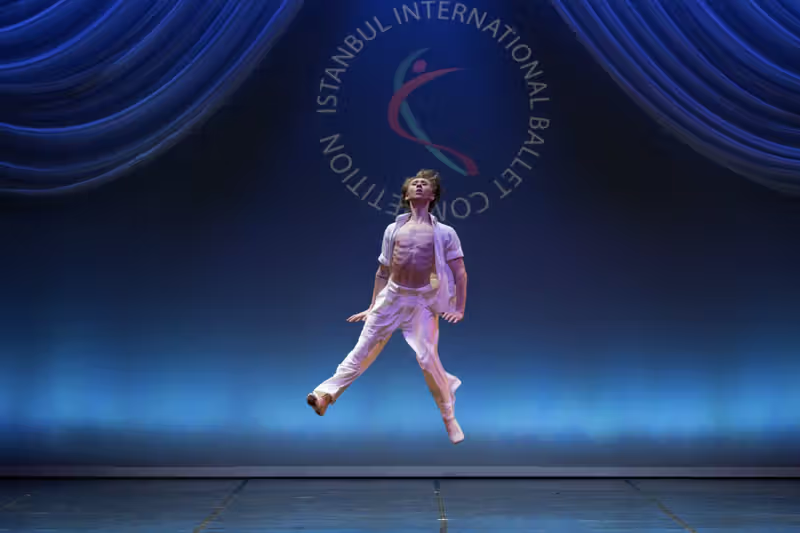
He has also worked in front of students - the Bolshoi Ballet Academy twice brought him to its New York summer intensive to represent the school, and after the Istanbul gala he taught a free master class for children at a local studio. For a dancer whose competition program came together in the hours before performances, the distance between rehearsal and stage was always short, and his view of competing grew out of it.
“In rehearsals, you have time to think about every movement and correct what isn’t working,” he says. “But once you’re onstage, you have to trust your preparation.”
Photo Credit: Murat Dürüm
Breaking Broadway alerts by text
Get the biggest stories sent straight to your phone.
Broadway news in your inbox
Weekly top stories - unsubscribe anytime.
Weekly top stories - unsubscribe anytime.