


Review: SISTER ACT - National Tour, Germany
A Euphoric Celebration of Music, Comedy and Sisterhood
“Sister Act” owes its status as a global phenomenon to the iconic Whoopi Goldberg film, but Alan Menken’s stage version of the beloved Hollywood comedy has long since conquered stages all over the world. In its acclaimed West End incarnation, the musical has already been touring German-speaking venues for a third year, presented by production company Showslot, continuing to fill auditoriums all over the country. Both the linguistic adaptation and the technical realization for touring operations across Germany are flawless. The show is nothing short of a gospel of good fun – hallelujah!
The musical adaptation of the 1992 film premiered in 2006, produced by Stage Entertainment. Countless touring productions have since emerged from the lavish original sit-down staging, and by now “Sister Act” has also become the go-to musical for countless open-air productions and amateur theatre groups alike. In 2022, the nun comedy returned to London’s West End in a glitter-soaked new incarnation. Bill Buckhurst directed, joined by Morgan Large (sets and costumes), Alistair David (choreography), Tim Mitchell (lighting), and Tom Marshall (sound). This production was replicated almost seamlessly and adapted only minimally for touring operations in Germany, so that by 2024 the current road production was already sent out on tour.
The resident directors and German creative team have translated the West End production wonderfully. The German-language lyrics and dialogue from the original 2006 Stage Entertainment production were revised, one song was completely re-written (“Meine Offenbarung” is now called “Nonnen haben’s gut”), and the jokes were reimagined to be less edgy but still funny in different ways. The book by Cheri and Bill Steinkellner was entertainingly adapted for the German market by Werner Sobotka and Michael Ronzoni, with some joke variations existing exclusively in this touring version. Glenn Slater’s lyrics for Alan Menken’s unmistakable score, oscillating between grand Disney balladry and 70s disco tracks, were translated with rhythmic and lyrical finesse by Kevin Schroeder and Heiko Wohlgemuth.
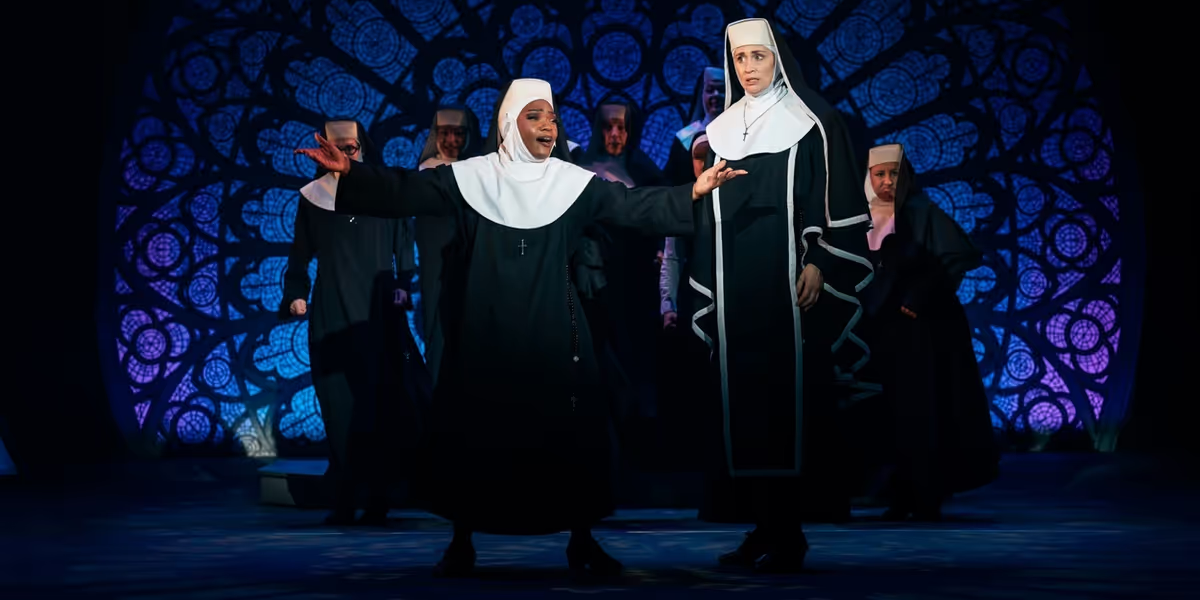
The focal point of the set design is a semi-circular stage portal that can be illuminated in every colour of the rainbow and, together with the large backdrop, evokes the image of a gothic cathedral rose window. For scenes outside the convent, the elements are simply taken out of the light while several selectively used oversized props — a bedroom façade, a bar with jukebox, a tuk-tuk, or filing cabinets from a police office for example — instantly and convincingly evoke the other locations of the turbulent story.
The rose window remains the visual showstopper, theatrically framing the many scenes surrounding Deloris, Mother Superior, and their flock of nuns through the lighting design — sometimes delightfully chaotic, sometimes surprisingly intense and introspective. The choreography is buoyant and delivers everything one could wish for from this sacred comedy: it shakes, sways, grooves, jiggles, and waddles; the habits flutter and billow, hands fly skyward, people hop, rejoice, and exult. Standout moments include Eddie’s quick-change extravaganza during “Tief in mir”, the goofy seduction trio performing “Hey Schwester”, and of course the exalted nun-choir showstoppers “Sonntagmorgenfieber” and “Singt hinauf zum Himmel”, where both the comedy and sheer joy transfer directly through the movement vocabulary.
The costume design is outstanding. Not only does it perfectly capture the spirit of the 70s and manage to visually distinguish the very different nuns through subtle nuances, it also delivers genuine eye-catchers and wow moments. Eddie’s double onstage quick-change from police uniform into a white disco outfit and back again is spectacularly executed. Deloris’ glittery stage outfits, her white gown for the curtain call, and Mother Superior’s imposing robe compete with the sparkling nun costumes in full technicolour frenzy. The finale thus becomes a full-blown theatrical spectacular – a true euphoric sensory overload.
Even in Frankfurt’s Jahrhunderthalle — whose auditorium is arguably far too wide and deep for a musical — the sound design and acoustics function astonishingly smoothly. Spoken dialogue, sung lyrics, and the music performed by the dynamic eight-piece band under Florian Kießling are transmitted crystal-clear even to the furthest and highest rows, while the sound design deliberately plays with volume and sonic force: the climax of Mary Robert’s ballad “Die Welt, die ich nie sah” hits the audience with almost physical force and creates goosebumps, while “Sister Act” as Deloris’ emotional quiet ballad moves audiences to tears precisely because of its introverted sound approach, and “Lass die Liebe herein” brings the audience to its feet. Technically, the production is magnificent.
The ensemble is cast coherently throughout. While Alexander di Capri plays gangster Curtis with relaxed arrogance in “Ich mach sie kalt”, Marcel Weber’s shy police officer Eddie Fritzinger remains intentionally restrained and understated in his performance. Mark John Forbes spices up his eccentric Monsignor with cool dance moves, and the gangster trio consisting of Pablo (Diego Montez), Joey (Benjamin Hauschild), and TJ (Andres Vercoutere) evolves into audience favourites thanks to their flirtatious number.
Yet the evening clearly and unequivocally is in women’s hands, performance-wise. Deloris’ showgirl companions Michelle (Aminata Ndaw) and Tina (Naomi Diebel) immediately heat things up at the beginning of the show with “Fabelhaft, Baby!”. Ronja Rückgauer’s ancient Mary Theresa and Susanne Rietz’s utterly spaced-out Mary Nirvana ensure there isn’t a dry eye in the house. Linda Rietdorff plays bubbly, quirky Mary Patrick, who — according to her own account — used to trigger her uncle’s seizures with her epic operatic soprano before taking the habit.
Janina Maria Wilhalm as the shy Mary Robert is a vocal revelation. The audience is left with goosebumps and jaws dropped when the postulant belts out her self-discovery ballad in the second act. Dramatically, too, she undergoes a touching development from wallflower to self-determined young woman. Sylvia Moss absolutely steals the show as cynical, eccentric, somewhat tomboyish Mary Lazarus, laying down the hottest moves on stage with sonorous hip-hop and outrageous choreography. Moss is also a true master of comic character acting. Kevin Gordon Valentine as the unlucky taxi driver, Florian Karnatz as police informant Clemont, as well as Daniela Moser and Silja Teerling as fellow sisters round out the ensemble harmoniously.
Femke Soetenga in the role of the stern Mother Superior is a presence that commands reverence without ever becoming antagonistic. Rarely is this role played with such nuance. As a second heroine alongside nightclub singer Deloris, one follows her struggles with the unwanted exile within her convent walls with equal amusement and empathy. No matter how forceful and uncompromising she may appear, Soetenga’s nuanced acting repeatedly offers glimpses behind the façade, revealing not only the abbess’ odd little quirks but also her own distinct sense of humour. It is worth watching the performer even in scenes where she is not the focus of the action — laughter is guaranteed. When Deloris stretches out her arms for a hug during the final reconciliation and Mother Superior, completely misreading the gesture, responds by raising her own arms heavenward in beatific praise, her singular comedic timing lands perfectly with the audience. That Soetenga belongs among the most distinguished performers in the German musical theatre scene becomes apparent in every single entrance through her extraordinary Stage Presence, which commands the stage effortlessly.
American performer Jahlisa Norton conquers German stages as disco queen Deloris Van Cartier. Her charisma goes far beyond the diva qualities demanded by the role profile. Brash and rough-edged, loud and a little “from the hood”, she completely makes the protagonist her own. In doing so, she generously mixes in traces of her own background: she flirts with American slang, parodies the nuns with whooping mannerisms borrowed from exuberant Southern church services, and vocally thunders with the expressiveness of holy ghost preaching, at times recalling the legendary Oda Mae Brown, another of Whoopi Goldberg’s iconic roles. Norton’s physical comedy and facial expressions are likewise an experience in themselves: always on point, always the centre of attention, she effortlessly wraps the audience around her finger. Vocally, she is brilliant and at times evokes the great Patina Miller — especially her lower register causes outright enthusiasm. Yet she convinces just as fully in the quieter scenes that reveal the character’s emotional depth, moving audiences to tears with her eleven-o’clock number. A magnificent performer and an absolute enrichment for the German musical theatre scene.
“Sister Act” promises immensely entertaining, high-quality escapism with sparkling music, plenty of laughs, and a whole lot of heart! Amen!
Erhalten Sie Broadway-News auf WhatsApp
Erhalten Sie aktuelle Nachrichten, exklusive Berichte und Theaterupdates direkt in der App.

Sign up for all the news on the Fall season, discounts & more...

|
GIOVANNI ZARRELLA Boulevardtheater Bremen (4/08-4/08) |
|
|
anders - so kurz davor Forum Hasetal (10/02-10/02) |

|
Dr. Leon Windscheid - Einfach sein - Psychologie Live Metropol Theater Bremen (1/24-1/25) |
|
Die Comedy Camp Tour 2026 Theater am Marientor (10/14-10/14) |
|
HG Butzko Hamme Forum Ritterhude (4/11-4/11) |

|
Herr Schröder - Der Rest ist Hausaufgabe Theater am Marientor (5/21-5/21) |
|
|
Die Reimanns - Sabbelstunde mit Manu & Konny Kulturspeicher (10/11-10/11) |
|
Die Schöne und das Biest - Das neue Musical Boulevardtheater Bremen (2/02-2/02) |
|
|
Das Geld liegt auf der Fensterbank, Marie - Glorreich versieben Hamme Forum Ritterhude (5/28-5/28) |
|
|
MAGISCHER SAMSTAG: Die Jüdin von Toledo Puppentheater Zwickau (11/07-11/07) |

Reader Reviews
To post a comment, you must register and login.