


REVIEW: The Festival d'Avignon Presents ISLAND STORY By Kyung-Sung Lee
For the many mainlanders who visit, Jeju is beautiful (and Jeju is beautiful.) Yet despite its vision of Eden, it is not a beauty outside of history.
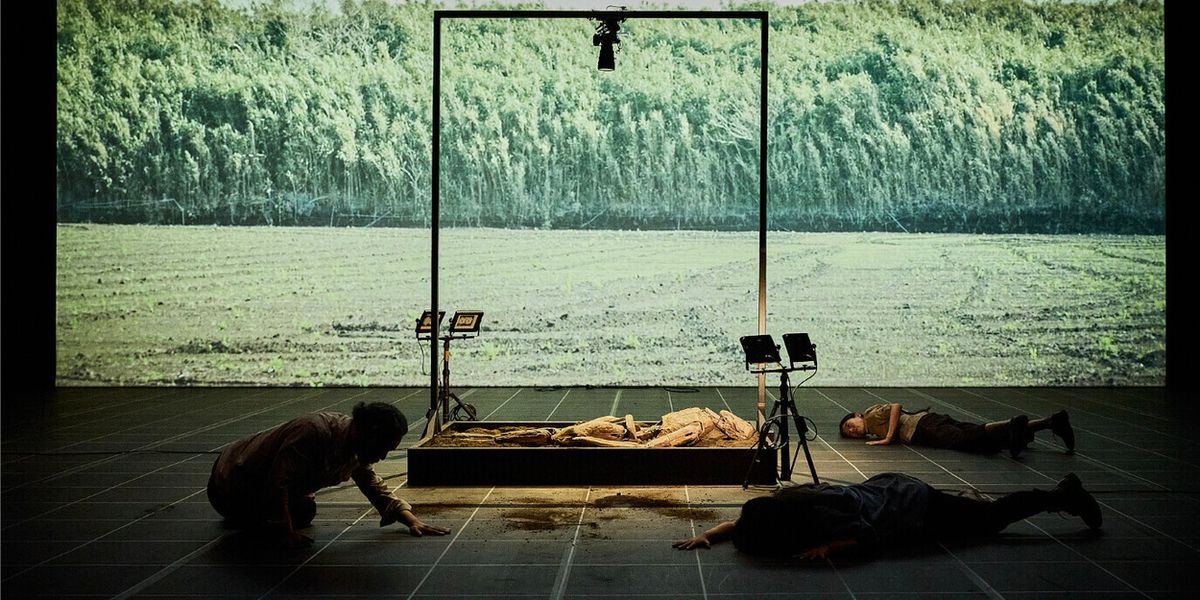
The beautiful island of Jeju lies in the Korean Strait some fifty miles south of the Korean Peninsula. Today, it is a popular holiday destination with striking vistas, beautiful waters, and lush vegetation. Beneath this verdant landscape and tourism infrastructure, however, lies a tragic history. The Jeju uprising, also called Jeju 4.3, took place between the end of the Second World War and the Korean War as the island fought for political autonomy. With American aid and military influence, the Korean government responded with brutality, systematically murdering an estimated 30,000 Jeju residents. In recent years, during a renovation of Jeju International Airport, Korea’s second busiest airport, workers discovered a mass grave containing hundreds of victims of the massacre. Kyung-Sung Lee’s Island Story, now in performance at the Festival d’Avignon’s Gymnase du Lycée Aubanel, uses performance to offer closure to a pain buried beneath years of government-enforced forgetting and repressed trauma.
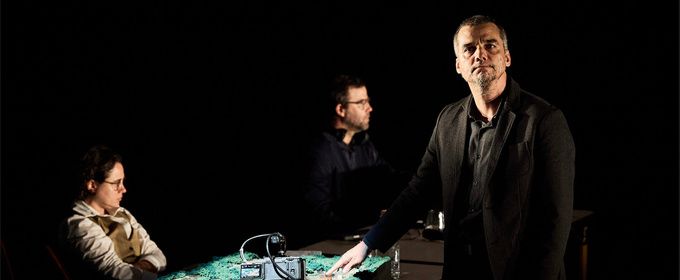
Five performers enter the stage. They introduce themselves through their physical idiosyncrasies: my hair is gray, I’m the shortest, I have long limbs, and so on. It creates a bridge between the physical specimen, so clinically and methodically recovered from the mass grave, and the beauty of an individual. What would we notice about these actors if they, too, were found in such a grave? Two take to stationary bicycles connected to a generator that lights a small sandbox center stage. The other three sit at office desks upstage before a large screen. Using texts in front of them or delivered through headphones connected to smartphones, they recount interviews with Jeju locals about hearing of the discovered bodies. Is my father there? What did this event mean to Jeju? How did my parents and grandparents respond to it, and how did it affect the way they raised me? These stories are less cathartically moving than they are journalistic documentation, a work of social and historical duty.
The piece then turns to the sandbox, resembling a displaced section of an archaeological excavation at center stage. The exhumed bodies are presented in their clinical state as the actors place themselves in their recorded positions (hand next to the hip / face down / legs splayed / etc.). Then they discuss a child. As we have seen with tragedy, great scale can numb. The aphorism "A single death is a tragedy; a million deaths are a statistic" holds true. For an American like myself, the scale of death at Jeju is unimaginable. In our modern history, only natural disasters or pandemics approach its magnitude. The discovery of a child's body, represented by a wooden puppet, tells a less clinical story. The child was found face up, his hands covering his face. Through this, we discover that the people in the grave were not placed there after death, but forced into the pit alive, where soldiers shot them, a horror from which this child instinctively shielded his eyes. At this point, the actors reveal an authentic American-made bullet casing recovered from the grave site as proof that the victims were shot in the pit. The actors surround the child puppet (beautifully designed by Lee Jee-hyung) in the positions of the dead as a camera suspended above the sandbox zooms in on the bullet held in one of their hands.
From this shattering moment, the piece moves to Jeju today, where its history and dialect are slowly disappearing. The production affirms that Jeju is a real place with a local history and local people. They use the theatre as a kind of time capsule, bringing Jeju from the pages of history into lived experience. With the theatre darkened, we hear recordings from across the island, each accompanied by an indication of an otherwise anonymous location where the sound was captured. This atmospheric soundscape contrasts with Kayip’s theatre-shaking airplane sound design, which caused more than a few audience members to look around the auditorium in search of the aircraft. Later, Hwant Ho-gyu’s videos of Jeju’s beautiful landscapes invite us to imagine not only the horrors but also the rural life of a region crushed not by a single incident, but by decades of repression.
Except for the analysis of the child’s body, Island Story does not aid in emotional digestion. Instead, it helps settle a memory. It resists a straightforward crescendo into dramatic poetry, at times becoming almost a gallery installation. While this disrupts a conventionally satisfying pace, it affirms the selfless charge that the performers (Kyung-Sung Lee, Na Kyung-min, Bae So-hyun, Sung Soo-yeon, and Jang Sung-ic) have taken upon themselves. With subtle lighting by Kim Hyo-min and clinical scenography by Shin Seung-ryul, the production attempts to evoke a past that has been denied both restitution for its trauma and nostalgia for its rural beauty. For the many mainlanders who visit, Jeju is beautiful (and Jeju is beautiful.) Yet despite its vision of Eden, it is not a beauty outside of history.
Photo Credit: Christophe Raynaud de Lage
Prefer BroadwayWorld in Google Search?
Add us as a preferred source so our stories show up more often in Top Stories and Google’s AI answers — for you.
Recevez l'actualité de Broadway sur WhatsApp
Recevez les dernières mises à jour, les nouvelles de dernière minute et une couverture exclusive directement dans l’application.

Sign up for all the news on the Fall season, discounts & more...

