
Zhenqiao Hu: Finding Common Ground Through Music and Community
Zhenqiao Hu had helped organize the first pilot workshop of Carnegie Hall’s Lullaby Project in Yangzhou.
Written by Tom White
During the 81st session of the United Nations General Assembly, Zhenqiao Hu spoke at a Science Summit webinar about a community project she had helped run in Yangzhou, China. Her topic was lullabies, and specifically the songs parents write for their own children.
As a student and youth project lead, Zhenqiao Hu had helped organize the first pilot workshop of Carnegie Hall’s Lullaby Project in Yangzhou. Sharing the experience at an international forum gave her an opportunity to look beyond the practical work of organizing an event and consider what it meant in a wider context. “There was a time I listened to other speakers, including a violinist and a health advocate peer; I began to think more deeply about how music carries personal memories, connects people across cultures, and allows families to pass their stories to the next generation.”
Zhenqiao Hu came away thinking that global citizenship often starts small. The Yangzhou workshop, held on August 11, 2026, offered a concrete example. Organized by ALT Alliance at Tangjun Music Healing Center, the two-hour session brought together four families with children aged zero to six. Working alongside a professional musician, parents transformed their thoughts about their children into original lyrics and melodies. By the end of the evening, each family had a lullaby of its own, accompanied by a hand-drawn cover.
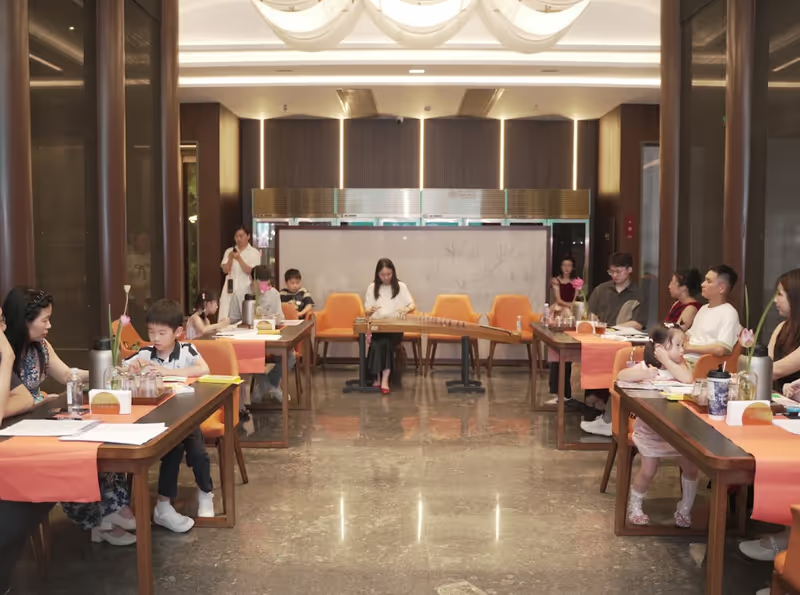
The project originated with Carnegie Hall’s Weill Music Institute in New York in 2011. It pairs parents and caregivers with professional artists to create personal songs for their babies, with the broader goals of supporting parental well-being, encouraging childhood development, and strengthening the bond between parent and child. In 2025, ALT Alliance became its first official partner to bring the project to China. The Yangzhou workshop marked the first pilot of that collaboration in 2026, with Zhenqiao Hu serving as youth lead.
Carnegie Hall’s format couldn’t simply be translated and dropped into Yangzhou. Many of the families had no musical training, and some parents doubted they could write a lyric, let alone a melody. So the team gave them lyric prompts and familiar nursery rhymes to start from and transcribed what parents said aloud so no one had to write anything down if they didn’t want to. Each family decided how much to take on, and a professional musician helped turn their ideas into finished songs. Children too young to sing or write drew the cover art instead.
Zhenqiao Hu also wanted the workshop to reflect the community in which it took place. Rather than relying exclusively on Western musical traditions, the team brought the guzheng and guqin together with the piano.
The families’ responses offered encouraging signs. Post-workshop questionnaires indicated positive satisfaction, increased confidence in creative expression, and a stronger sense of community among participants. Caregivers who had arrived as strangers had opportunities to connect, while most families planned to continue singing their lullabies at home. The songs were not intended to remain as products of a single evening; they were made to become part of family life.
When Zhenqiao Hu later reflected on the experience at the Science Summit webinar, the relationship between local practice and global dialogue became clearer. The Yangzhou workshop had given her specific experiences to discuss, while the perspectives she encountered through the webinar encouraged her to reconsider how caregivers and children could be better supported in future sessions. Each setting informed the other.
That exchange also offered a useful perspective on global citizenship. “Cultural understanding is not simply a matter of presenting one's own traditions to an international audience. It involves learning how other people experience the world, recognizing differences without treating them as barriers, and adapting one's approach when working across communities.” To Zhenqiao Hu, this meant understanding that a program could travel internationally, but the support surrounding it had to be rebuilt locally.
For her, the Yangzhou pilot was one step in that continuing process. Her work brought together music, family relationships, and local traditions, while her participation in the Science Summit gave her a wider framework for reflecting on what she had learned. Rather than offering a definitive model for cross-cultural work, the experience left her with practical questions to carry forward: How can an activity better accommodate the people taking part? How can cultural traditions remain meaningful in contemporary family life? And how can international collaboration begin with genuine attention to local needs?
A lullaby is a small thing, usually made and sung at home. But the stories in these songs didn’t stay in Yangzhou. Zhenqiao Hu’s care, effort, and the conversation she later brought to an international audience, showed how a two-hour songwriting session could give families a way to say something about themselves and give people far from Yangzhou a reason to talk about what families pass on to their children.
Breaking Broadway alerts by text
Get the biggest stories sent straight to your phone.
Weekly top stories - unsubscribe anytime.

|
NYFOS Next: This Now Naked Life The Theater at 150 W 17th Street (11/15-11/15) |
|
Grand Choral Opening: War & Requiem Church of the Ascension (10/29-10/29) |
|
American Composers Orchestra: Hello, America: We Gather Here at Carnegie Hall Carnegie Hall (10/27-10/27) |
|
American Composers Orchestra: New Virtuoso: Low End Theory at Carnegie Hall Carnegie Hall (3/18-3/18) |
|
Carnegie Hall Presents: Santiago Cañón-Valencia and Victor Santiago Asuncion Carnegie Hall (11/10-11/10) |