


Review: CAESAR/AMERICANA at Fells Point Corner Theatre
A logistically and artistically ambitious mashup of Shakespeare's play and modern American songs with some great acting.
Back in 2017, Cohesion Theatre Company, a very interesting and ambitious Baltimore theater group of the time, tried resituating a Shakespeare play, Henry V, in 19th-century Appalachia, in the midst of the Hatfield and McCoy feuds. Though I wasn’t in love with everything in it, I found it fascinating, and recommended it to my readers. Two of the participants in that show are now prominent participants in another effort to resituate a Shakespeare play, this time Julius Caesar, also in an Appalachia of another era, and I sense the same DNA at work, even though the producing company this time around is something called “Motte & Bailey prod.” (By what is surely no coincidence at all, “motte-and-bailey” also happens to be the name of a form of medieval castle construction, so I wouldn’t waste time looking for a Mr. Motte or a Ms. Bailey, if I were you.) This show is, if anything, even more ambitious, even more challenging, and even more engaging than the Henry V I’ve been discussing, and I end up giving the same advice: go and see it, even if it’s not perfect.
What it is – well, it sort of runs on two tracks, one dramatic, one musical. They accompany each other loosely, but definitely diverge in all sorts of ways. The dramatic track is Shakespeare’s play, and the musical track is a bunch of contemporary songs which may or may not be on-point as accompaniment to the action of the play, performed by a six-man ensemble (also billed as Greg Bell and Cry Havoc) occasionally augmented by select members of the cast. These songs qualify as “Americana,” and I’m assuming that they account for the right side of the slash mark in the title of this show, Caesar/Americana. The work is “adapted and directed by Hannah Fogler.”
I understand that this is at least the second of Fogler’s mashups of Shakespeare and something else under Motte & Bailey’s aegis, an earlier one last year having been called Hamlet/Black Parade. (Unfortunately, I didn’t get to see it.)
To get a sense of how these two tracks accompany each other but also sometimes diverge, consider the story and the music during the first three songs: Blues Saraceno’s “Dogs of War,” Poor Man’s Poison’s “Let’s Go,” and Bruce Springsteen’s “Born to Run.” These are sung during what is derived from Act I, Scene 1 and parts of Scene 2 of Shakespeare’s play, in which begins Julius Caesar’s progress from dominant figure in Rome of 44 B.C. to impending emperor.
It would be churlish to complain about the song “Dogs of War” standing as the introduction to the show, since this is the very play which made the phrase “dogs of war” a commonplace. Sung by the band as a kind of prologue, it is a mostly generally-worded expression of dread of an impending war. And certainly a war does arrive by the end of the show. At the same time, the song doesn’t foreshadow the play’s whole agenda, or even most of it. Julius Caesar is a play about so many things: political behavior, the ethics of assassination, personal integrity, constitutional government, two marriages, and ghostly intervention in worldly affairs, to name some of them – all of them on display in this adaptation. Arguably, the war is less important in the play than many of them. In other words, this isn’t an opener like “Good Morning, Baltimore” or “Tradition,” songs designed to introduce you to the whole world of the show. (I know; no one promised us a musical or the conventions of one. But the imperatives of exposition are perilous to ignore regardless of genre.)
The use of “Let’s Go” (2023) is more questionable. It’s a song of protest against the way unnamed members of “the war machine” take advantage of us all not being “the same … to separate” us and exploit us, and how therefore “let’s all give and take” and avoid “being caught up in a great big lie.” It’s sung in this show as the anti-Caesar resistance is trying to encourage the populace not to support Caesar’s being crowned. In the world of Shakespeare’s play, it surely makes sense for people to be skeptical of Caesar, but there’s no showing in the play of a “war machine” as the phrase is used today, i.e. no defense establishment, nor, more crucially, have we witnessed – nor will we witness – Caesar telling any lies. And this matters; Shakespeare is deliberately opaque about a whole lot of things, and Caesar’s relationship with the truth is one of them. Brutus (Brad Norris) admires Caesar a lot, and he notices when his closest colleague Cassius (Emily Classen) engages in dishonest behavior; it doesn’t end up destroying Brutus’ relationship with Cassius, but the relationship is surely damaged. Brutus’ critique of Caesar turns only on Caesar’s perceived ambition. So what exactly is the “great big lie” in this context to which “Let’s Go” might be referring us? Your guess is as good as mine. I suppose it could be the notion that totalitarianism could ever be good for a society, but having frequently shilled for the totalitarian Tudor clan, would Shakespeare would have gone for that? I don’t think so. More importantly, though, we never see Caesar definitively accepting emperorship, even when it’s offered. Still, one can still see how the attitude works, even if the phrasing is wrong.
The use of the songs really goes off the rails, however, when we reach “Born to Run.” It’s sung by no less a personage than Caesar himself (Carlos Del Valle), apparently to express the urgency with which he pursues power, “run” in this case to be understood not as Springsteen used it (to escape from a town that’s a death trap, a suicide rap) but instead to mean seeking public office as one would do in an election. Whatever either the historical Caesar was actually doing in 44 B.C. or whatever Shakespeare in 1599 thought Caesar was doing in 44 B.C., neither of them was contemplating a U.S.-style election campaign.
And again, this matters. Here Fogler is employing a song to cancel an ambiguity Shakespeare had intended about Caesar’s intentions. It takes a figure Shakespeare has presented as majestic, though perhaps fatally flawed and dangerous in various ways, and turning him into a mere politician with a widely-understood high tawdriness quotient. And of course it completely elides the sensitive, questing, somewhat desperate but also hopeful young man Springsteen was evoking in this song, running away, not for office.
This is not to suggest that all the music clashes with the context. Creedence Clearwater Revival’s “Bad Moon Rising,” for example (sung a little later in the show) works well in the context of the stormy night before Caesar’s assassination, filled with dire portents on the land and in the sky. (When things are getting spooky and discomfiting, you tend to believe in bad moons!) And there are other songs that work well.
I only want to mention one more song, one where I’m more on the fence with my reaction. In more than one place in the final going of the play, we hear Bob Dylan’s “The Times They Are A’Changin’.” On the one hand, its associations are so specific to a particular moment in American history, a moment that really isn’t at all like what we witness in the play, and the song’s imagery is so removed from the world of the play, it shouldn’t work. And yet I’m hesitant to say that this is really so. Somehow the emotion in the song chimes pretty well with what we’re feeling at these points in the play. Sensibility sometimes can trump mere sense.
And then there’s one more thing I really must say about the music: A lot of the time, the voices of singers and actors are unintelligible over the band. This can and should be fixed.
Let me turn, then, from the mashup part to the play performed inside the mashup.
Julius Caesar is one of those plays which reveals more every time one sees it. As so frequently happens, the new revelations come from performances that show us different ways of doing roles. And in this staging, it was Emily Classen as Cassius and Lance Bankerd as Antony who most revealed the most to me.
Small surprise, I’ve never seen a female performer take on Cassius before. I’m not sure why it should make a difference, but it did; there was an engagement, particularly in Cassius’ protracted debates with Brutus, that was new to me and that I’m convinced related in some way to gender. Classen deeply understands the character, his indignation at Caesar’s disregard of his peers, very different from Casca’s scorn for Caesar’s seeking out support amongst the common folk. (Although it must be said that Shakespeare frequently is as scornful of rabbles as Casca.) Cassius is upset not only that he himself is subordinated to Caesar, but also that everyone else is. That, we are given to understand, is not the approved Roman way. Notwithstanding his manipulative behavior toward Brutus and his later acceptance of bribes, Cassius’ sense of what is proper also motivates him, and Classen gives both sides of this coin a moment of shining out.
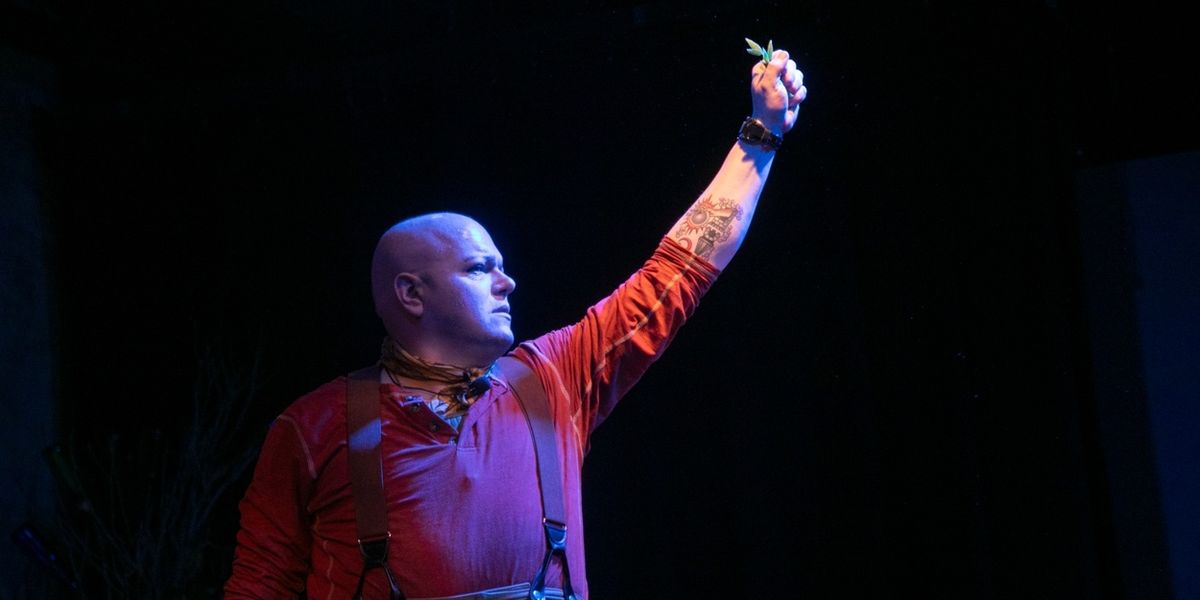
Bankerd, a clean-headed and muscular performer, with pugilistically bare forearms during his all-important “Friends, Romans and Countrymen” oration (see the production photo above), gives us a tough Antony, but not merely tough. His command of the emotional range that Antony must run through in that oration’s brief space is astonishing. Antony has to be shown to be in touch with his sensitive side too. We watch the speech to see both sincerity and even vulnerability (Antony genuinely mourns Caesar) and manipulative artifice (Antony cynically keeps one eye on the effect of his emotional display on an impressionable crowd, not to mention keeping track of how effective it will be in undermining Brutus and the rest of the conspirators). The sheer physical rendering of the conflict between Antony’s two sides makes Bankerd’s rendition stand out.
I should also mention Shiobhan Beckett as The Soothsayer. One innovation of Fogler’s that I liked here was giving The Soothsayer some Appalachian voodoo to do. As a kind of inscrutable medicine woman Beckett was intriguingly unpredictable; we’ve seen The Soothsayer before, but never this one.
I’ve mentioned the ambition of this performance; let me go further. We’re talking a community theater production with a cast of 16 plus a band, performing on a well-thought through and -crafted set created by three of the principal actors (Bankerd, Norris, and adaptor/director Fogler, who also turns in a smaller but important role as Calphurnia, Caesar’s wife), in a show with a running time of nearly 2 hours, 45 minutes (including an intermission), in a small theatrical house … that’s commitment.
This is a group to keep on watching, starting here. And note that there's only a week to catch this show.
Caesar/Americana, adapted from a play by William Shakespeare and directed by Hannah Fogler, presented by Mott & Bailey, prod., through March 21 at Fells Point Corner Theatre, 251 S. Ann Street, Baltimore, Maryland. Tickets $20-$30, available at www.motteandbailey.org. Caesar / Americana depicts on-stage violence of many forms including: violence against a queer Black person, riots, assassination, and war. This production makes use of theatrical effects including haze/fog, flashing lights, loud sounds, and very loud music.
Production photo supplied by motteandbailey.org.
|
Classic Theatre of Maryland presents "SHE STOOPS TO CONQUER" Classic Theatre of Maryland (3/04-3/21) |
|
Godspell Bowen Theater at Maryland Hall (3/05-3/21) |
|
It's a Wonderful Life: A Live Radio Play Live Arts Maryland (11/20-12/05) |
|
The Moors Maryland Ensemble Theatre (2/12-3/07) |

|
Laura Benanti: Nobody Cares Baltimore Center Stage (9/18-9/26) |
|
TWO TRAINS RUNNING Theatre Morgan (10/19-10/30) |

|
The Rocky Horror Show Iron Crow Theatre (10/16-11/07) |
|
A Christmas Carol Olney Theatre Center (12/03-12/03) |
|
The 39 Steps Maryland Ensemble Theatre (5/21-6/13) |
|
Classic Theatre of Maryland presents "HAMLET" Classic Theatre of Maryland (10/01-10/18) |

Reader Reviews
To post a comment, you must register and login.