
“Gold Diggers” Frauds or Icons?July 19, 2018Upon learning that Elliot's new partner is a 20-year-old named Trey, Jodi and Benjamin immediately mistrust his motives. Trey swears that he loves Elliot regardless of their difference in age, but Jodi and Benjamin are convinced that Trey is only after Elliot for his money and lavish gifts. Trey's role in this play may seem familiar -- his storyline draws from the archetype of the Gold Digger, traditionally portrayed in literature, film, and music as a young woman who dates or marries rich men for their money alone. As a young man rather than a young woman, Trey is an inversion of the traditional type, but the implications of calling him a gold digger remain much the same. The term is used colloquially today in a generally derogatory manner against those who are seen as dating only for mercenary purposes, but the history of the phrase has more folds than one might think.
Invisibility of Middle Aged WomenJuly 16, 2018In Skintight, both Jodi, a woman in her mid-40s, and Elliot, her 70-year-old father, grapple with what it means to age in modern society. Elliot, a successful fashion designer and businessman, is in a relationship with a much younger man, while Jodi, a lawyer, is dealing with the emotional fallout of her husband leaving her for a much younger woman.
Interview with Actress Idina MenzelJuly 9, 2018Education Dramaturge Ted Sod sits down with actress Idina Menzel to discuss her character in 'Skintight' and what inspires her as an artist.
When Men Became Sex ObjectsJuly 5, 2018Until the 1980s, mainstream culture and advertising often cast women as sex objects, and framed their images to appeal to the male gaze. Historically, men in advertisements were represented as figures of authoritative masculinity (such as the Marlboro Man), but rarely sexualized.
The Objectification of Women in MediaJuly 2, 2018On June 16, 2018, Joshua Harmon spoke about Skintight with education dramaturg Ted Sod as part of Roundabout Theatre Company's lecture series.

The Importance of Henry CarrJune 14, 2018Unlike the other the major characters in Travesties, the real Henry Carr holds little claim to fame. Stoppard learned about Carr and became intrigued by a real-life incident mentioned in a biography of James Joyce. In Zurich during World War I, Joyce worked with an English theatre to produce Oscar Wilde's The Importance of Being Earnest. Joyce cast a mix of professionals and amateurs, including Henry Carr, an Englishman living in exile, as the lead role of Algernon. Apparently, Carr gave an enthusiastic performance, but afterwards, a small financial dispute with Joyce escalated into dueling lawsuits. Carr sued Joyce for reimbursement on clothes he bought as his costume; Joyce counter-sued Carr for money owed on five tickets. Carr lost his case and was further punished by Joyce when he named an unlikeable character in Ulysses after Carr. Stoppard knew little more about the real Henry Carr while writing Travesties; however, after its 1974 London premiere, a surprise letter from Carr's widow provided more details of the real man's life.
Tristan Tzara and DadaJune 14, 2018Born in Romania under the name Samuel Rosenstock, Tristan Tzara was introduced to the Symbolist art movement by poet Adrian Maniu. Symbolism stood in opposition to realistic art, emphasizing emotions, feelings, and ideas, and often featuring mystic or religious imagery. Together with poet Ion Vinea and painter Marcel Janco, Tzara founded the magazine Simbolul shortly prior to the First World War, when he was just 16 years old. It was during the War that he moved to Zurich, co-founding the Cabaret Voltaire, which became known as the 'cradle of Dada.' Featuring experimental forms of performance, poetry, art, and more, the Cabaret Voltaire was where early Dadaist manifestos were read, many of which were written by Tzara, who could often be spotted sporting a monocle and suit, or even with 'DADA' written on his forehead.
The Travesty of TravestiesMay 21, 2018At first glance, Travesties may seem to be a nearly impossible work to crack. Traversing literary styles and references, delving headfirst into the history of World War I and the Russian Revolution, and pitting dense intellectual arguments on the meaning and purpose of art against each other, Tom Stoppard's absurdist and avant-garde play can seem hopelessly out of reach for anyone who isn't an expert in these particular topics. But Stoppard has created a roadmap that allows his audiences to untangle the characters, plotlines, and references of Travesties as they watch, and his first clue for doing so is provided in the title of the play itself. What exactly, then, is a travesty?
Interview with Travesties' Sara TophamMay 21, 2018Education Dramaturge Ted Sod sits down with actress Sara Topham to discuss her role in Travesties and her return to Roundabout Theatre Company.
Travesties Design StatementsMay 9, 2018Tim Hatley/Costume and Set Design
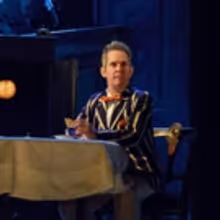
My starting point as a designer is always to read the play, and in the case of Travesties, which is a complex play, it required careful reading and thought to begin to understand the threads and layers of the writing, and talking closely with the director, Patrick Marber. It seemed to me that our production needed a strong yet simple approach to the design. The shifting of time and location is clear in the writing and did not need physical transitions to interrupt the flow. Our space is both present and memory, library and apartment, and allows for characters to appear and disappear within. The costumes are rooted strongly in the period, and their palette was developed in tandem with the development of the space. Cross references to Oscar Wilde's play, The Importance of Being Earnest, were an enjoyable anchor to designing the play.
Bobbie Clearly Interview with Ethan DubinMay 7, 2018Ted Sod: Tell us about yourself: Where were you born and educated? When and why did you decide to be an actor? Did you have any teachers who had a profound influence on you?
Bobbie Clearly Designer StatementsApril 4, 2018Arnulfo Maldonado/Set Design
Bobbie Clearly by Alex Lubischer is exciting in its structure and unique storytelling -- I was immediately struck by how engaging the interview format can feel within a theatrical context. What is the setting for such a world? In the film/documentary version of this play, these subjects would be interviewed against a static background. But this play spans both various locations and time.
Corn DetasselingMarch 29, 2018What is corn detasseling?
Every corn plant has both male and female parts-the tassel and the silk, respectively. Detasseling is the process of removing the male parts of some rows in a cornfield in order to create strictly female plants, which can then be pollinated by the remaining male plants in the field. While mechanical pullers are used to pull as many tassels as possible, they typically only get about 70% of them, meaning that the rest have to be pulled by hand.
AMY AND THE ORPHANS Design StatementsMarch 27, 2018Amy and the Orphans is full of design challenges. For starters, it is a road trip play. Lindsey Ferrentino has written a play that has 18 scenes in 13 locations and in which there is no home base. Every location she describes is transient and impersonal, and most of the scenes take place in public locations. As a designer, the question becomes why?

From the Artistic Director/CEA Todd Haimes: TRAVESTIESMarch 19, 2018When I saw the Menier Chocolate Factory's production of Travesties on the West End last spring, I was stunned. Director Patrick Marber had captured Tom Stoppard's sprawling, absurdist epic with a captivating electricity that I had never before seen. Embracing the full power of Stoppard's explosively theatrical dive into the past, Patrick harnessed every bit of the play's sharp hilarity, keen topicality, and, most of all, boundless thrill. I knew that I needed to make Marber's triumphant and endlessly entertaining production part of our 2018-2019 season and give Travesties its first-ever Broadway revival since its 1975 debut, which won the Tony Award® for Best Play. A vortex of caricatural historical figures, clashing political philosophies, and radical artistic movements, Stoppard's early masterwork dismantles just about every convention of the Western stage and reassembles their parts into an entirely original theatrical machine. There's no simple narrative thread in this play, no strict adherence to the laws of our physical world, no clear divide between fact and fiction -- and no end to the tenets of artistic tradition that this whirlwind of a comedy deconstructs.