I received my Master of Arts Degree in English from Memphis State University and worked as an English instructor at Christian Brothers High School from 1971 until 2007. When I retired, I was Chairman of the English Department and moderator of the Film Society. I have always been involved in the arts, and upon retirement I pursued my interests in painting (watercolors, acrylics, oils) and sketching (charcoal, pen and ink, graphite), ultimately resulting in a one-man show at WKNO Gallery in 2013. Having taught American, British, and World Drama, I have always had an interest in local theatre; and my reviews of plays at such venues as Theatre Memphis, Playhouse on the Square, and Circuit Playhouse have been posted on FACEBOOK and CALLBOARD in Memphis.
In Terrence McNally's MOTHERS AND SONS, now playing at Theatre Memphis' Next Stage, there's something out of place in Jack Yates' smart New York apartment set -- and it has nothing to do with furniture. Rather, it's the presence of Karen Mason Riss's 'Katharine,' who, unannounced, has flown from her home in Dallas to visit 'Cal,' the one-time lover of her long-deceased son 'Andre.' Her anomalous presence is not unlike situating Archie Bunker's armchair in the foyer of the Biltmore. She has arrived with baggage: Not what she uses for travel -- but what she has carried within herself for the last twenty years; and of all times, it's the Christmas season -- and, clutching her fur coat as if it were some time of impenetrable armor, she comes across like some unwelcome Ghost of Christmas Past.
A GENTLEMAN'S GUIDE TO LOVE AND MURDER must have been a 'labor of love' for Robert L. Freedman, who wrote the book: After all, it is derived from the brilliant 1949 British comedy classic KIND HEARTS AND CORONETS, which benefited immeasurably by performances by Dennis Price, Joan Greenwood, and -- most especially -- the brilliant Alec Guinness, whose impersonation of all the victims was a tour de force. Yet, A GENTLEMAN'S GUIDE, with wickedly droll music and lyrics by Steven Lutvak, is a deliciously poisonous bon bon all its own. It's as if Joseph Kesselring's ARSENIC AND OLD LACE had somehow melded with Oscar Wilde's THE IMPORTANCE OF BEING EARNEST, and somewhere 'up there' (or 'down there,' whatever the case may be) writers like Roald Dahl and directors like Alfred Hitchcock must be smiling at the production currently delighting audiences at the Orpheum.
Throughout Sunday's matinee of Sharr White's intensely watchable THE OTHER PLACE at Circuit, for some reason I kept thinking of Edgar Allan Poe's 'A Dream Within a Dream' and, particularly, of these lines: 'All that we see or seem / Is but a dream within a dream. / I stand amid the roar / Of a surf-tormented shore, / And I hold within my hand / Grains of the golden sand -- / How few! yet how they creep / Through my fingers to the deep, / While I weep -- while I weep.' THE OTHER PLACE, ably directed by the always dependable Dave Landis, is somewhat constructed like a Chinese puzzle box. Like the main character, a drug company scientist named 'Juliana Smithton' (who, in turn, is married to 'Ian,' an oncologist), the audience is continually challenged with questions of what is real and what is not.
In his Sonnet 116, William Shakespeare wrote, 'Let me not to the marriage of true minds admit impediments' -- and impediments there are aplenty in A.R. Gurney's oft-performed LOVE LETTERS, which Director Anthony Isbell and a sterling, rotating cast of three couples has staged at the intimate Germantown Community Theatre. It's a St. Valentine's gift to the community, to be sure; and as soon as you enter the atmospheric lobby, pay heed to the scattering of deep-red rose petals and the framed quotations of letters from famous lovers -- everyone from John Keats to (even) Oscar Wilde to Johnny Cash. You'll be doing yourself a disservice if you don't, as they establish a real mood for what takes place on stage.
Let's see now -- older married man with mistress, seething ex-wife, resentful and mistrustful offspring -- where was Dr. Phil? Alas, nowhere in sight in Chinon during the Christmas of 1183, as the powerful English king Henry II has released his imprisoned wife (and sparring partner) Eleanor of Aquitaine and allowed her admittance to a family gathering (along with his mistress Alais). Is it for personal or political reasons? Perhaps a bit of both? Henry, great in stature and accomplishments, has to decide which of his sons (none of whom will historically 'measure up') will become the future King of England. It's a Lear-like choice, and poor Henry has 'slim pickings.' With the oldest son dead, the three remaining are a snarling, disgruntled lot -- in one corner (Eleanor's), there's the pillage-prone Richard (later Richard the Lionhearted, who will spend most of his time abroad); in the other (Henry's), there's the pimply, unwashed, and feckless John (later, a famously unpopular king who will be forced to capitulate to baronial pressure and sign a little document known as the Magna Carta). Oh, yes, and then there's the ignored, Machiavellian Geoffrey, mistrusted by both parents and willing to play anyone on the human chessboard.
Now that Peter has returned to Neverland and the good citizens of Tuna have returned their yard ornaments to their garages and attics, Green Day's AMERICAN IDIOT has seen to it that all the kiddies need to be tucked away in bed: Playhouse's electrifying production of the punk rock musical odyssey, with Book and Lyrics by Billie Joe Armstrong and Book by Michael Mayer, has traded in pirates for pushers; and the result must have Rodgers and Hammerstein scratching their heads in musical heaven and asking the question, 'What in the name of Bali Hai is going on here?' However, if like me, you're primed for some stimulating adult entertainment, you'll find more than your toes tapping in this 'in your face' assault on the idiocy that is America -- that is we the audience.
Evan Linder's BYHALIA, MS, a winner of the 2014 NewWorks@The Works Playwriting Competition, came about at an interesting time. I had recently heard an interview on NPR featuring Alabama-born Walton Goggins, currently co-starring in Quintin Tarantino's THE HATEFUL EIGHT. Goggins, a gifted actor, made the point that he did not wish to perpetuate the tired old 'let's paint Southerners as uneducated rednecks' point of view that all too often emerges in Hollywood films about the subject; having appreciated his point, I was initially wary of a work about racism entitled BYHALIA, MS. The South, and Mississippi in particular, are easy 'punching bags' for liberals; and yes, the historical past can surely produce numerous examples. There's no way, I thought, that Evan Linder should ever run for Mayor of Byhalia, a small Mississippi town not far from Memphis. However, after seeing the play, I realized that I was guilty of preconceived notions and misconceptions -- a shortcoming shared by black and white characters alike in Mr. Linder's probing, ambitious work.
There was a moment tonight in the Orpheum's presentation of NEWSIES that I envisioned the entire production as an animated feature -- and why not? There was the infectious music of Alan Menken, who long ago set the 'gold standard' for the resurgence of Disney animation beginning with THE LITTLE MERMAID; there was, too, the 'underdog' hero ('Jack Kelley,' played with panache and charisma by Joey Barreiro), who serves as a point of inspiration for a horde of ragtag 'newsies'; and instead of an 'Ariel' or 'Belle,' there was 'Katherine,' the spirited young 'girl reporter,' who, with her independence and ingenuity, could fall right in line with the other young heroines of Disney films.
During the Holiday Season, theatregoers looking to dodge 'fairy dust' and seek for something beyond the shadow of the Ghost of Christmas Future might as well have a Christmas stocking with a hole in it. Occasionally, the 'grownups' might find something like the dark and challenging THE SEAFARER, which played to meager audiences a few years back at Circuit; despite an exceptional cast (Tony Isbell, Jim Palmer, et al) and a fine production, this beautiful little play failed to bring in the audiences (it was one of my favorite theatrical experiences). The result is that PETER PAN, A TUNA CHRISTMAS, A CHRISTMAS CAROL, and all their Yuletide ilk pretty much dominate the stages -- and why not? They are delightful experiences, eliciting all the joy and sentimentality one craves as the 25th approaches. However, for those who gag on eggnog, Playhouse on the Square has squeezed out a few performances of I LOVE YOU, YOU'RE PERFECT, NOW CHANGE, the 'slice of life' musical with Book and Lyrics by Joe DiPietro and Music by Jimmy Roberts. Ironically, it's Playhouse's 'gift' to those who prefer to leave their Christmas spirit at home.
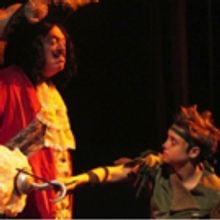
Whether it's fruitcake or eggnog, people love their traditions during the Holiday Season -- and you'd better not disappoint. Memphians are accustomed to cranky 'Ebeneezer Scrooge' hoarding his coins at Theatre Memphis, and in midtown, we're resigned to A TUNA CHRISTMAS at Circuit and PETER PAN at Playhouse on the Square. Just last year, I had seen two -- yes, TWO -- productions of the latter: The version done live on NBC (with an off-center, almost 'sleep walking' Christopher Walken as 'Captain Hook') and the marvelous version directed and choreographed by Jordan Nichols and Travis Bradley at Playhouse. The Playhouse featured players were the unique Morgan Howard (as 'Peter') and the versatile David Foster (as a 'Jack Sparrow'-like 'Hook'); they were alternating the roles with Carly Crawford and Bill Andrews. I am happy to report that I finally was able to see Ms. Crawford and Mr. Andrews assay those roles, and they were equally inspired casting choices (but more about that later).

Produced by the Women's Theatre Festival of Memphis, Natalie Parker-Lawrence's A BOX OF YELLOW STARS is a play inspired by true events -- one man (we never know his name) rescues fifteen women from the horrors of the Holocaust by . . . marrying each one and taking her beyond the reach of the Nazis. I only had a sketchy knowledge of what Ms. Parker-Lawrence was attempting in this play, and knowing practically nothing else, I questioned what her approach would be. (At one point I imagined a grim line-up of fifteen women relating horrific experiences, and that would have been a torturous experience indeed.) What she has accomplished is a surprisingly balanced piece: She wisely utilizes humor and dry wit to leaven her characters' painful, sometimes long-buried recollections.
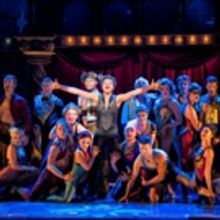
There are the warhorse musicals of Rodgers and Hammerstein, Cole Porter, and Irving Berlin; there are the lavish productions befitting Phantoms in opera houses and French revolutionaries and revisionist fairy tales (and you know the ones I mean); there are the Disney powerhouses; and . . . there are musicals of a quaint, mind-nudging nature that don't quite fit into any category. Certainly THE FANTASTICKS comes to mind, and -- at least in the previous productions I have seen -- Stephen Schwartz's PIPPIN. Somewhere in my video collection is a filmed version of the musical with William Katt, and just a few years ago PIPPIN was the first musical staged at the shiny, new Playhouse on the Square (with Alvaro Francisco stepping in for a sidelined Jordan Nichols). I sometimes think that small-scale musicals are better suited to venues less grand than the Orpheum; I needn't have worried, however, as PIPPIN has acquired the kind of theatrical, Cirque du Soleil-style atmosphere that perfectly suits the show's opening number, 'Magic to Do.'
People shuttle back and forth at an airport, dragging their luggage behind them. A preoccupied 'Rider,' texting away, impatiently boards an uber cab as his Indian driver eagerly greets him -- and enthuses that they were almost destined to meet. As the passenger, initially annoyed at the driver's prattling, hopes in vain for silence, the driver recalls a seemingly unrelated memory from his childhood; that memory recalled then stirs within the Rider a like memory; and if you have ever experienced the loss of a parent, you, too, become a part of their connection. Thus, 'Uber,' the short piece that opens Jerre Dye's SHORT STORIES at VOICES OF THE SOUTH,, becomes, as 'Tom' in Tennessee Williams' THE GLASS MENAGERIE might call it, a 'memory play.'
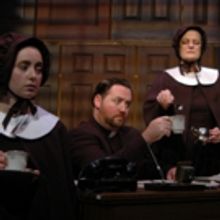
The set for Theatre Memphis' Next Stage production of John Patrick Shanley's Pulitzer Prize-winning DOUBT impresses with its austerity: The walls and doors are of rich,dark wood; the red leather chair behind the principal's desk and the furniture in the room are carefully arranged; everything seems compartmentalized. Moreover, St. Nicholas School is in the apparently firm hands of 'Sister Aloysius' (yes, it rhymes with 'suspicious'), and wary she is. The time is the early 1960's, shortly after the unsettling assassination of President John F. Kennedy. St. Nicholas has accepted its first black student, 'Donald Muller,' a lonely and isolated thirteen-year old altar boy of 'the new priest on the block,' 'Father Flynn,' who, with his tweaking of tradition and progressive inclination have made him a threat to Aloysius' tightly run ship. As Bob Dylan famously sang, 'The times they are a-changin' -- but, as far as the straight-backed, bespectacled principal is concerned, 'not at THIS school.' For Aloysius, art and music classes are a perfect waste of time; at first glance, she is a stereotypical 'old school' nun. However, Pulitzer Prizes are not awarded to writers who resort to stereotype, and Mr. Shanley's script is tight, subtle, and full of surprises.
Probably the best (of the few) productions of TITUS ANDRONICUS was the 1999 film directed by Julie Taymor. Anthony Hopkins, donning his apron from SILENCE OF THE LAMBS, was a witty choice as 'Titus,' and Jessica Lange, years before jumping with abandon into the excesses of AMERICAN HORROR STORY, was a stunning 'Tamora, Queen of the Goths.' The visuals, typically 'Taymor,' were imaginative and impressive. Yet, by the film's conclusion, one thing was obvious about Shakespeare's TITUS (wildly popular in its day, but largely dismissed by modern audiences): The Bard jettisoned poetry for gore and special effects. That is also the direction that John Maness and his eager group of actors has taken New Moon Theatre Company's latest production at Theatre Works.
The set alone is testament as to why Theatre Memphis invariably is recognized during awards season for its designers -- two dominant windows admitting shifts in light as darkness falls, steps descending into a blind woman's apartment (steps on which menacing characters will align themselves as they focus on their sightless victim), a refrigerator that will become a hiding place, a source of danger, and a shield of protection. Frederick Knott's chiller (adapted by Jeffrey Hatcher and suspensefully helmed by Director Tracey Zerwig Ford) is a tense and understated October alternative to the bucket of blood drenching poor CARRIE just across town at Circuit Playhouse.

From what I've gathered, the original production of CARRIE THE MUSICAL would have been a dream project for Bialystock and Bloom, THE PRODUCERS: There's something eyebrow-raising about taking Stephen King's novel CARRIE and drenching it - not just in blood, but in music and lyrics. Evidently, Michael Gore and Dean Pitchford felt up to the task, and with a book by Lawrence D. Cohen, the musical version became a theatrical reality. However, it's a 'slippery slope' they tread: Do you play something like this 'straight' - or do you decide to go in the direction of 'camp'?
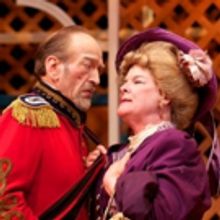
Interestingly, Playhouse on the Square has opted to produce Thornton Wilder's THE MATCHMAKER rather than HELLO, DOLLY, the legendary musical that it spawned - and therein lies both the blessing and the curse: There are so many lines here that served as song cues that the specter of Jerry Herman's 'ear-candied' score keeps hovering over the play. To add to the dilemma, the ever-arranging 'matchmaker' herself is none other than that talented musical performer Ann Sharp (surprisingly making her theatre debut at Playhouse): Because she doesn't have the opportunity to use that particular talent, and because those darned Herman songs keep popping up in the mind, THE MATCHMAKER might prove frustrating for those familiar with its melodic offspring. That's too bad, as Herman's score is rather like some pushy first grader who breaks in line; without it, the audience is left with . . . a fine romantic comedy, filled with mistaken identities and matches and mismatches - and more than just a touch of Wilder's warm , incisive writing.
offers minimal dialogue -- and a memorable performance.

Videos