

Review: THE LIGHT IN THE PIAZZA at Opera Theatre Of St. Louis
Plays at Opera Theatre of St. Louis through June 28
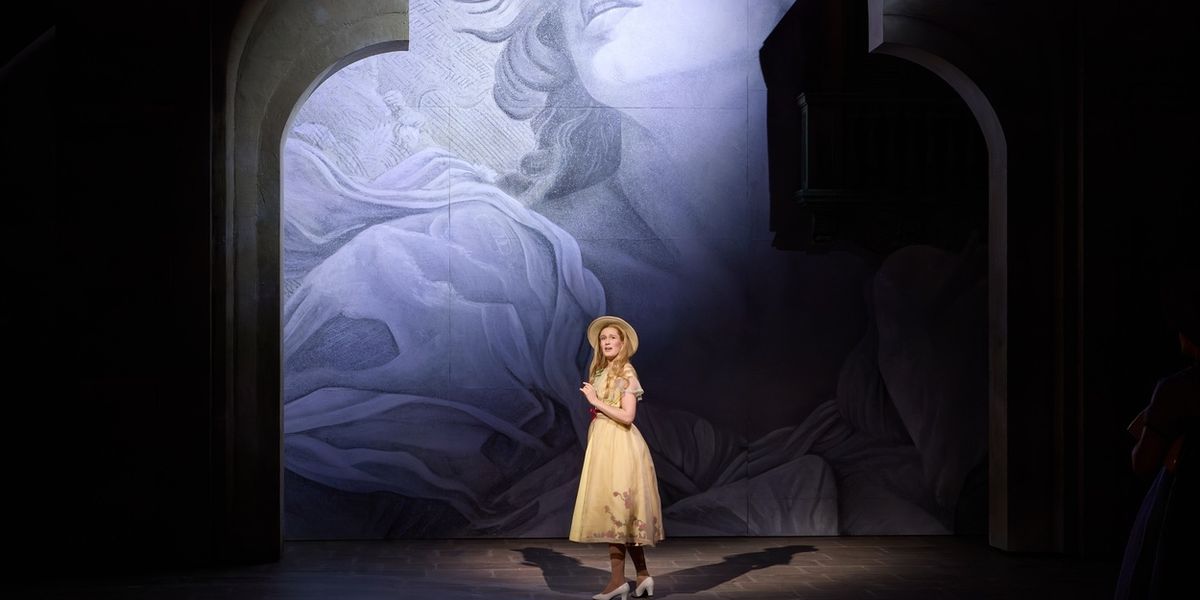
Bright young love! Parents disapprove!
A new take on an old, old story.
Opera Theatre of St. Louis continues its fifty-first season with (would you believe?) a Broadway musical! But just as the first show of the season, Pirates of Penzance, was, musically, something rather more than an operetta, The Light in the Piazza is musically rather more than the usual Broadway musical.
Lonely American woman finds true love in sunny, romantic, magical Italy! It’s an all-too-familiar trope in films. It’s happened to Kate (and Audrey) Hepburn, to Marisa Tomei, to Renée Zelwigger, to Miranda Richardson and others.
The Light in the Piazza is a 2003 musical based on a novella by Elizabeth Spencer (1960) and a movie (1962). When I first saw this show, eight years ago, I thought it was going to be that same old tender but familiar story.
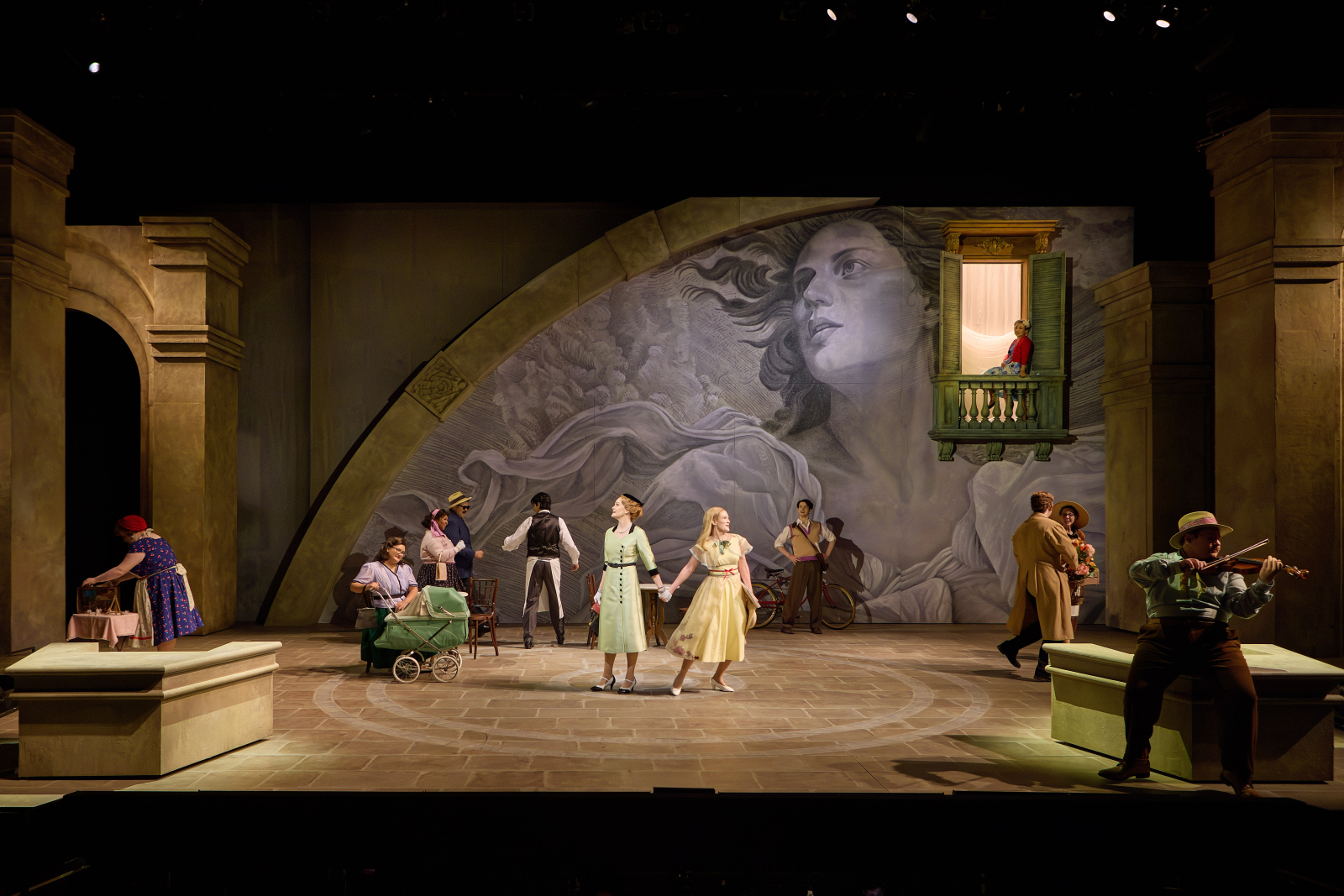
We find ourselves in Florence somewhere in the ’50’s. Margaret Johnson and her daughter Clara are on vacation from their affluent life in Winston-Salem. They’re doing something of a “Grand Tour”. Clara meets a handsome young Fiorentino. She falls in love with him, and he with her. Mother disapproves.
But then we learn that there is some secret about Clara. She appears to be only a rather brattish and immature young woman. She’s sweet but given to temper tantrums when denied her way. She can be gauche in public settings. We learn that there is a sad reason for her behavior: a head injury as a child left her mentally and emotionally impaired. Margaret, the mother, finds herself faced with a poignant moral dilemma. It’s the sort of show that makes you talk about it for a long while afterward.
Should the damaged Clara be allowed to marry Fabrizio? That’s the question that haunts Margaret—and it will haunt you too. Does he realize her limitations? Is it fair to him and his family? But can a mother deny a young woman the love of her life? Come and see. You decide.
The set by Cameron Anderson is gorgeous! At the back a vast Renaissance painting of an angel seems to bless this space. Huge marble columns and arches abound, and they separate and move about the stage to configure many different settings.
It’s a very strong cast. The central role is the mother, Margaret. She is sung by Kate Baldwin—a multiple Tony, Drama Desk, and Outer Critics Circle nominee for performances in Broadway shows. She is so right for the role of Margaret! She’s singer enough to master this beautiful score, and actress enough to movingly reveal the heart in this troubled woman. And she gives her speech a touch of lovely “Nawth Caralahna”.
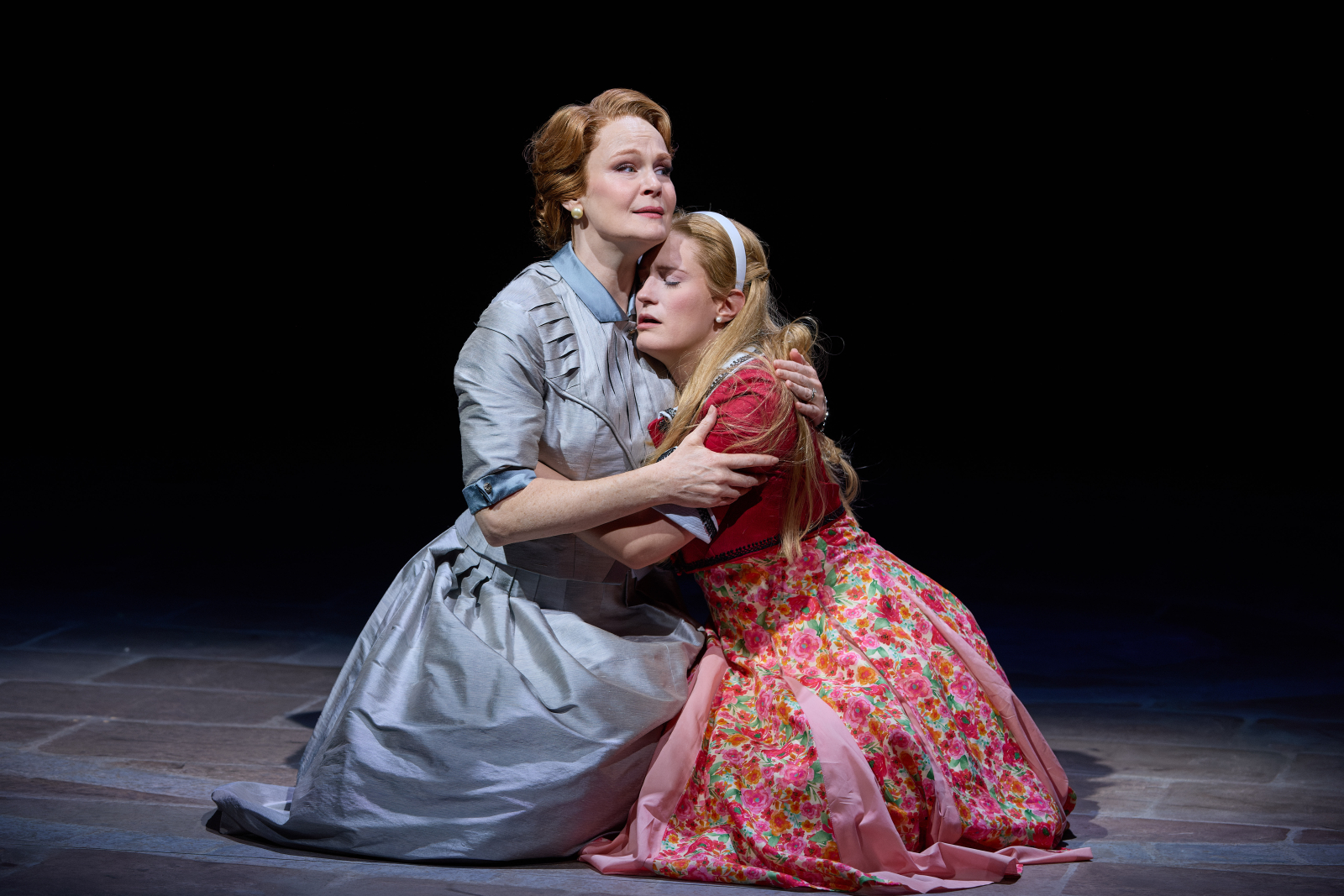
Clara is sung by the lovely Katrina Galka who premiered at OTSL as Isabel Stanley in Pirates of Penzance (2013). She has sung opera at Dresden, Hamburg, Zurich, Milan (La Scalla). Ms. Galka gives Clara a true, sweet and agile voice that’s perfect for these songs of young love, young anger, young panic. She deftly balances the innocence and the recklessness of this fragile girl.
Fabrizio, Clara’s love, is sung by Roy Hage, and his is a stellar performance. Handsome, graceful, and with vocal power and diction to reach the last seats.
Both Hage and Miss Galka fledged their operatic wings in OTSL’s Gerdine Young Artists program.
This Fabrizio and this Clara are beautifully matched. Both characters are innocents caught in the magic of love-at-first-sight. (We adults in the audience should just swallow our doubts and accept this.) Even the moment of their first meeting is magic; in a grand square, in that charmed Florentine light, the wind whisks Clara’s sun hat off and away into the sky. A moment later this lovely young man returns it graciously to her.
The Naccarellis, Fabrizio’s family, are an adorable, complex incarnation of what it is to be Italian.
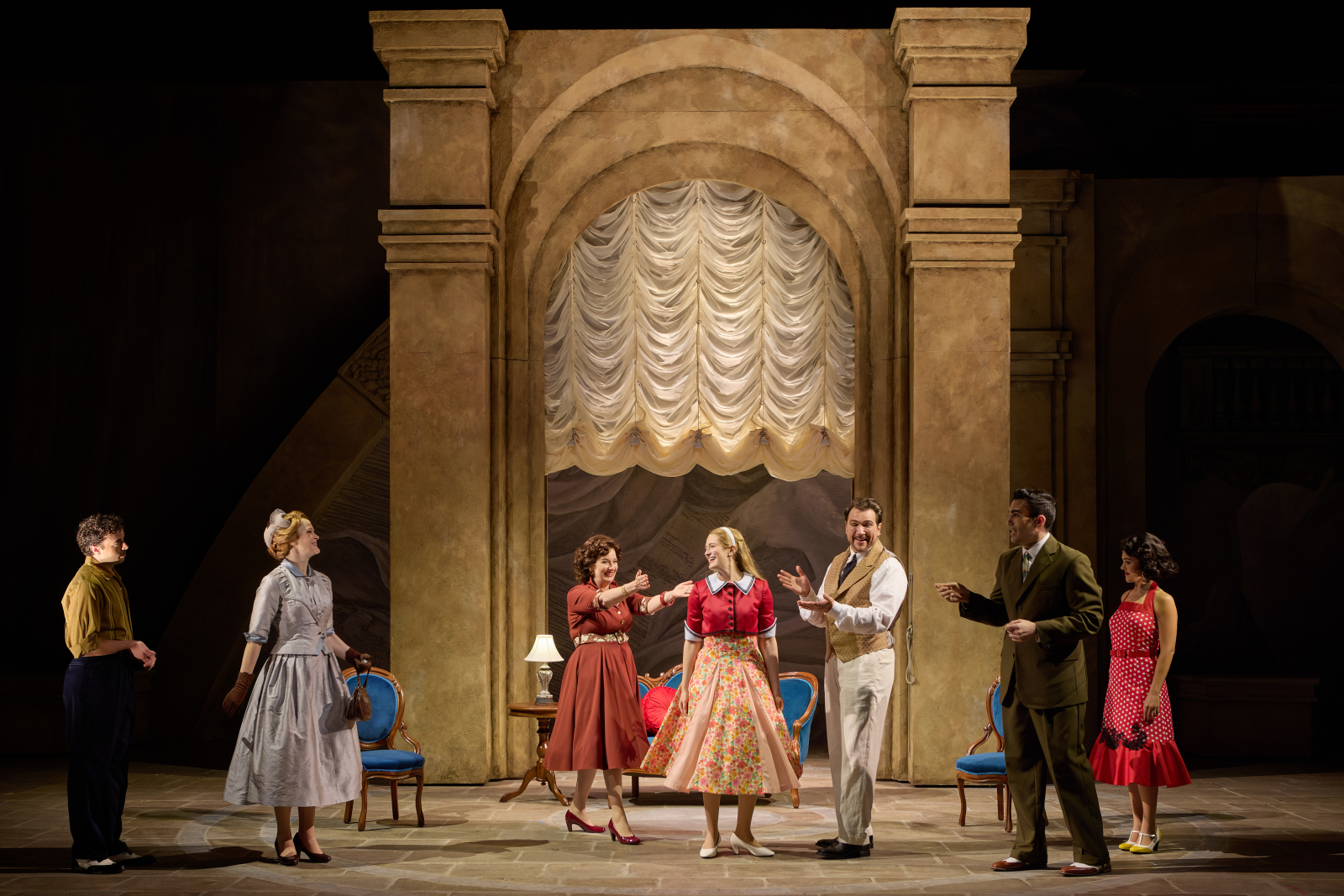
Paolo Szot, Roy Hage, Kelly Guerra
Papà is sung by Paulo Szot, who is a Tony winner and has sung at The Met, La Scalla, the Paris Opera and in Australia. He gives this pater familias just a little swagger, but he has such an open heart. His warming relationship with Margaret is gentle, and it flowers into a most lovely duet as they chat about their children’s future.
Mamma Naccarelli is sung by St. Louis favorite Debby Lennon, who is familiar from her many fine performances on both opera and musical stages here. She fills the role with wit and intelligence.
Fabrizio’s brother Giuseppe and his wife Franca are often embroiled in jealous hand-waving arguments over his womanizing. Joel Clemens (a Gerdine Young Artist) makes Giuseppe macho and assertive but a little feckless. He gives Fabrizio a stylish and energetic dancing lesson.
Kelly Guerra makes Franca a fiery force of nature. When her frustration with Giuseppe’s roving eye reaches the boiling point she, to spite him, fiercely kisses the nearest male—which happens to be young Fabrizio. Sparks fly from all directions!
At one point Margaret telephones her husband, Roy, who is back in Winston-Salem. Roy (a non-singing role) is played by one of St. Louis’ most gifted and most professional actors—Michael James Reed. He nails it!
There are lovely, unusual theatrical devices, the most significant of which is that several scenes among the Naccarellis are done in Italian. Supertitles are not used, nor are they at all needed. We see, we know exactly what is transpiring; titles would just be a distraction. What’s more this profoundly Italian family seems to carry on their emotive conversations in opera. There are veritable arias, quartets, even an octet flying around among them. It’s all an Italian stereotype, of course. But it’s a gloriously successful one. And it’s not just a gimmick: it underscores the differences between the Italian family and the American one, and it points up their difficulty in communication. Do the Naccarellis mistake Clara’s idiosyncrasies for mere language problems that will disappear with fluency?
Once, late in the evening Signora Naccarelli steps out of the scene to address the audience. She really speaks no English but nevertheless uses English to translate for us what is being said in Italian—it’s just so important. This leads into a beautiful song about “Risk”; It is vital to be willing to take a risk—in love, and in life in general.
Musically there is occasional use of vocalise—wordless singing. This is wonderfully effective in a rapturous lyrical duet between the young lovers. Later vocalise fills that most touching scene between Clara’s mother and Fabrizio’s father as they take a quiet walk to discuss the wisdom of allowing the wedding to go forward.
The Light in the Piazza won Tony awards in 2005 for best score and best orchestration.
The score is luminous. It embodies the almost palpable sunlight that bathes this story. The music often shimmers impressionistically, like Debussy or Fauré. It enlightens, it awakens, it reveals possibilities. The novella’s author, Elizabeth Spencer, met her own husband in Italy. She sees Italy as a psychological landscape.
Composer Adam Guettel is the grandson of Richard Rodgers and the son of Mary Rodgers (who composed Once Upon a Mattress). As a teen he was mentored by Stephen Sondheim. He abandoned his early goal of playing bass in a rock band to venture into opera. His strangely beautiful Floyd Collins is, I think, the world’s only spelunking opera. (New Line produced in 1999.)
In Light in the Piazza composer Guettel puts the American world into strict tempo, while the freer Italians live with changing meters—7/4, 5/8, 5/4, etc. Clara’s moments of panic drift into atonality.
Guettel as librettist? Well Sondheim cannot resist filling his songs with very clever words. Guettel wisely sees that sometimes words are not the only (let alone the best) means of communication.
The musicians in the pit are from the St. Louis Symphony Orchestra. They’re under the baton of Rob Berman, and they are (as ever) quite perfect. They draw every ounce of romance and conflict and fear from this rich score.
But size!
The orchestra at OTSL is about twice the size of the Broadway orchestra. I’m not sure if that’s needed. Even with amplified voices (a first, I think, at OTSL) the orchestra occasionally dominates. This is an intimate story.
The most serious “size” difficulty in the production is with the sets. Ms. Anderson’s columns and arches are huge! Quite beautiful, but huge. And they are in almost constant motion
Remember that formula from high-school physics?
F=ma (Force = mass times acceleration)
Well, we see those arches and columns as many tons of fine marble. That sheer mass being moved and moved and moved constitutes an enormous visual force which overwhelms the intimate story being presented by the singers and actors. Clara and her mother are not touring Florence; Florence is touring them. All of this marble-motion is achieved smoothly, but it requires a dozen or so folks to push the marble around. Now this is an intimate story. There are no big "production numbers"; there are no dance numbers; there is no actual chorus (let alone a chorus-line). There are a few small roles and a variety of people going about their lives in the streets. But these good folks are drafted to move scenery—and then, however they’re costumed, we must see them simply as an army of stage-hands.
Costumes by Ulises Alcala place the characters nicely in the ‘50s. The costumes for the principals are all beautiful and stylish. One or two of the passers-by, however, wear things that are oddly just ugly (purple/green/pink/yellow?) and distract from the magical romance of the scene.
Costumes by Ulises Alcala place the characters nicely in the ‘50s. The costumes for the principals are all beautiful and stylish. One or two of the passers-by, however, wear things that are oddly just ugly (purple/green/pink/yellow?) and distract from the magical romance of the scene.
Stage director Chrystal Manich masterfully manages the complex but fluid staging, and helps her actors find every subtlety in this gentle but difficult story.
But overall it's a splendid production. The Light in the Piazza offers you a fine, funny, thoughtful romantic evening. You’ll ponder afterwards. Will Clara and Fabrizio be happy ever after? Well, I think the odds for these two innocents are better than those for Sarah Brown and Sky Masterson at the end of Guys and Dolls.
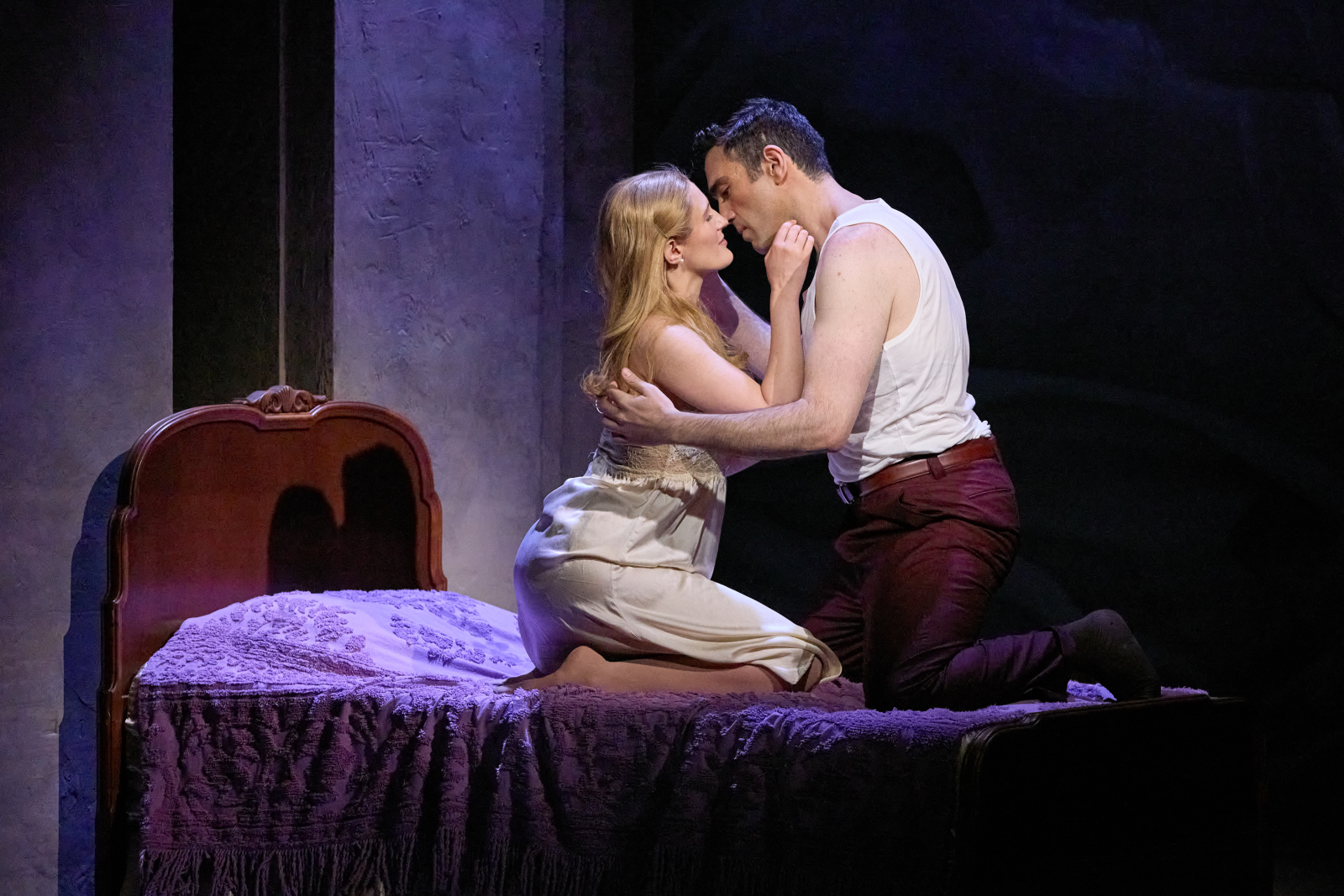
Light in the Piazza plays at Opera Theatre of St. Louis through June 28.
Photos by Eric Woolsey
Reader Reviews

Videos