


Review: Rome Opera’s New FALSTAFF Shows Off Gleaming Cast, Lackluster Production under Mariotti
Director Gürbaca didn’t have an idea for her new version of the Verdi-Boito opera—but it didn’t stop her
I wonder what Arrigo Boito might have done with Shakespeare’s “A Comedy of Errors” or “Twelfth Night.” Because, while he’s best known for his libretto crafted for Verdi from the Bard’s “Othello,” his work on FALSTAFF—based on “The Merry Wives of Windsor” and “Henry IV”—is just as marvelous.
The trouble, of course, is that FALSTAFF is a comedy. The American playwright and wit, George S. Kauffman once said that “satire is what closes on Saturday night.” When it comes to Verdi opera, a similar description might have been in order. Audiences have shown rather a lack of interest in the work, certainly on the US side of the Atlantic, for something that should have been a cause for cheering. Its cardinal sin: Nobody dies in it.
In the new production of the work, which opened at Rome’s Opera House (Teatro dell'Opera di Roma) last week, it didn’t help that director Tatjana Gürbaca didn’t seem to have anything particular in mind in her take on it—nor did she appear to trust Shakespeare enough to play it straight. The result, to put a spin on the title of Pirandello’s famous play, is she gave us 10 characters in search of direction. Neither did she provide much help for Henrik Ahr’s sets with Stefan Billiger’s lighting or Silke Willrett’s costumes.
Luckily, she had a composer of Verdi’s stature, working with a writer as brilliant as Boito to move things along, whether with a plethora of small ensembles or in the distinctive arias. Gürbaca appeared to offer the fine cast little assistance in bringing across the charming (and dramatic, of course) score.
The result: The singers appeared to have been left to their own devices in crafting their characterizations. In spite of that, the experienced cast vocally hit all the high marks (and notes), starting with the superior performance of baritone Luca Salsi in the title role.
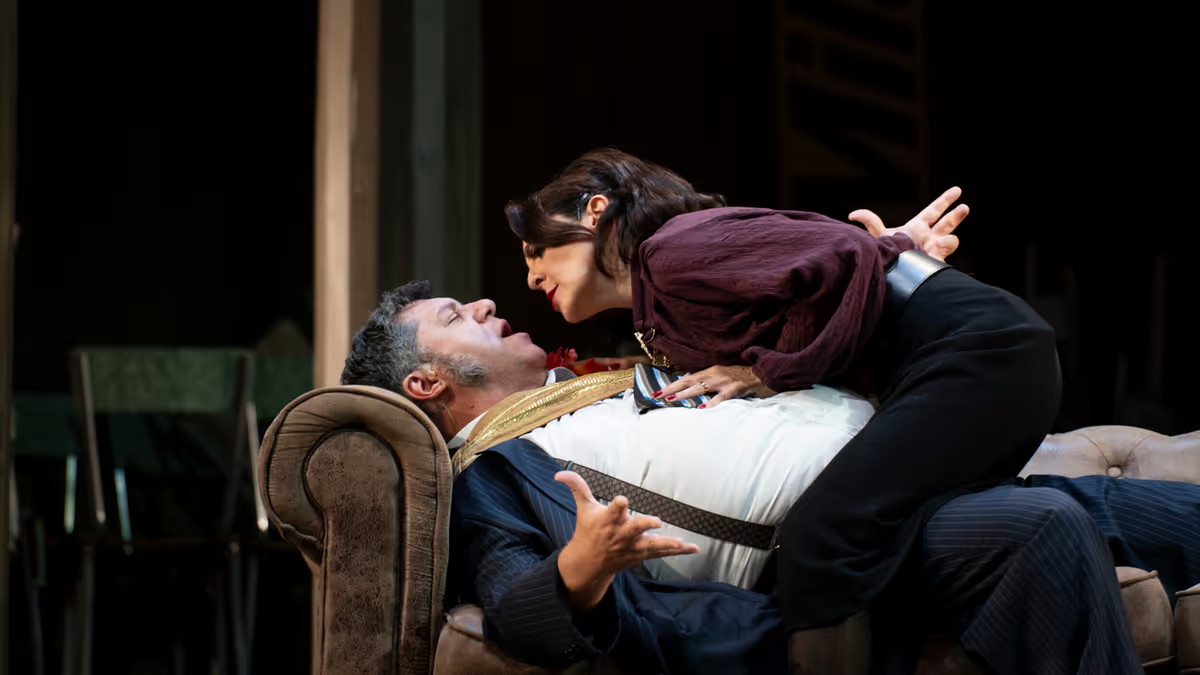
On paper, Salsi may not necessarily seem to have the buffo chops that can sometimes make the character a dizzying wonder. (He’s usually a superior Macbeth, Rigoletto or Scarpia.) Yet he knows how to use his ample, appealing voice to bring forth the gusto that one expects from Verdi’s “big belly” (as the composer referred to him). He also did well in the work’s quieter moments with his “Va, vecchio John” and “Quando era paggio.”
Also high on the list of the performance’s assets was the Alice Ford of soprano Maria Agresta, who sounded gorgeous and was most appealing as a key player among the merry wives. She was most charming in teaming up with mezzo Carmen Artaza’s delightful Meg Page or being protective of her daughter Nannetta, sung by the gleaming, melodic soprano Marina Monzò.
She was also no shrinking violet faced with the jealousy of her husband, Ford (baritone George Petean). Ford is one of the trickier roles in the piece, having to do double duty, with the character called Fontana, who’s supposedly trying to make time with his own wife (Alice) for Falstaff's benefit. Besides being given an outlandish costume, Petean could have used some directorial help in forging his portrayal of an odd role.
Tenor Dave Monaco was in lush voice as Fenton, Nannetta’s chosen partner, in his big solo, “Dal labbro il canto estasiato vola.” Then there was mezzo Violetta Urmana as a game Mistress Quickly, who could hold her own against the high ego of Salsi’s Falstaff. Yet I missed some of the contralto sound that often brings extra fun to the character’s theme phrasing (“Povera donna” or “Reverenza”).
The principals were rounded out by the trio, pros one and all, of tenor Carlo Bosi’s Dr. Cajus (promised by Ford for his daughter), and Falstaff’s sidekicks, tenor Paolo Antognetti as Bardolfo and bass Gabriele Sagona as Pistola.
The orchestra, under Opera’s Music Director Michele Mariotti, turned in a thoughtful rendition of the score, with its rich orchestration, while Chorus Master Ciro Visco kept the opera’s choral forces well in hand.
Caption: Luca Salsi as Falstaff, Maria Agresta as Alice Ford
Credit: Fabrizio Sansoni/Teatro dell'Opera di Roma
Sign up for all the news on the Fall season, discounts & more...

Reader Reviews
To post a comment, you must register and login.