Portent: An Endless Drama of Power and Human Vulnerability
A production in which every audience member recognises their own reality, regardless of country or context.
Written by Molly Peck
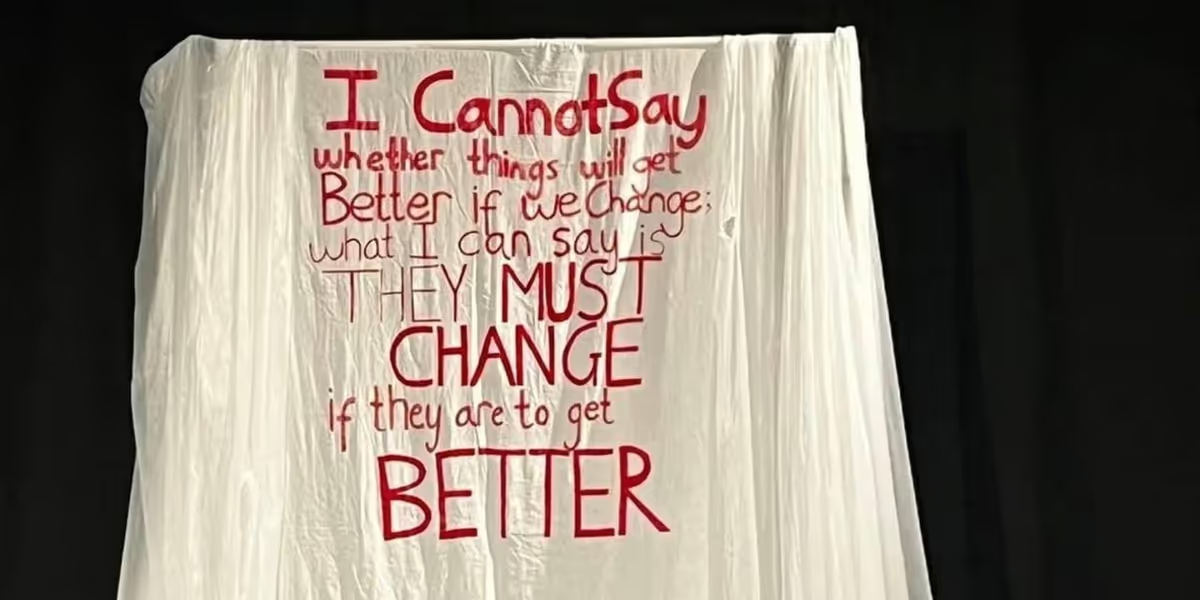
"I cannot say whether things will get better if we change; what I can say is THEY MUST CHANGE if they are to get BETTER" — so ends the production of Portent, directed by Anastasia Nikolaeva. The actors take their bow, the curtain falls, and yet the audience sits motionless, still processing what they have just witnessed.
In the departing theatrical season, British theatre has increasingly turned to social and political themes, becoming almost a space for direct conversation about what is happening in the world beyond the stage, functioning as a way of recording reality, sometimes more precisely than journalism. In this context, Portent lands squarely within that tradition.
Portent falls into the category of political satire. But the production feels more like an unending drama about power and the human vulnerability that lives inside it. There is no safe vantage point here: what unfolds is far too recognisable in today's reality, regardless of which country or political system the audience member calls home. It seems that everyone encounters echoes of what breaks their heart daily, reflecting the world's cruelty and senselessness.
The plot unfolds inside the cabinet room of an authoritarian state. But power here is not a structure; it is a condition, one shared by people forced to sustain the illusion of control. On the surface, everything appears formal and composed, yet inside, a sense of disintegration gradually builds. This disintegration does not stop at the cabinet door; it seeps into every sphere of life, turning existence into a grim kind of chaos.

Interestingly, on the visual level, the atmosphere of bleakness is achieved not through dark colours but through their opposite, a dominance of white. That whiteness reads as a form of pressure and erasure, though in the production everything works this way: the dialogues with their long pauses, the actors' expressions and gestures, the musical score that underscores the emotional weight of each scene. The costumes and set design by Olya Lysenko imbue the characters with both expressiveness and depth. Each character is meticulously crafted, with their appearance not only showcasing individual traits but also revealing internal conflicts. The contrast in the costumes of certain characters is particularly striking. For instance, the wife of a government official wears a dress adorned with flowers, symbolising her vulnerability. She is sincere and remains true to her beliefs, yet she becomes the first victim of the system.
Throughout the performance, the audience is left in suspense, yearning for a resolution, hoping to see the conflicts untangled and at least a glimmer of a hopeful ending. Yet, that moment never arrives. Nothing changes, mirroring the very systems depicted in the play, which are too unwieldy and inert to be transformed by any single decision. The production's conclusion, which poses yet another question amidst the many already raised during the performance, only intensifies this sense of unresolved tension.
What kind of change, exactly, is being spoken of? Is replacing the figures in power enough, or does the very logic of the system demand something far deeper? And can such a transformation happen without a radical, painful break?
Portent offers no answers, and perhaps that is its defining stance. It doesn’t close the conversation, but instead, it leaves it open, inviting the audience to move beyond mere observation and become active participants in the reflection.
Photo Credit: Anastasia Nikolaeva