Interview: David Oyelowo on Making NEWBORN a Hopeful Psychological Thriller
Newborn will be released theatrically on April 10th exclusively at AMC Theatres.
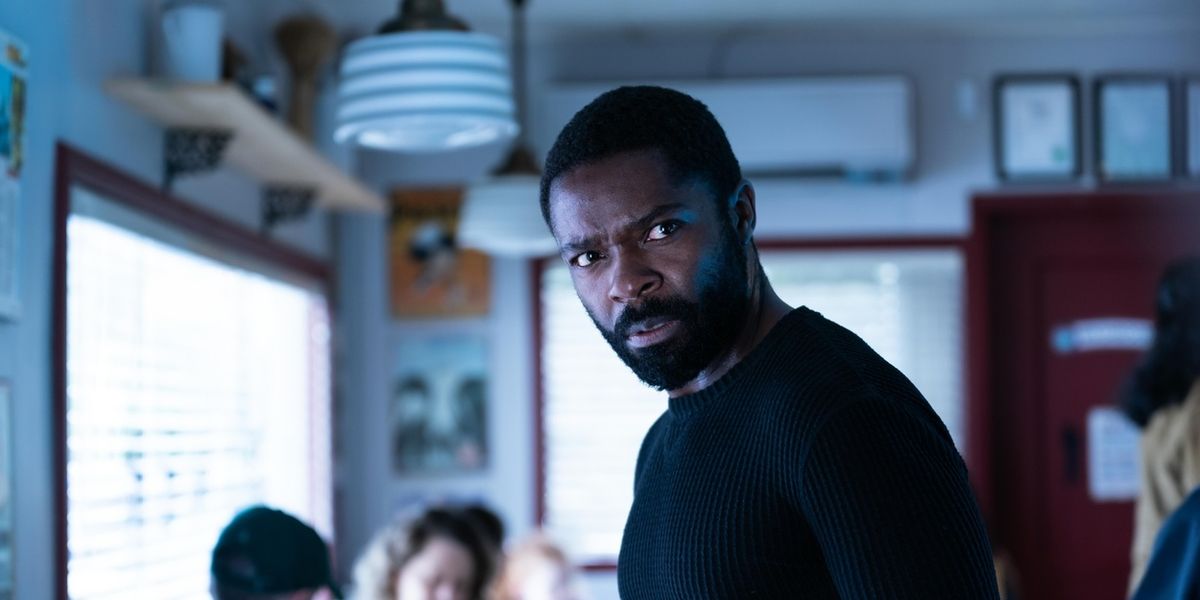
David Oyelowo is back on the big screen in a new psychological thriller, Newborn. In it, the award-winning stage and screen performer takes on the character of Chris Newborn, a family man who suffers through a ruthless seven years of solitary confinement.
After a swift opening that introduces Chris, his wife Tara (Olivia Washington), and his brother Keith (Jimmie Fails), Newborn picks up with him following his release from prison, and this is where the movie really starts. Now with a young son (Aiden Stoxx), Chris and his family attempt to enjoy a vacation away, but instead are forced to grapple with the trauma of Chris' experience.
Filmed against the wooded backdrop of Vancouver, Newborn is a difficult film, both psychologically and emotionally. It's unclear what is happening much of the time, as Chris fights these inevitable demons that arise after years of unrelenting treatment.
But, even if what we are seeing isn’t always representative of the objective reality, one thing is clear: it is his reality. And it is terrifying. The specifics of Chris' experience are not based on any one person, but those of many. As Oyelowo shares, there are currently 80,000 people in solitary confinement in America today.
With a statistic like that, it's hard to be hopeful. And yet, at the center of Newborn is a definite hopefulness. Family, selflessness, and the importance of connection are all tied to the identity of the movie. These are not necessarily qualities one might associate with a film of this genre, but, as Oyelowo points out, isn’t that life?
Ahead of the film's release this Friday, BroadwayWorld sat down with the actor, who spoke about how he prepared to take on this monumental project, the movie's themes, and what he hopes audiences will take away from witnessing the story of Chris Newborn.
This interview has been condensed for clarity and length.
A lot of the time, we don’t know what’s real in the film. We are struggling to understand what’s happening, right along with Chris. Why was it important, from a storytelling standpoint, that we are experiencing things from Chris’s perspective?
In the research that I did around the effects of solitary confinement, paranoia is a big byproduct. What is real? What is perceived? That really lent itself to this story specifically, but also a psychological thriller. The reason why you can call a film a psychological thriller is that it works both in the literal and physical, as well as the imagined and in the mind. That is very much the existence of someone who, in the case of Chris Newborn, has spent seven years, 23 hours a day on his own, unraveling. [He] is now trying to put himself back together enough to be able to be with his wife and son again.
Despite the terrifying things that are happening, there are a lot of emotional moments in the film. How did you and the rest of the team work to balance those tones that, on the surface, may appear to be contradictory?
I think that's what we are as human beings. We are full of contradictions. When a film is working, it's because it's telling the truth of that. Chris is both someone to be admired, but, at times, someone to be distrusted. The circumstance he finds himself in is truly challenging, but what he does that makes him end up in prison is kind of beautiful from a sacrificial standpoint. These contradictions coexist, and I think that's why, hopefully anyway, an audience is going to watch this and feel connected to it. Ultimately, it's hopeful because it's all about a family refinding itself.
One difference between doing something onstage as opposed to a film is that you aren’t necessarily telling the arc of the character in sequence from beginning to end because of the nature of filming. How do you approach that as a performer when you have to access where your character might be at that stage in his development based on whatever you might be shooting that day?
That's particularly tricky when you're dealing with someone who has this psychic break they're dealing with, which has its own arc. That’s where you really have to go and do the work, trust your director, trust your collaborators.
I spent a fair bit of time talking to a few people who had endured solitary confinement. One in particular was a gentleman called Richard Rosario, who had been in solitary for seven years. His experience was very specific and was very much mirrored by what we were doing with the film, even before I met him. Charting that through someone's experience, through a very well-written script, [and] as an actor, it's my job to make sure that the arc of transformation is clear. I felt very supported between all of those elements I've just listed.
The movie is built on the relationships Chris has with his family, and your co-stars are incredible. Did you have time with them before filming to develop or talk about your dynamics together?
We spent a lot of time talking about it, in all honesty. There wasn't a ton of rehearsal, but it was more about really breaking down what these relationships are and how they've come to be the way they are. Obviously, the person I spent the most time talking about that with was Olivia. We play husband and wife, and we go on quite the journey with each other through the course of the film. It was a combination of a lot of conversation, but research as well. She interviewed Minerva Rosario, who is Rich Rosario's wife. Minerva stuck by her husband for those 20 years, while he was incarcerated. That would not be everyone's choice, and she spent a lot of time talking to her.
Chris’ surname, Newborn, which is also the title of the movie, is a fitting one because there is a theme of rebirth throughout, which can take both positive and negative forms. In what way did that idea of rebirth find its way into the storytelling?
It’s very rooted in what we wanted the film to hopefully [show]: How can light shine in the darkest of places? I read a book about solitary confinement called “Hell Is a Very Small Place.” That sounds like the kind of place that hope would not dwell. And so this notion of rebirth, this notion of renewal, it was a question we asked ourselves: Is it possible, having been dehumanized to this degree, to still find hope?
Another book I read [was] called Solitary by Albert Woodfox, a guy who had been in solitary confinement for over 40 years. Somehow, he managed to stay whole and present and human and is now freed and has been deemed innocent of what he was accused of. I just don't know how you do that. I don't know how Richard Rosario, whom I was with just the other night, is seemingly as whole as he is. Trust me, he deals with the effects of solitary confinement, but that's why we chose not to dwell on the portion where he's incarcerated, but on his attempts to be reborn beyond it.
Newborn will be released theatrically on April 10th exclusively at AMC Theatres. Watch the trailer below.
Prefer BroadwayWorld in Google Search?
Add us as a preferred source so our stories show up more often in Top Stories and Google’s AI answers — for you.
Sign up for all the news on the Fall season, discounts & more...
.jpg?format=auto&width=300)