

How Central Asian Nomadic Movement Traditions Are Being Reinterpreted Through Contemporary Choreography
Saks in Movement: Back to Heritage Workshop will take place on June 20.
Written by Molly Peck
Across Central Asia, movement has historically carried cultural meaning far beyond performance itself. The physical language of nomadic communities developed through mobility, relationship to landscape, horseback travel, ritual practice, and collective memory. Yet in contemporary stage contexts, many of these traditions have often been preserved primarily through theatrical folklore forms rather than examined as independent systems of embodied knowledge.
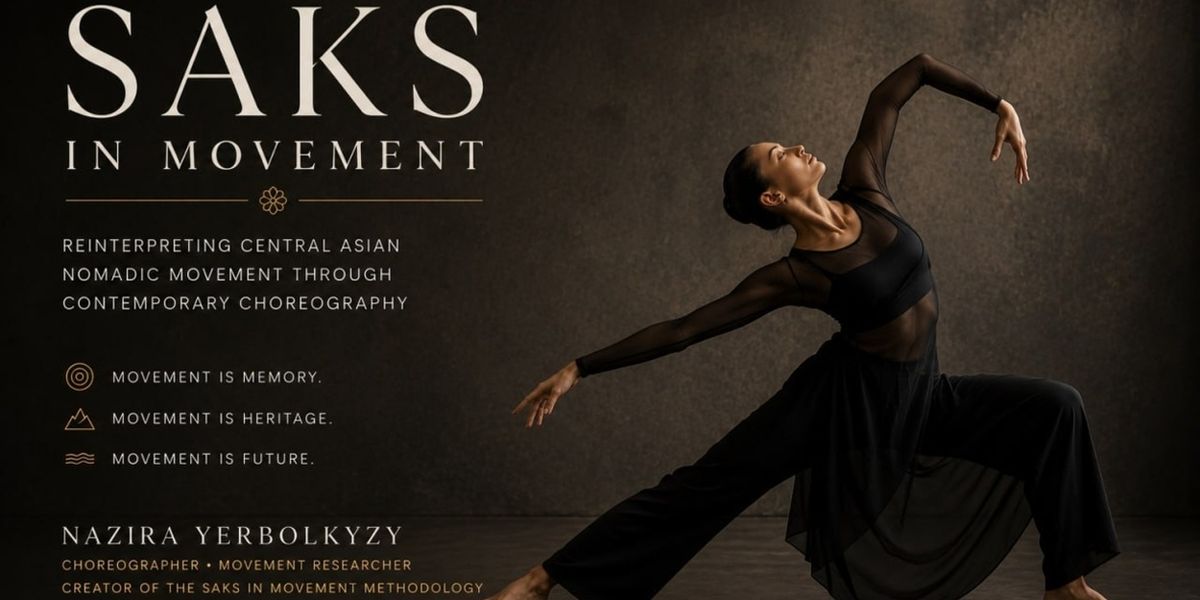
Choreographic researcher and artist Nazira Yerbolkyzy is among a new generation of practitioners working to reframe this relationship by exploring how traditional movement philosophies can be reinterpreted through contemporary choreography and movement analysis.
Rather than reconstructing folkloric dance in its staged form, Yerbolkyzy’s work focuses on identifying the underlying physical principles embedded within nomadic movement culture — including grounded mobility, circular spatial orientation, controlled weight transfer, symbolic gesture, and the dynamic relationship between the body and open space.
“Movement traditions contain systems of thinking,” she explains. “They reflect how people interacted with landscape, balance, travel, community, and physical endurance. Contemporary choreography gives us an opportunity to reinterpret these principles in a modern movement language.”
At the core of her research is the Saks in Movement methodology, a practice-based system developed in 2021 that organizes these principles into a structured framework for contemporary choreographic practice. The system does not function as a fixed technique or repertoire.
Instead, it operates as a set of generative movement principles used to create choreography through embodied experimentation.
These principles include soft-knee weight transitions that support grounded mobility, circular spatial pathways that replace linear stage orientation, and a structured vocabulary of hand and arm articulation that functions as expressive and compositional material within choreography.
Yerbolkyzy’s work has increasingly attracted attention within international creative environments engaged in movement research and intercultural performance practices. Her methodology has been applied in studio and performance contexts, where its principles have informed choreographic development and ensemble-based movement creation.
Rather than treating movement as purely stylistic or representational, her approach positions it as an evolving system of knowledge — one that can be analyzed, transmitted, and reconfigured within contemporary artistic practice.
Some elements of the Saks in Movement system, including structured weight transfer, grounded alignment, and expressive hand vocabulary, have also been explored by collaborating artists and choreographers working within contemporary performance environments, demonstrating the methodology’s adaptability across different creative contexts.
In addition to her choreographic work, Yerbolkyzy views movement research as a form of cultural continuity that operates within contemporary artistic language.
“Preserving culture does not only mean repeating traditional forms exactly as they existed before,” she notes. “It also means allowing culture to evolve and speak through contemporary artistic language.”
Currently based in Chicago, Yerbolkyzy continues to expand the methodology through ongoing research, choreography, and collaborative artistic projects. Her work increasingly focuses on how embodied systems of knowledge can be transmitted through structured studio practice while remaining open to reinterpretation by other artists.
As part of this development, Yerbolkyzy is preparing a public workshop initiative for contemporary dancers, choreographers, movement educators, and performing artists interested in intercultural movement research.
Saks in Movement: “Back to Heritage” - Movement Workshop
The upcoming workshop will introduce participants to the foundational principles of the Saks in Movement methodology through guided movement exploration, improvisational tasks, spatial awareness exercises, and choreographic investigation.
Rather than focusing on the reproduction of traditional dance forms, the workshop invites participants to examine how movement knowledge derived from Central Asian nomadic traditions can be translated into contemporary creative practice.
Participants will explore concepts including grounded mobility, circular spatial orientation, adaptive directional movement, symbolic gesture language, and body-space relationships. The workshop is designed as a practice-led research environment where movement becomes a tool for cultural inquiry, artistic experimentation, and choreographic development.
The event will bring together artists from diverse backgrounds and will contribute to an ongoing dialogue about cultural heritage, embodied knowledge, and contemporary performance-making.
Workshop Information
Title: Saks in Movement: Back to Heritage — Embodied Movement Workshop
Date: June 20, 2026, 01:00PM
Location: 1114 N Arlington Heights Rd Suite: 201, Arlington Heights, IL 60004
Instructor: Nazira Yerbolkyzy, choreographer and creator of the Saks in Movement methodology
Photo Credit: Yerbolkyzy Nazira