


Season 2, Episode 5: Behind every summer is a community that keeps Fire Island alive. This episode explores the history of the beloved Pines Pantry through the eyes of its iconic Pantry Girls, alongside the volunteer firefighters of The Pines and Cherry Grove who protect the island from fires, hurricanes, beach erosion, and an uncertain future.
Chengyu Deng Turns Sound, Data and Movement Into Living Performance
Deng continues to work on Ambiguous Silence, an audiovisual piece that includes writing, generative visuals and moving images.
By: Team BWW
Written by Daniel Fusch
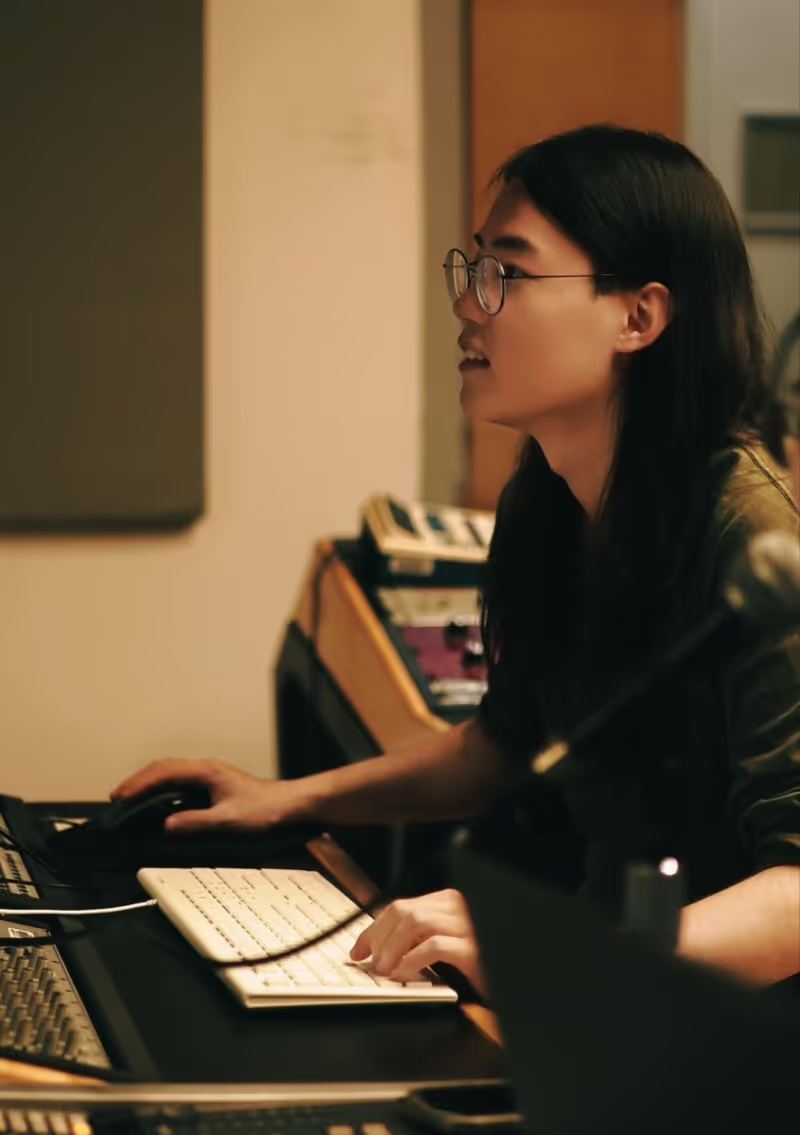 For Chengyu Deng, sound is something that moves through a room, responds to the people inside it instead of being something that simply plays in the background. His projects bring together installations, electronic music, live performance and creative technology, often inviting the audience to become part of the work.
That idea is central to Ebbs N’ Flows 若浮若休, an interactive audiovisual installation Deng began developing this year. The work places participants inside a particle-based environment where each person appears to move independently while remaining part of a much larger system.
The Chinese title suggests a state between emergence and stillness, which is reflected in the installation’s continuous movement. Particles form, separate, disappear and return, following cycles of growth, decay and regeneration. Repetition creates a sense of order, but it also raises questions about how much freedom can exist within a system that is constantly recalculating its own behavior.
What makes the work more special is the role of the audience. Their presence affects the sound and visuals in real time. There is no fixed sequence and no definitive version of the piece. Each presentation develops according to the people who enter the space and the way they move through it.
That relationship between the individual and a larger field also appears in Pluto Movement / A State of Particle, another ongoing project that Deng began also in 2026. Here, his starting point is not the movement of an audience but the movement of Pluto.
Using astronomical position information from the NASA Jet Propulsion Laboratory’s Horizons data library, Deng extracts Pluto’s changing coordinates and translates them into visual motion, particle behavior and sound. The result is not intended to resemble a conventional model of the solar system. Instead, scientific data becomes the underlying score for an abstract audiovisual environment.
Pluto’s long orbit and extraordinary distance give the project an emotional dimension as well. Deng considers the planet’s isolation and constant movement in relation to migration, memory and the experience of living far from your place. In A State of Particle, individual points gather, separate and reorganize, creating an image that can suggest social groups, ecosystems or people trying to locate themselves within something much larger.
His interest in making invisible systems perceptible was also the basis of Designing a Data Derived Sonic Event Generator for Immersive Audio Environments, the project he completed in 2025.
The system takes digital network packets and turns their hexadecimal values into waveforms and individual sonic events. The data does not simply activate a collection of prerecorded samples. It participates directly in the creation of the sound, allowing everyday Internet activity to produce musical material.
.jpg?format=auto&width=800) That material is then distributed through eight speakers. Sound travels around the listener according to factors such as trajectory, distance and aperture, making network activity feel physical. A system that normally remains hidden behind screens and devices becomes something that can be heard moving through a room.
That material is then distributed through eight speakers. Sound travels around the listener according to factors such as trajectory, distance and aperture, making network activity feel physical. A system that normally remains hidden behind screens and devices becomes something that can be heard moving through a room.
For theater and live performance, this type of work points toward new possibilities. A stage environment no longer has to respond only to a predetermined cue. Sound and visuals can react to performers, audience members, digital information or changes taking place outside the venue. Deng’s projects show how technology can function as an active part of a performance instead of being simply a tool used to present it.
He has also designed instruments that give performers more immediate control over complex electronic systems. In 2025, Deng created a high resolution wavetable synthesizer in Eurorack format using the Bela development platform. The module includes separate controls for volume, frequency and modulation, along with control voltage inputs that allow it to communicate with other modular synthesizer equipment.
The instrument brought ideas from Deng’s software work into a physical object that could be used during composition or performance. Building it required programming, circuit integration and interface design, but the final purpose was practical: to place an expressive electronic instrument directly in a musician’s hands.
A similar concern with accessibility informed his eight knob MIDI controller, developed in 2024. Chengyu Deng created the portable device along with a custom script that connects it to Ableton Live. Through that integration, performers and producers can move between several groups of software parameters without relying on a complicated setup.
These instruments may be compact, but they reflect an important part of his practice. Deng is interested in what technology allows artists to do in the moment. He looks for ways to make that complexity usable, responsive and open to experimentation.
That approach can already be seen in MIDI Ball, a wireless controller he made in 2022. Equipped with a gyroscope and accelerometer, the device converts physical movement into notes and continuous MIDI information. The way a performer moves the ball can affect velocity, scale selection and other software controls, while Bluetooth allows the information to be transmitted wirelessly.
The project replaces the familiar gestures of pressing keys or turning knobs with movement of the body. It is easy to imagine how a device like this could be used by a dancer, actor or musician, allowing physical action to influence a score as it is being performed.
.jpg?format=auto&width=800)
Also in the past, Deng’s Analog Audio FX Unit combined tremolo, distortion, filtering, audio interfacing and patching functions in one system. The project gave him early experience with analog circuits and signal flow, laying the groundwork for the digital instruments and interactive environments he would later develop.
Alongside these projects, Deng continues to work on Ambiguous Silence, an audiovisual piece that began with electronic compositions and later expanded to include writing, generative visuals and moving images. The project considers uncertainty, memory and the way a person rebuilds a sense of familiarity when circumstances change.
Deng is exploring a kind of performance that does not remain exactly the same from one evening to the next. It listens to the room, responds to those inside it and changes while it is happening.
Photo Credit: Chengyu Deng
Broadway news in your inbox
Weekly top stories - unsubscribe anytime.
Weekly top stories - unsubscribe anytime.
Popular episode

.gif?width=300)


Tickets From $59

Tickets From $70

Tickets From $59

Tickets From $101