


Review: LOGAN STREET at Space Theatre, Adelaide Festival Centre
Based on the true histories of two people and a forgotten part of Adelaide.
Reviewed by Barry Lenny, Tuesday 28th July 2026.
Logan Street is a new play, written and directed by Kaurna and Narungga theatre-maker, Jacob Boehme, another world premiere from State Theatre. The play is set in the south-west corner of Adelaide, where working-class migrants and indigenous families formed a community, with the area nicknamed as ‘Little Beirut’. In the 1940s, a 16-year-old Aboriginal girl, Dulcie, a character based on Boehme’s grandmother, becomes friends with 70-year-old Goolie, an Afghan cameleer, a vocation ended by progress, who is now the caretaker who lives behind the Mosque.
Before it began, though, a recorded video of Uncle Lewis O’Brien and Aunty Lynette Crocker took the audience through an innovative and interactive version of the welcome to Kaurna country.
The Adelaide Mosque, built in 1886-8, is in Little Gilbert Street, but rear access is from Logan Street, through the car park. Property values in gentrified Logan Street, nowadays, run into millions, a far cry from the shabby homes of the community of the 1940s, all demolished long ago. Gool Mahomet is buried in the West Terrace Cemetery.
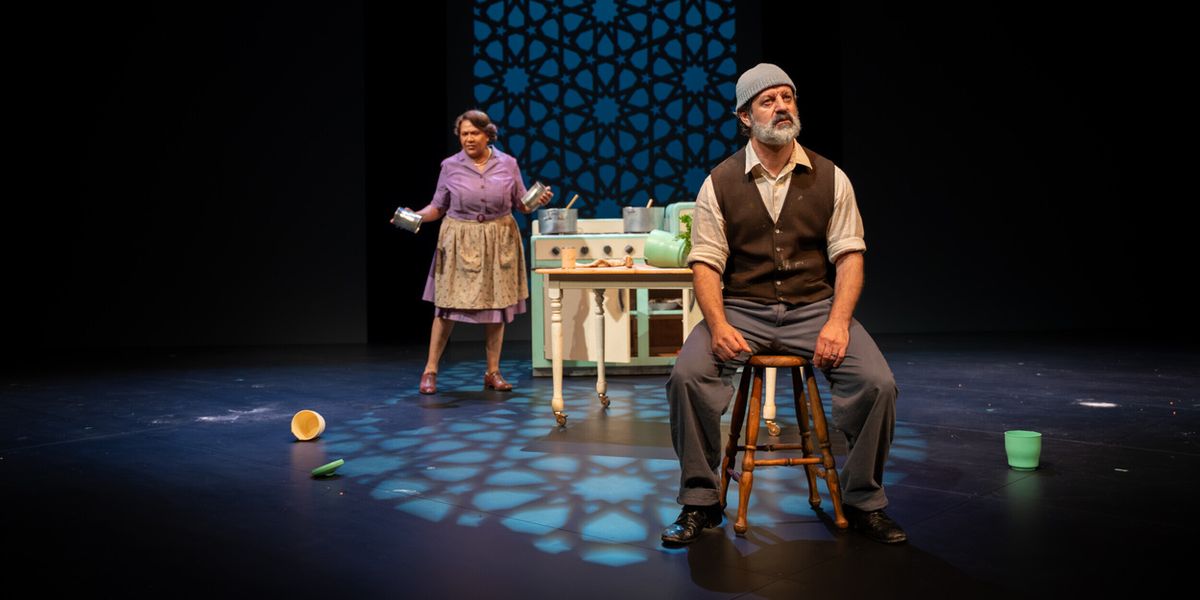
Kathryn Sproul’s set design is sparse. Across the back are three pointed arches, representing the doors of the mosque. They form a triptych for video projections. The stage is initially bare, save for a street sign and five pomegranates on the ground. Nic Mollison’s lighting provides a wealth of subtle nuances.
Goolie enters and calls to a bird, and the voice of a neighbour complains that it eats his peppers. A cheeky 16-year-old, Dulcie, slips in to collect some fruit and is caught by Goolie. It is the start of a decade-long friendship that sees her grow, marry, and become a mother, taking an interest in his religion, and becoming an apprentice in his kitchen.
Food, glorious food. Cooking and storytelling are central elements in this play as Dulcie joins Goolie, instructing her as he cooks each year for Eid al-Fitr (Festival of Breaking the Fast), the feast at the end of Ramadan. A table and a kitchen unit incorporating a stove are wheeled around at each scene change, Scents waft through the audience, Native Blue Bush Smoke at the beginning, and that smell of rosewater reminded me that I haven’t made Turkish Delight or brewed Turkish coffee for far too long.
Ali Ammouchi gives a convincing performance as Goolie, a gentle man who is happy to mentor Dulcie and share his story and beliefs with her. He has nothing much of value except some meagre, slowly growing savings for his ultimate goal, a trip to Mecca before he dies. Ammouchi brings Goolie’s simple existence to life, revolving around his religion, his gardening, his bartering, and his kitchen and conveys Goolie’s gentle acceptance of Dulcie into his world.
Alexis West plays Dulcie, seeming a little tentative to begin with, then strengthening, becoming more confident, and growing into the character as the play moves forward. She creates a character that displays genuine fondness for her aging neighbour, and a willingness to share cultures and family stories. Her Dreamtime stories are balanced by his story of a poor man asking Allah for riches.
They speak of hardship, betrayal, control, displacement, and resilience, all of the external influences that have affected their lives, with WWII in the background, and political decisions beyond their control. They speak, also, of goals once held. Dulcie wanted to study science. Goolie’s life as a cameleer was taken from him. They survived it all.
The play also features vocals by Sonya Rankine, with musical direction and composition by Dale Cornelius. Both Kaurna and Farsi languages are spoken and sung, with further vocals added by Feroz Ansari, and surtitles are a part of the projections.
Aviana Daveson appears as young Munarto, alongside West as older Munarto, in Mark Oakley and Matt Byrne’s projected film depicting the abuse of indigenous peoples in 1836 through the story of Munarto, the great-great-great-grandmother of Jacob Boehme. Sealers took her to Kangaroo Island and she bravely made her way back to the mainland, swimming with her children on her back.
Even in the 1940s, indigenous Australians were not permitted to use their own languages under the restrictive control of the Catholic sisters. This was nothing new; it was a pattern. Much earlier, the English banned the Scots from wearing tartan and speaking Gaelic, and the Irish suffered the same oppression of their language, Gaeilge. Indigenous tribes were forced onto reservations in America. The racial White Australia Policy was introduced in 1901 to prevent non-European immigration and remove non-white workers. It included the Immigration Restriction Act of 1901 and the discriminatory Dictation Test. It was softened under Harold Holt’s government in 1966, allowing entry to non-Europeans with skills badly needed in Australia, and it was finally abolished in 1973, under the Gough Whitlam government.
There have been improvements, but much more can still be done.
As we left, we were each presented with a tasty memento, a small piece of shirpera (a type of nougat), Goolie’s favourite sweet, a nice touch. Do get a ticket to this beautiful piece of theatre while you can.
Photography, Matt Byrne.

Sign up for all the news on the Fall season, discounts & more...

|
The Heartbreak Choir State Theatre Company South Australia (11/20-12/05) |

|
Vanya and Sonia and Masha and Spike Little Theatre (10/09-10/18) |

|
Log Boy State Theatre Company South Australia (10/01-10/10) |
|
The Shawshank Redemption Her Majesty's Theatre (4/01-4/11) VIDEOS |

Reader Reviews
To post a comment, you must register and login.