

Review: BETWEEN THE RIVER AND THE SEA, Royal Court Theatre
Straight from the Maxim Gorki Theater in Berlin, this is an impressive reflection on cultural borders, discrimination, and the importance of taking a stand.
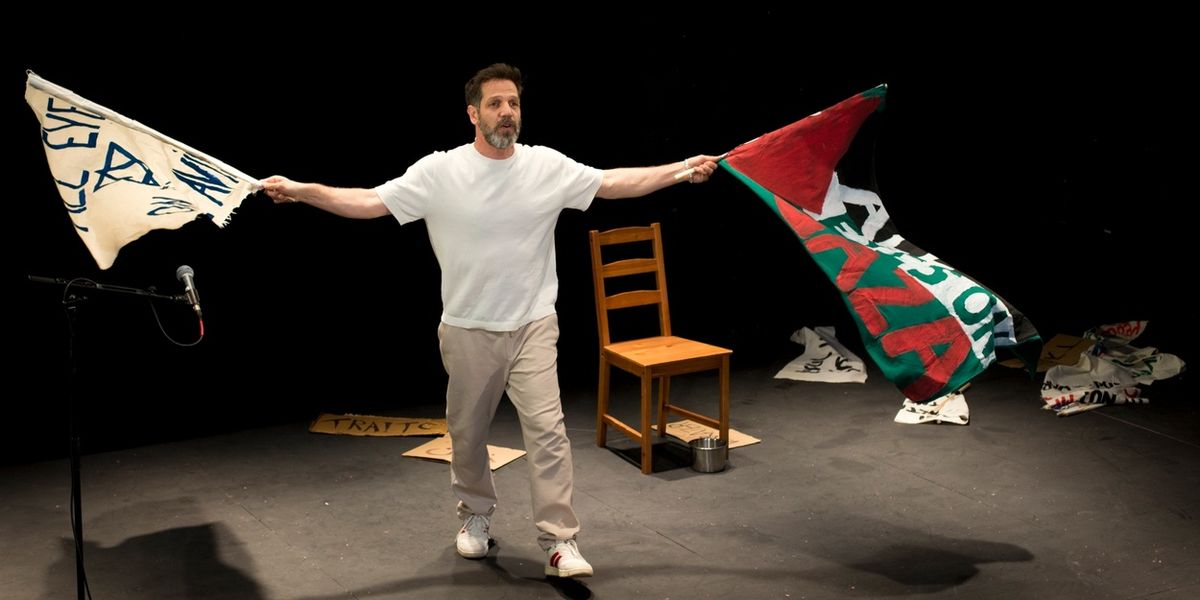
 “I’m just here to talk about my divorce,” says Yousef Sweid right after a preamble about the complicated reception of political productions. He and Isabella Sedlak write a poignant reflection on how beliefs and birthplaces raise us and shackle us at once. Between The River and The Sea approaches the Palestinian genocide from a personal standpoint, never making it its focus, yet permeating every word with the weight of it.
It introduces a Christian-Arab-Palestinian-Israeli father who’s raising two Jewish-Arab-Austrian children in Berlin. Yousef (Sweid) is trying to get custody of his youngest after his second divorce, after his ex-wife told him she wants to move back to their home country.
As he explains that he doesn’t want either of his kids to grow up knowing the vocabulary of discrimination, he details the logistics of growing up Palestinian in a Jewish neighbourhood. This constant split between cultures resulted in many instances of confusion and misunderstanding for young Yousef, who often found himself telling half-truths to be recognised by his peers. Later, this became the chance for his friends to accuse him of refusing to take a stand against terrorism in the aftermath of the 7th of October 2023.
So far we’ve made the show sound heavy and sombre, but it’s surprisingly funny. There’s a calculated candour both in writing and delivery, and clever observational comedy lightens the performance as Sweid jumps between characters. His father interrupts his monologue while he tells us about his upbringing, demanding a more thorough look into the struggles of the Palestinian people and urging his son to be more precise in his explanations, befor we meet other influential figures in Yousef’s life, from teachers to classmates. They all contribute to the larger construction of a complex sense of identity.
.jpg?format=auto&width=800)
The piece is approachable and conversational, led by Sweid with charismatic flair. The cultural clash of living in Berlin is compared to what it felt like to blend in with Israeli Jews as a Christian-Arab in Haifa. Just as there was no drastic segregation between them when he was in school, there is no separation between Sweid and the audience. A firmer division appears once he’s reprimanded and reproached for wanting to remain neutral: spotlights isolate him and surround him by darkness. It’s quite the atmospheric representation of his state of being.
Behind Sweid’s warmth and lightheartedness hides the tense personal strife of fighting hard to fit in. The lateral question that surfaces is: what happens when fitting in is actively harmful? When does the need to challenge hatred trump our innate pull towards being accepted? “If you don’t want babies to be killed, why are you selling them weapons?” he asks, backhandedly, to his lawyer when she tries to make his divorce a political matter. As his colleagues tell him about the horrors they face in Gaza, he’s thankful his children have the privilege of never having to experience a checkpoint.
If there’s one aspect that could be better nurtured, it’s Sweid’s tendency to self-police. While he’s honest in the admittance of his flaws, he also endlessly justifies and excuses his actions. He argues against himself often and very well, but it’s rarely with the same force as the other side. Still, the play is remarkable in its achievement. It marries provocation with emotional intelligence, presenting its arguments in a fresh light and therefore instigating a new line of thought in its public. It’s really smart programming by the Court.
Between The River and The Sea runs at The Royal Court Theatre until 9 May.
Photo Credits: Holly Revell
Sign up for all the news on the Fall season, discounts & more...







Reader Reviews
To post a comment, you must register and login.