


Interview: COME FROM AWAY's Timothy Koh Talks About the Joy of Directing Theatre in Singapore
The director chats with us ahead of Come From Away's run at the Victoria Theatre from 11-27 September
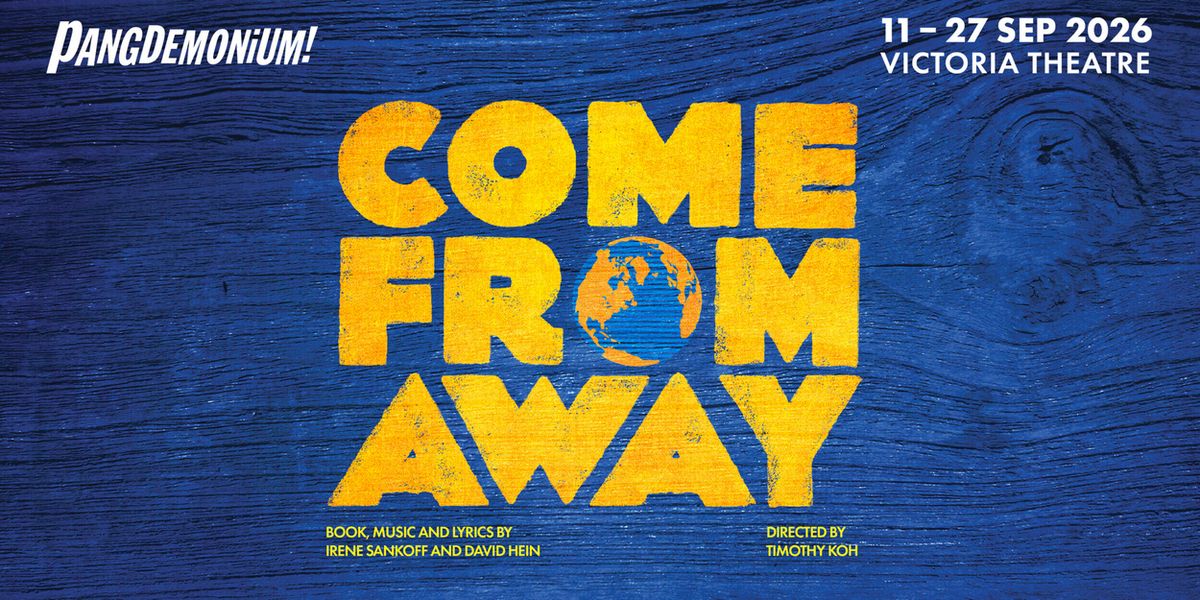
Singapore — Walking through Pangdemonium’s office, you’re greeted with posters of the last 16 years of productions. Every single one is framed and signed by the people who made each show happen. As Pangdemonium celebrates its closing with Come From Away, BroadwayWorld was invited to Pangdemonium’s office to speak with Timothy Koh, who will be directing the company's final production.
Come From Away is set during the events of 9/11. It tells the true story of Gander, a small Canadian town where 38 international aircraft carrying nearly 7,000 passengers were diverted following the closure of United States airspace. With little warning and few resources, residents of Gander and its surrounding communities opened their schools, homes and community spaces to complete strangers, offering food, clothing, shelter and reassurance at a moment of profound global uncertainty.
The musical, with book, music and lyrics by Irene Sankoff and David Hein became beloved by fans for its delicate and truthful handling of heavy topics like grief, while also celebrating the joy and community that is formed amidst tragedy.
Directing this production is Timothy Koh. He joined Pangdemonium as Associate Director in 2022. Since then, he has directed Pangdemonium’s Muswell Hill, Doubt: A Parable, Who’s Afraid of Virginia Woolf? and Singapore, Michigan. His work on Doubt: A Parable and Singapore, Michigan earned him nominations for Best Director, and Doubt: A Parable was nominated for Production of the Year at The Straits Times Life Theatre Awards. This production marks a milestone for Koh as he helms his first musical.
Koh graciously talks to us in much depth about his journey as a director, his directing philosophy, and his journey with Pangdemonium while giving hints of what to expect from their final production. Looking to the future, he also shares his passion for cultivating new local works and local talent, and contributing to the growth of the Singapore theatre scene for the next generation of theatre-makers.
This interview has been edited for length and clarity.
Thank you for meeting us today. What got you first interested in directing for theatre?
I was always involved in drama club when I was in primary school and did a Saturday morning out-of-school drama thing. Originally I was interested in acting, as it is for most people. In secondary school, one year I didn't get cast in the yearly play and I was not happy. The teacher/director asked me to be the assistant director. I didn't know what that meant so I just said whatever I’ll do it. That was the moment I realised that this was more fun. From then on, I decided I want to direct, and that has never wavered since secondary school.
There's not a lot of people who get to find what they love and get to do what they love once they find it. So I'm very, very lucky that I found theatre and directing at a very young age and that I’ve been given the opportunity to pursue it professionally.
What about directing made you feel “this was more fun”?
Directing scratches an itch for me because I like to have a bigger picture understanding of the work I’m making. I like to see the whole process from start to finish and lead a room of people, designers, and stage managers.
A lot of people say that theatre is more of an actor’s medium and film is more of a director’s medium, but I don’t think that’s necessarily the case. It’s always a collaboration. Also as time went on, I realised that I do not like to be perceived as much as acting needs. For me, I don’t like or need to be the one front and centre of the thing, but I want to be deeply involved in the creation of a piece.
Can you walk us through your time in New York? How did those experiences develop your approach to directing?
I went for undergrad in New York and I worked for almost a year after graduation. Then COVID hit and I came back to Singapore.
My time in New York was very valuable and I still go back to it every day. The training I received there I couldn’t have gotten anywhere else. It really created my sense of aesthetic and my approach to directing and performance-making. Even my acting training in school really shaped how I look at things.
I think because of our colonial history a lot of our approaches to theatre in Singapore are very British. There’s me and a couple other directors and actors who have trained in the US and I find that it provides a slightly different approach to theatre-making.
I try to bring in some things that I learnt from the companies there back to Pangdemonium. My time in the US was very integral in providing me with a holistic education to know what I want out of my shows and the type of leadership I could emulate and aspire to be.
Are there any specific things you picked up in New York that you found applies well in Singapore?
One that I do every day in rehearsal — I like a lot of breaks. In the US, you work 80 minutes and you have a 10 minute break, or you work 55 minutes and you get a 5 minute break. I thought that was a very good rehearsal practice. If your working actors are doing an 8 hour rehearsal day, sometimes by hour 6 they get tired and everyone’s brains are a little fried. In the American way of working, everyone knows the most they will go is the next 80 minutes. You get more out of your actors that way because they have more time to rest in between so they can give their 100% all the way to the end of the workday.
I think that’s something that is a union requirement for professional theatre in the US that isn’t in Singapore that I have instituted for every single one of my shows that I found extremely effective even for my brain and for everyone in the room. It is a wonderful thing and it is a falsity to think you have less rehearsal time, because instead you get more quality rehearsal time.
Moving on to your time in Pangdemonium, can you tell us more about how you initially joined?
I sent a cold email saying I wanted to intern in 2015, so about 11 years ago.
What about your time interning here made you want to come back?
I really sang with the way the work was presented. I really sang with the themes, the ideas, the ethos, the structure of company building and company making and so I wanted to do work here.
You worked on quite a number of productions as assistant director Tracie Pang. What are some of the most valuable things that you've learnt from working with her?
Staying calm and being patient. She's a very calm and patient director and I think that is something that I have seen her be through many productions which I hope to emulate in my own rehearsal process, especially working on a larger-scale show like this.
How does it feel then to be helming your first musical?
In some ways it’s scary because my background is not musical theatre. My background has always been the classics, but I've always loved musicals. It has been a part of my blood for as long as theatre has been a part of my blood, but weirdly enough I've always sold myself as the not-musical guy.
Typically your average musical is more expensive than your average play, so there's a lot more pressure, but I feel very ready for it. We're about to start week 3 of rehearsal, so we’ve done quite a bit of staging at this point. It feels very much like “yeah, I know how to do this.” I feel very ready and very excited and very energized by my team and the people in the show.
You've previously worked as Assistant Director on some really great musicals with Pangdemonium. Are there any experiences that have helped inform how you direct Come From Away now?
This musical is very different from our prior two musicals. Kimberly Akimbo and Dear Evan Hansen are traditional book musicals where there's a song, scene, song, scene. Come From Away is a very different beast.
I find what prepared me for taking on this challenge is Into The Woods. It has more book scenes than Come From Away does, but it’s similarly very bitty and has a huge cast. Characters do little bits for two pages and then disappear, come back for two pages and disappear.
It was also similar because you’re steering a ship that is very musically complex. In Come From Away, almost everyone is on stage for almost the entire show. You're doing twelve people harmonizing at the same time, basically the whole show. It's kind of mind-blowing! So with Into The Woods, it showed what a big cast running around doing lots of different things can mean.
Are there any specific things about Come From Away that have been exciting to direct so far?
Something that's been really exciting for me to direct is the confluence of acting, staging, and lighting design. We've got some very, very interesting lighting design on this show that we're very excited to bring out and show the audience that’s different from the Broadway version of it.
For the readers who love Come From Away, what are you able to tease about the new spins that this production is putting on the show?
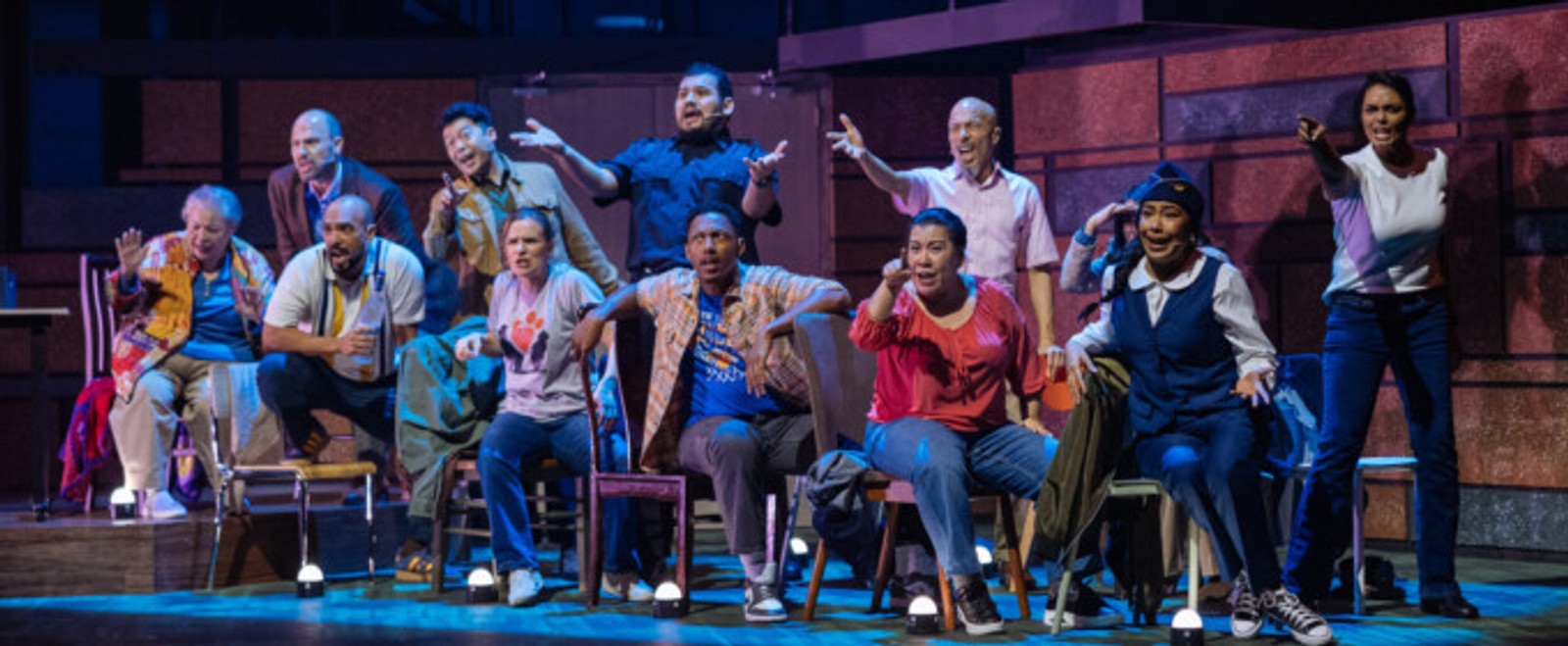
The lighting is one big new thing that we're doing. We're also not following the traditional set design of the show. We will still have chairs because they need to sit on the plane and all but I think my biggest hope is that with the lighting design we can create something quite truthful to the core of the text, but puts our own stamp on it.
Come From Away is a very big ensemble piece that features so much multi-rolling too. What are some joys and challenges in directing a show like that?
As a director, the way I see my job is to create a playground for the team to play on. If you're doing a show that has a dining table set, that is your playground, it's very clear. But here because this set is more modular, it’s not as literal. You theatricalize a lot of moments without a real prop, maybe using a chair in place of something else.
I think the joy has been showing the actors the tools that we have and allowing them to contribute to the process as well. So for example, we're using a very specific lighting tool for this show that I call hockey pucks. You can carry them around, put them on the floor, on a chair. So I told the actors that these are tools we can use to create together. You can create the lights on plane aisles, or a flashlight. And then there's one moment where an actor said, “why don't we use it as like a traffic light for this moment?” The actor was able to build upon an idea that me and Genevieve Peck, my lighting designer, have been instituting. The joy has been the discovery, that's always fun for me.
You've also assembled a very diverse cast coming from very different backgrounds. How is it like working with that kind of cast?
Yeah, it is a very diverse cast, both racially diverse and diverse in terms of national origin. We've got people with passports from the US, the UK, Australia, the Philippines, Singapore. Interestingly enough, we all still share this common language and this common idea of being professional theatre-makers. There is strength in the diversity of casting. I think this has allowed us to create something greater than any of us would have been able to do ourselves in our own home countries. I've really, really been very grateful for that.
The story of Come From Away is about a real historical moment set in North America. Are there any challenges in presenting that for a Singapore audience?
The biggest thing that I could think of was the accent. Newfoundland, where the show is set, has a very specific accent that is not a “normal” Canadian or American accent, and most Singaporeans are not used to hearing it.
Me and my and my accent coach Gavin Leahy have been working on making sure that the accents are accurate while still being understandable. If they're too thick it's hard even for me to understand, but it’s important to not second guess the intelligence of your audience. That's been a fun challenge!
I think in terms of storytelling, the impact of 9/11 speaks to Singapore quite strongly. 9/11 was the first global event I remember, and I remember it very distinctly. I was 7 years old during 9/11, and I remember walking to my parents room as the second plane hit the tower. Everyone in Singapore who was alive and sentient at the time would remember and we all understand it very deeply.
More importantly, this show is about community, love, compassion and coming together regardless of who you are and where you come from. In its intention towards pushing for a more diverse, understanding, kind world it speaks to a Singapore audience just as well as it does anywhere else in the world.
Come From Away is so heartwarming because you're watching a community work together to help people they did not know before that.
Exactly. People that have nothing to offer you, all they can do is ask for help, and the people of Gander rose to the occasion. I think that is very inspiring, regardless of who you are, where you're from. It warms my heart, so I hope it warms the audience's heart as well.
Since it's the last production of Pangdemonium, can I ask if you have any moments you can share with us that you hold dearly from your 5 years here?
Something that I'm looking forward to which I think will be my favorite memory, which hasn't happened yet but I'm anticipating, is actually the closing night of Come From Away. I think it's going to be extremely emotional for everyone involved. There are 3 people in our cast (Lim Yu-Beng, Candice de Rozario, and Sheila Francisco) who were in the very first production, and now they're back for the very last one. It's been a big journey, and I think that closing night is going to just bring out everyone's tears but in good ways. It will be a celebration!
You've been directing so many fantastic productions with Pangdemonium, can I ask how your journey with Pangdemonium has impacted you and your purpose in directing?
It's been a very exciting 5 years. I've gotten to direct shows that I would not have imagined I could have done within less than 10 years of graduating from university. This will be my fifth or sixth professional production. It's kind of crazy to be at the age I'm at and be given the opportunity to direct on the scale that I've been directing.
It has allowed me to explore and think about what else I want to do. How else do I want to create? I want to do new shows, musicals or plays, that I feel would resonate in Singapore. I see it as a good first 5 years of a career that is hopefully going to be 40, 50 years long until the day I die.
You talked about the kind of work you wanted to do next. Is there anything in particular you’re pursuing next?
Next year I have a controversial play that will probably go up in February or March, which I call the most controversial play of the 21st century. I'll be very excited to be making the Singapore premiere of that play. I'll also be directing a new bold piece of Singapore writing by a Singapore playwright, and I'm very excited for that, probably later in the year.
What do you enjoy about directing new works?
It's fun to have a playwright in the room! And I feel that when you do a new play, the challenges are different. When I did Who's Afraid of Virginia Woolf? we knew that play’s good, so our job is to do justice to the text, which is fun in its own way. But when you're doing a new play, it's not that we know this play’s good, but we believe in an idea so strongly that we are putting a lot of money, resources, and time into making that a reality.
There is a sense of blind faith that you need to put into doing a new play because it is always going to be a risk regardless of how good you think the idea is. I think there's a thrill to that and a thrill in developing the canon of Singapore work. I want to keep building more Singapore plays, platforming playwrights and ideas that are difficult to discuss that speak directly to the Singapore experience, or at least an aspect of the incredibly diverse Singapore experience.
Are there any specific topics you gravitate towards making?
Wow, there's a lot. But I definitely want to start doing more political work. One that I can talk about because it's close to actually being realized is about the environment. There's a new Singapore play that talks about Singapore's relationship to trash and recycling, and how we are quite sheltered in our own ways, but also how we are and can be players on the global stage, both positively and negatively affecting change around the world. That's one that I'm hoping to come out next year.
Speaking of developing new works, you're involved with Pangdemonium's New Works Lab. Tell us about what your involvement with that looks like.
So that started because I wanted us to do more new plays at Pangdemonium. We started I think in 2022. We would pick one new play to develop intensively with myself over the course of time. And so Singapore, Michigan, which we staged last year, was the result of that. That was a submission from 2023 that we worked on throughout 2024 before staging in 2025. That’s the ideal of what should happen. That was the only play from the program that managed to make it out of the gate, so to speak, but I've developed a lot of relationships with a lot of playwrights since instituting this program that I hope to work with moving forward after this company closes. It was a very meaningful time for me.
What do you enjoy the most when engaging with these playwrights?
As a director, you are not the originator of a project. The project always has to come from a playwright or a producer, if you don't have those two things you can't do a play. Putting me in contact with playwrights helps me understand the stories they're interested in and whether we could dance together and create something with these stories. I love working with playwrights because they talk to you, you get excited by the idea, and you want to build on the idea.
Playwrights are the center of our entire ecosystem in theatre. With Singapore, Michigan, it was Chong An Ong’s first professional play. It was very gratifying to me to give him the space to develop, write, and create a story that was close to his heart, and that I could help make something happen using the resources I’m given.
You also work with the Very Youthful Company. What's that process and experience like?
That was a 3-4 month process every year that I've been doing since 2021. We meet every Saturday, I'd audition a bunch of kids, they would come in as actors and stage managers, and we would work towards staging a play. Through that I would teach them the basics of acting, theatre-making, and what it means to create together through the frame of this one play that we were working on. For example, last year we did Twelve Angry Jurors as our chosen text.
I met a lot of great kids through that program. I enjoy that because it reminds me of when I was 15 or 16, how excited I was to be doing theatre, telling stories and creating. Being able to give back to the community in that way teaching what I can is very meaningful. I formed very deep relationships with some of these kids who I've written letters of recommendation for, who I have mentored over the years and who I hope to work with.
They are our next generation of theatre-makers, and investing in the next generation is so, so, so important because it doesn't end with me. Even though I'm still considered a young director, I think that there are even younger directors and younger actors who are coming up through the pipeline. The stronger a base you can give them, the more prepared they will be to take on the professional world. Now I'm like 32, some of my kids are like 22, so they're not much younger than me. Hopefully they will become collaborators with me as the years go on, then eventually they can eclipse me and become better than anything I've ever achieved. That is the hope.
It's really impressive that less than 10 years after graduating, you're already putting so much effort into developing those even younger than you in the local scene. What drives you to develop the local scene?
I think that we have a lot of talent to offer here. It is a false illusion to think that the work done here is somehow inferior to work in London or New York or Tokyo. Having lived in New York for 5 years, I saw a lot of great stuff, and yes, some of these Singapore either can't afford or don't have the resources to do, but I also saw a lot of bad stuff. I saw things that are far worse than things that I've seen here. So I think there's a lot of pride to be had in the quality of the work that we're creating here.
Yes, Singapore as a theatre industry is much younger than New York or London or Tokyo. You cannot run away from the fact that people in London have been doing this for hundreds of years longer than anyone in Singapore has been doing it, but I think the progress that has been made in the last few decades that Singapore theatre has been professional is astounding. We have such talent that I feel that we have a responsibility to build on it, to build our audiences, actors, industry, and philanthropy to the arts.
The generation that is directly above me, the current generation of artistic directors in Singapore, have had to work far harder than me or any millennial director has had to. They hacked and built their way up with so little. Tracie always says the theatre in Singapore only sort of started becoming professional in the 90s, so I've already been lucky to inherit a system that has been professional as long as I have been working as a professional.
As a respect to the generation above, challenging ourselves and making strong choices is the only way to go, and is the only way to make sure that more people come to theatre, donate to theatre, and want to care about theatre.
Do you have any advice to give to readers who may be young and budding theatre-makers?
Don't be scared to send a cold email because you never know who might be reading. My time here started as a cold email. Cold emails can make careers if you know how to word them carefully and if you come in at the right time.
Prefer BroadwayWorld in Google Search?
Add us as a preferred source so our stories show up more often in Top Stories and Google’s AI answers — for you.
Love Theater in Singapore? Join The Community!
Whether you've got past experience writing about theater or just starting, the BroadwayWorld Community offers a unique opportunity to become a champion for your local arts community, helping raise awareness of local offerings and adding another local voice to the conversation at a time arts coverage is shrinking in the press across the continent. Join us and become a pivotal part of the movement that celebrates and promotes the arts in the digital age.
Learn MoreSign up for all the news on the Fall season, discounts & more...
