


Interview: Amy Crum on GIANTS: Art from the Dean Collection of Swizz Beatz and Alicia Keys at MCASD
The Associate Curator discusses its multisensory presentation shaped by scale and sound, and its role in expanding the canon. On view from April 18 - August 9 in La Jolla
To us at BroadwayWorld, Alicia Keys is first and foremost a storyteller for the stage in music and theatre. As a Tony Award–winning producer of the Broadway musical based on her own life and featuring her own music, Hell’s Kitchen, she has proven her ability to translate music, identity, and lived experience into a theatrical language that resonates far beyond the recording studio. That instinct for narrative extends into visual art through her work alongside her husband, Kasseem Dean, known professionally as Swizz Beatz, as collectors of the Dean Collection.
This creative evolution is underscored this spring as the Museum of Contemporary Art San Diego (MCASD) prepares to host Giants: Art from the Dean Collection of Swizz Beatz and Alicia Keys (April 18 – August 9), the only West Coast stop for the exhibition. MCASD’s presentation situates the collection within San Diego’s coastal, outdoorsy, cross-cultural landscape, which, as Associate Curator Amy Crum notes, shapes how the exhibition is encountered in this specific context.
.jpg?format=auto&width=800)
The Dean Collection, courtesy of Swizz Beatz and Alicia Keys.
“Giants offers an exciting opportunity for MCASD to participate more meaningfully in crucial dialogues about Black joy, resistance, and cultural identity in contemporary art,” says Crum. “Many of the artists in the exhibition are already in MCASD’s collection and the exhibition will give our visitors a chance to experience them in a new way.”
.jpg?format=auto&width=800)
The Dean Collection, courtesy of Swizz Beatz and Alicia Keys.
At its core, Giants brings together more than 130 works by Black artists spanning Africa, Europe, the United States, and the Caribbean, positioning the exhibition as both a survey and a curatorial argument about scale, legacy, and visibility in contemporary art.
Organized by the Brooklyn Museum in 2024, the exhibition reflects what Crum describes as an intentional expansion of the canon, placing foundational figures such as Gordon Parks and Jean-Michel Basquiat alongside contemporary voices working across photography, painting, sculpture, and installation. This framework extends into MCASD’s two-floor presentation, which reconfigures how audiences move through the museum.
One of the museum’s gallery spaces—typically home to some of its most recognizable works—is reimagined entirely for Giants, opening it to new artists and works. Crum notes this shift as central to the exhibition’s ethos: expanding not only what is shown, but how the canon is defined within the museum itself.
The installation is structured thematically, beginning with "Becoming Giants," which traces the Deans’ entry into collecting through personal objects such as BMX bikes and an early piano. It continues with "On the Shoulders of Giants," which foregrounds intergenerational influence and cultural legacy. The next sections invite viewers to participate in "Giant Conversations," exploring the dual notions of "critiquing society” and “celebrating Blackness.”
Across the galleries, Crum identifies a recurring curatorial concept of “giant presence,” referring both to the monumental scale of the works and their cultural weight.
A defining element of the Dean Collection is its approach to atmosphere and sensory experience. While music has been present in earlier iterations of the exhibition, Crum notes that Swizz Beatz has expanded the playlist for San Diego. Sound functions not as background, but as part of the curatorial environment, shifting the museum experience away from silence toward something more immersive.
“That continuous presence of music changes how people move through the space,” Crum says. “It invites visitors to stay longer, to experience the work differently.”
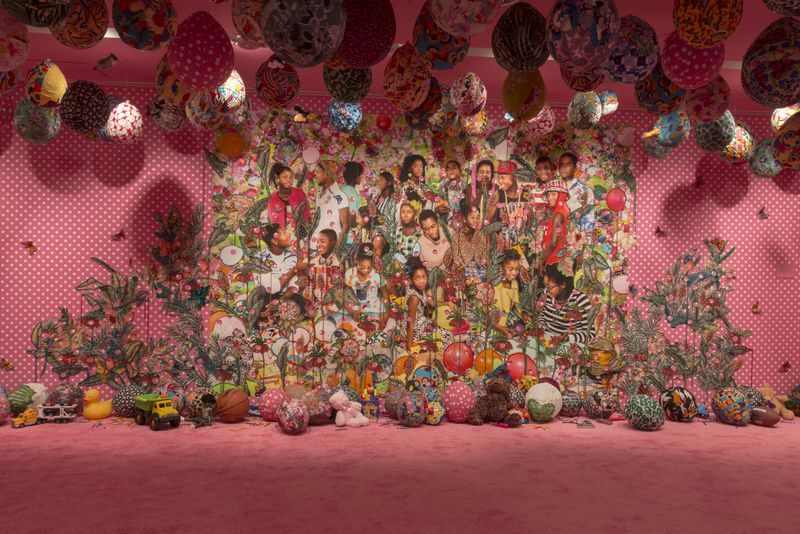
The exhibition emphasizes dialogue across media rather than separation by discipline. Painting, photography, sculpture, and mixed media installations are placed in conversation, activating the galleries as spatial experience. “The show creates a dialogue between generations of artists who may not otherwise be seen together, but who are speaking to shared histories and concerns,” Crum notes.
The Dean Collection, courtesy of Swizz Beatz and Alicia Keys.
For Crum, the curatorial approach is also shaped by a less visible but essential dimension: the Deans as collectors who are also working artists. “What makes their perspective distinct is that they understand the creative process firsthand,” she explains. “They have real personal relationships with many of the artists, and there is a deep sense of community within the Dean Collection. That understanding of the creative grind is embedded in how the collection has been formed and how it is experienced.”
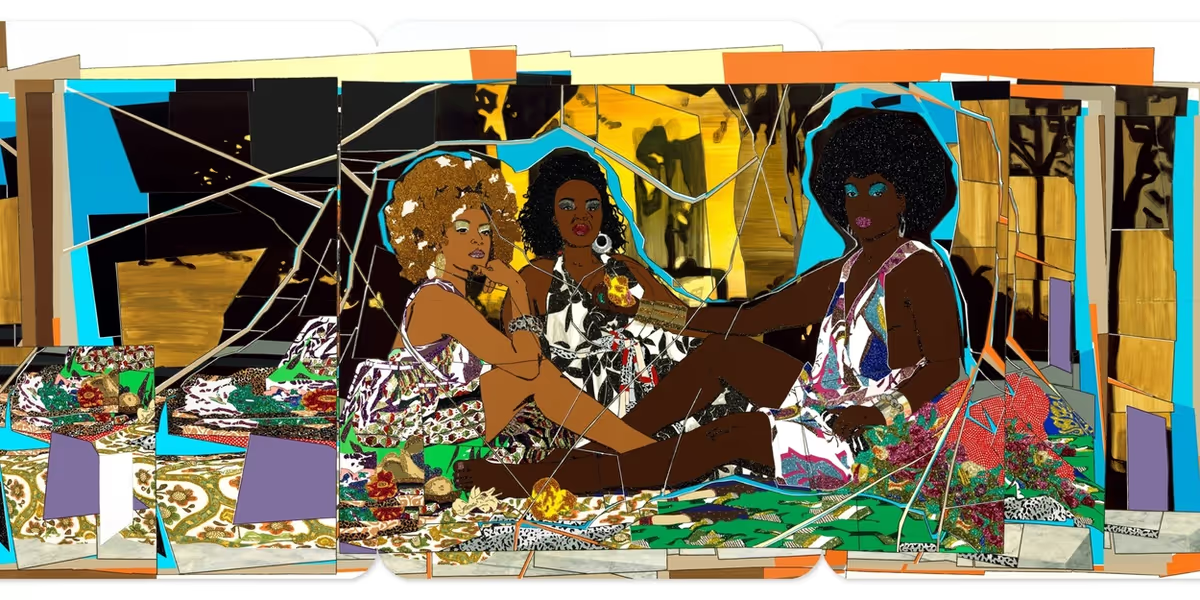
Rather than functioning as a static presentation of a private collection, Giants is structured as a living network of relationships—between artists, works, and institutions. The inclusion of a newly added monumental Mickalene Thomas work further underscores this evolving nature, marking its first presentation with the Dean Collection in MCASD’s installation.
Ultimately, Giants is conceived as an immersive and accessible experience that resists traditional hierarchies of viewing, inviting audiences into multiple entry points across scale, sound, and narrative.
As Crum articulates: “No matter what experience or familiarity you have with art, you can engage with it.” For audiences in San Diego, the result is an exhibition that moves fluidly between scale and intimacy, global discourse and local resonance.
As Crum puts it, “Art is for everyone. We can all be giants.”
.jpg?format=auto&width=800)
The Dean Collection, courtesy of Swizz Beatz and Alicia Keys.
Giants at MCASD will kick off with a Preview Party open to the public on Friday, April 17 from 6-9 PM followed by an After Party at Lou Lou’s Jungle Room at The Lafayette Hotel starting at 10 PM. On Saturday, April 18, MCASD will host a Free Public Opening of the exhibition.
For tickets and more information, click here.
Sign up for all the news on the Fall season, discounts & more...

|
BEGIN AGAIN The Old Globe (9/06-10/11) |

|
Good Night, Oscar North Coast Repertory (9/16-10/18) |

|
Ripcord The Roustabouts Theatre Co. (10/08-11/01) |

|
Charlie and the Chocolate Factory Casa del Prado Theatre (10/23-11/08) |

|
Curious George and the Golden Meatball Poway Center for The Performing Arts (1/16-1/16) |

|
Ripcord Scripps Ranch Theatre (10/08-11/01) |
|
National Comedy Theatre National Comedy Theatre (5/02-12/28) |

|
Odds Are Mosaic Theatricals (10/02-10/18) |

|
MJ Live Michael Jackson Tribute Concert Poway Center for The Performing Arts (4/03-4/03) |

|
Take3 Jukebox Rock Poway Center for The Performing Arts (4/18-4/18) |
