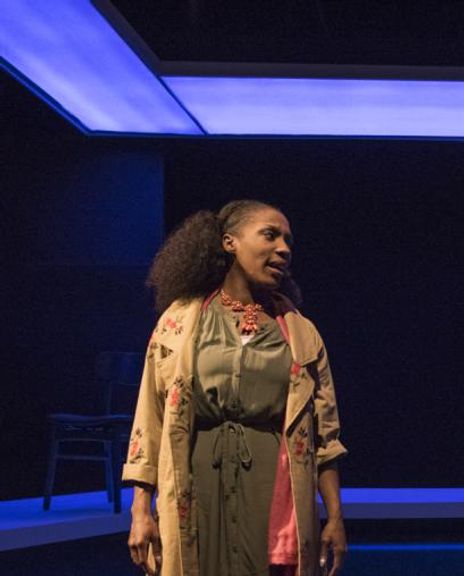
Playwright Lynn Nottage's CRUMBS FROM THE TABLE OF JOY, which is set in the 1950's, initially gives us more than enough plot for one play, presenting us with a grief-stricken widower who decides to pack up his two teenage daughters and haul them off to New York. But, Nottage isn't content to play out this scenario on its own, and opts to pile on contrivance upon contrivance in an attempt to create a sort of surreal slice of life comedy-drama. When it works, it's actually quite magical in execution, but when it doesn't, it just seems to be meandering aimlessly toward another predictably unpredictable twist that only serves to further muddy the heart of the story. Thankfully, Mustard Seed Theatre has put together an engaging production of this convoluted work that features solid acting and direction.
Mustard Seed Theatre opens it's 4th Season with Pulitzer-Prize-winner Lynn Nottage's CRUMBS FROM THE TABLE OF JOY August 27 - September 12, 2010. African-American teenager Ernestina Crumb uses movie fantasies to escape from the challenges of her recent move to New York and a most unexpected Step-Mother. The cast includes real-life sisters Alexis and Tyler White playing the Crump sisters, as well as Patrese McClain, Jill Ritter-Lindberg and Chauncy Thomas.
When August Wilson died in 2005, America lost one of its most influential playwrights. Wilson's legacy - a cycle of ten plays encompassing the 20th Century, continues to captivate audiences around the world for its poeticism and beauty. Geva Theatre Center, as part of its five-year commitment to presenting all ten plays in 'August Wilson's American Century,' will produce the seventh play of the cycle, Two Trains Running, opening March 30 and running through April 25.
It seems only appropriate that Rochester's Geva Theatre Center would transition from Arthur Miller's The Price to August Wilson's Two Trains Running; comparatively speaking, however, Wilson has given Miller a run for his money. Ron OJ Parson's exhilarating production of Two Trains Running, the fourth fully mounted play of Geva's celebration of Wilson and the seventh in his famed Pittsburgh Cycle, gives its audience what The Price never could: an entertaining, well-paced, and (dare I say) priceless night of theater.
When August Wilson died in 2005, America lost one of its most influential playwrights. Wilson's legacy - a cycle of ten plays encompassing the 20th Century, continues to captivate audiences around the world for its poeticism and beauty. Geva Theatre Center, as part of its five-year commitment to presenting all ten plays in 'August Wilson's American Century,' will produce the seventh play of the cycle, Two Trains Running, opening March 30 and running through April 25.
In director Chris Anthony's notes in the program she discusses the question of relevance where Shakespeare's ROMEO AND JULIET is concerned. She correctly points out that 'Shakespeare wrote a story about two families that are fighting and two teenagers that are in love. If you have ever fought or fallen in love, Shakespeare is for you.' This timeless and tragic classic continues to resonate with modern audiences, and under Anthony's guidance it gets a new coat of paint by setting the tale in the turbulent 1960's during the so-called 'summer of love'.