Inside “Stop Writing!”: How David Cornue Turns a Decade of Coaching Into a Story-Development Playbook for Writers
The book reached Amazon on September 1, 2026, moves into wide release across major retailers on September 15.
Written by Will Jones
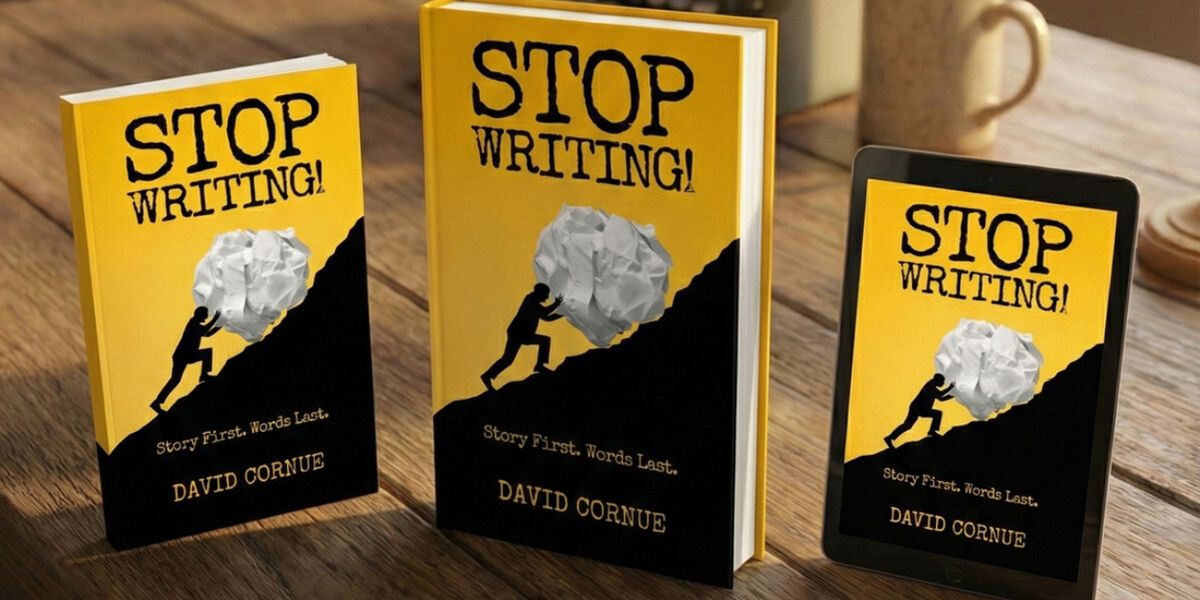
A writing book that opens by telling writers to stop writing sounds like a contradiction. That is exactly the point. David Cornue built his coaching practice on a diagnosis he saw repeat itself across hundreds of clients: the trouble usually starts before the first page, not on it. His new book, Stop Writing!, published by Every Story Press, argues that the writers who finish are the ones who develop a story fully before they type a word of the draft.
The book reached Amazon on September 1, 2026, moves into wide release across major retailers on September 15, and arrives as an author-narrated audiobook on October 1. Its subtitle carries the whole thesis in a single line: master story development before you write a word.
The Problem the Book Was Built to Solve
Most craft books coach writers through the act of writing itself. This one steps back to an earlier moment. The premise is that abandoned manuscripts and grueling late-stage rewrites tend to share a common root, which is a draft begun before its story was ready. “Just stop. Stop going to a blank page and writing yourself in circles,” Cornue writes in the opening pages. “Stop thinking that you’ll figure it out along the way.”
That framing reflects a familiar pattern for anyone who has stalled halfway through a project. A promising idea loses its shape somewhere around the middle; the writer pushes forward hoping clarity will arrive, and the work eventually stops. The counsel here treats development as the load-bearing stage of the whole process. Time spent shaping the story first, in this view, is what separates a completed work from one that ends up in a drawer of unfinished pages.
A Method in Four Movements
Rather than offering encouragement alone, the book lays out a sequence a writer can repeat on any project. It moves through four parts: Envision, Engineer, Execute, and a closing section named for the moment a writer has actually earned the right to draft: Start Writing! Each stage takes an abstract phase of development and breaks it into concrete steps.
Along the way, the book introduces the instruments Cornue uses in his own sessions, including the Story Catcher, the Logliner, the Story Rater, a Character Creator organized around twelve archetypes, and the Story Mapper. Each chapter converts a stage of the work into something a writer can practice and reuse, from capturing a raw idea to pressure-testing a premise and mapping the shape of a full narrative. The payoff Cornue describes is a shift in effort: “when you’re ready to write, the story writes itself.”
The structure doubles as a diagnostic. A writer who feels stuck can trace the stall back to a specific movement, whether the concept was never sharpened, the characters were never fully engineered, or the plot was never mapped before drafting began. That makes the framework useful not just for planning a new project but for rescuing one that already went sideways.
The Coaching Practice Behind the Pages
The authority of the method comes from a working coaching practice rather than theory. David Cornue has helped writers land representation at top agencies, staff Emmy-winning shows, and sell scripts to major studios. The book distills that track record into a form any writer can follow without access to a private workshop.
“For years, this method lived only in my workshops and private sessions,” Cornue said. “Stop Writing! is my attempt to hand it to every writer who has ever felt stuck, no matter where they are or who they know.” That last clause points at the book’s democratizing intent. Professional development coaching has long been the province of writers already inside the industry or able to pay for one-on-one guidance. Packaging the same instruments into a book lowers that barrier considerably.
The intended readership is broad by design. It reaches working professionals and emerging storytellers alike: screenwriters, novelists, television writers, and anyone who has shelved a promising idea before finishing it. Because the tools were drawn straight from a decade of coaching professional writers, the guidance carries the specificity of real cases rather than the abstraction of a general how-to. Additional craft essays and launch notes from the author run on his newsletter, Stop Writing! on Substack, which extends the book’s ideas week to week.
From the Writers’ Room to the Page
The professional history behind David Cornue gives the book its credibility. A writer, producer, composer, and story coach, he served as Executive Producer of COACH with Bill Belichick and Matt Patricia on ESPN+, and he created, wrote, and executive-produced the ABC and 20th Television medical drama TRIAGE, working with showrunner Erica Messer of Criminal Minds and director Jon M. Chu of Wicked.
His slate reaches across the industry. He is developing a television adaptation of Stephen King’s Insomnia with Rideback. He wrote, produced, and scored the pilot Unspeakable, which premiered at SXSW and won Best Pilot at multiple festivals. He was selected for Ron Howard and Brian Grazer’s inaugural Imagine Impact class and for the Fox Writers Lab, and he has written and produced for ABC, FOX, A&E, and USA Network. That range, spanning scripted drama, documentary, and original pilots, informs a method meant to hold up whether the end product is a screenplay, a novel, or a television series.
The through-line across those credits is story development as a discipline. Selling a pitch to a network, staffing a writers’ room, and shepherding a pilot to a festival premiere each depend on a story that works before production ever begins. The book treats that professional habit as a teachable skill rather than an instinct reserved for insiders.
A Publishing Venture With a Point of View
The book also marks a step into publishing on the author’s own terms. In 2024, David Cornue co-founded Every Story as a thoughtful venture aimed at helping creative minds get their stories into the world, with a publishing arm and a software platform. Stop Writing! arrives under its Every Story Press imprint. Releasing a debut craft book through a company he helped build lets the method and the platform advance together, with the book serving as the fullest articulation of the development philosophy the company is organized around.
The staggered release reflects that deliberate approach. Early access on Amazon on September 1 gives the earliest readers a head start, the September 15 wide release opens the book to every major retailer in ebook, paperback, and hardcover, and the author-narrated audiobook on October 1 hands the material to listeners in Cornue’s own voice. Readers who want to follow the author’s ongoing commentary can find him on LinkedIn, where he shares craft notes alongside the book’s launch.
Why the Timing Resonates
The book lands amid a broader conversation about how writers protect their craft and sharpen their judgment. It relies on Cornue’s own tagline of “Story First. Words Last.”, encouraging writers to give themselves permission to dream up possibilities prior to committing to a singular path. For an audience of screenwriters, novelists, and industry hopefuls, that message reframes discipline as an advantage rather than a chore, and it positions preparation as the writer’s most reliable tool.
What David Cornue offers, ultimately, is a structured alternative to the blank-page gamble that stalls so many projects. Stop Writing! translates a coach’s private toolkit into a public method, giving writers a repeatable way to know their story is ready before they commit to the draft. For a field crowded with advice about how to write, a book about what to settle before writing carves out a distinct and practical lane.
Photo Credit: David Cornue
Prefer BroadwayWorld in Google Search?
Add us as a preferred source so our stories show up more often in Top Stories and Google’s AI answers — for you.
Sign up for all the news on the Fall season, discounts & more...
.jpg?format=auto&width=300)