


Greek National Opera Will Perform THE WORD This Month
Performances will run 18-19 April.
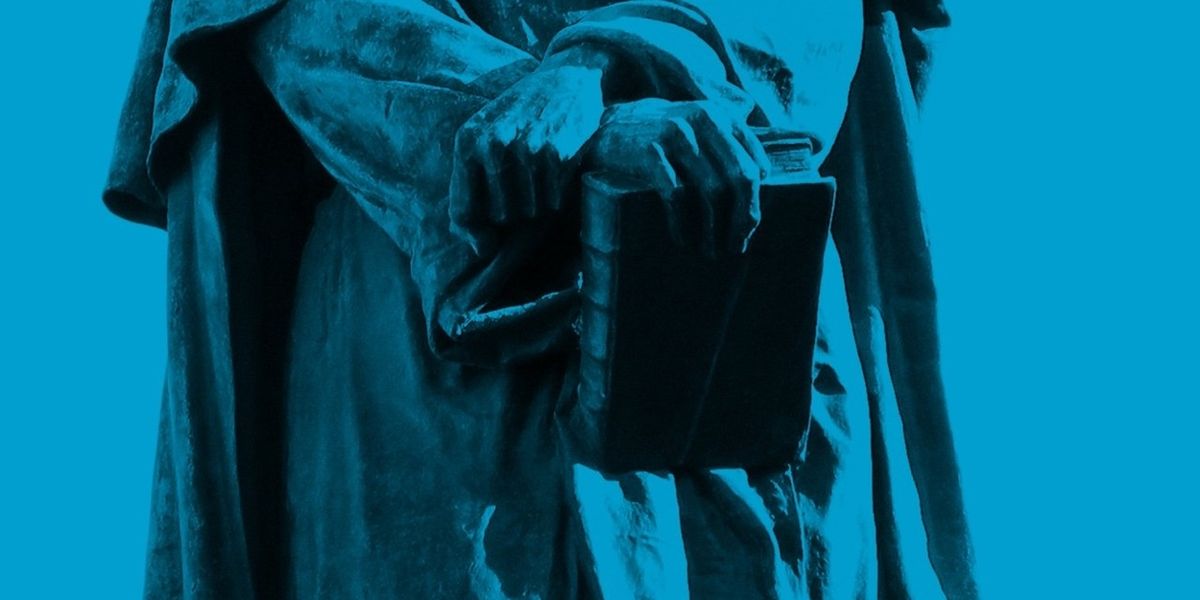
The life, ideas, and martyrdom of Italian philosopher Giordano Bruno will be brought to life at the GNO Alternative Stage at the SNFCC through a new opera production titled The Word, featuring music by the renowned composer and maestro Alkis Baltas and a libretto by Eleni Zafiriou. Directed by Angela-Kleopatra Saroglou, it will have two unique performances on the 18th and 19th of April 2026. The role of Giordano Bruno will be performed by the internationally acclaimed baritone Tassis Christoyannis.
The opera The Word dramatically and contemplatively illuminates a man’s unrepentant stance against obscurantism by recording his inner conflicts, scientific visions, and uncompromising choice to die as a free individual rather than renounce his truth.
Giordano Bruno (1548-1600) was condemned for heresy by the Holy Inquisition and was sentenced to death by burning at the stake for his theories about the immensity of the universe, the Earth’s motion, and the existence of solar systems. Despite threats to kill him, Bruno refused to utter the word “I renounce” regarding his theories until the very end of his life.
Within his cell, Bruno recalls periods of his life and his scientific theories as he engages in a difficult dialogue with his conscience and grapples with the dilemma of choosing between life and death. Before the Inquisitors, he defends his ideas and opposes obscurantism. In the end, he walks towards the “inflamed stake” with a full “heroic consciousness,” remaining faithful to the theoretical principle he both taught and fully practiced.
Synopsis
The work fictionalizes four final “snapshots” in the life of an unwavering consciousness that shone during the Renaissance: the “heroic consciousness” of Giordano Bruno. Bruno was a thinker, philosopher, astronomer, and poet who, when faced with the Inquisition’s fierce ecclesiastical court, refused to recant his beliefs and was sentenced to death by burning.
First snapshot: In an inhumane prison where he was held isolated for seventeen years, Bruno recounts stories and reminisces about events from his turbulent life.
Second snapshot: As he prepares to face his judges, he engages in a dialogue with his consciousness. This dialogue explores issues ranging from the dread humans feel when faced with the imperative necessity of the end to the adoption of an ethical stance against such an inevitability. The decision he makes will be decisive not only for himself and his era but also for the future.
Third snapshot: Before his judges, he doesn’t apologize; he takes stock of his life. He fulminates against his punishers, and with his arguments, he shifts the blame onto them. “I will not apologize. With my heart, I will speak and give an account of my life. I will not apologize! That is for the wrongdoers. And the wrongdoers in our case are you!”
Fourth snapshot: Giordano Bruno atop the burning stake unleashes the fiery arrows of his soul’s tremendous strength against the hypocrites and obscurantists, against the defenders of an inhumane, irrational, and degenerate world.
He also predicts the future. He foretells that his sacrifice will serve as fertilizer, helping the seeds of human society's historical advancement to sprout.
Eleni Zafiriou’s libretto, penned with poetic expression and rhythmic flow, is entirely a work of fiction, although it touches upon real-life figures, events, and circumstances. The author’s intention, inspired by Giordano Bruno’s ideological strength, was to capture man’s emotions, thoughts, ideals, conflicts, exceptional mental resilience, and uplifting qualities, who, when faced with all kinds of “death squads,” opposes the corruption and degeneration of life until the very end. “Can a word play the leading role in inspiring a libretto? Undoubtedly, yes, if that word is the word “renounce.” And there lies the “hidden identity” of the title of the opera, The Word. I – renounce – is the word that has historically led, and will continue to lead everyone to face their own consciousness in their inner battlefield, in a cunning, misleading, and seductive manner; there, where a person gives their own special fight for their beliefs, values, and worldview. Alone, armed with their morality and the strength of their convictions. Alone, like a weighmaster who uses either the deceptive image of a degenerate reflection of life or the truth of objective reality as a counterweight,” notes Eleni Zafiriou.
The opera’s music bears the stamp of distinguished composer and maestro Alkis Baltas, who will also be conducting the production. Eleni Zafiriou’s libretto, with its powerful, emotionally charged scenes and poetic style, enthused the composer, leading him to create this opera, which was completed in 2024. “Eleni Zafiriou’s powerful libretto gave me, as a composer, numerous opportunities to convey ideas and emotions through the music, without the need for them to be realistically conveyed on the stage. The element that moves me in Bruno – apart from his philosophical ideas and poetic visions – is his devotion to what he believes in and his refusal to renounce his theories, even knowing that this will lead to his death. I tried to include the poet Bruno, his philosophical, clear thinking, and, ultimately, his mental strength in my music,” notes Alkis Baltas.
The production is staged by Angela-Kleopatra Saroglou, in her new collaboration with the Alternative Stage, following the one-act chamber operas by Haris Vrondos, Requiem Akhmatova & The Anniversary (2021). The stage and sets are designed by Yannis Katranitsas, the lighting design was created by Christos Tziogkas, and the video projections by Vasilis Kehagias.
Giordano Bruno will be portrayed by Tassis Christoyannis, and the Voice of Consciousness by Marisia Papalexiou.
The vocal ensemble consists of Christos Amvrazis, Paris Dimatsas, Yannis Kavouras, Nikos Masourakis, Philippos Vazakas, and Dimos Vlachos.
Also performing will be a three-member instrumental ensemble, including Triantafyllos Loukas (violin), Asterios Pouftis (cello), and Thalia Athaniti (piano, harpsichord, organ).
Love Theater in Greece? Join The Community!
Whether you've got past experience writing about theater or just starting, the BroadwayWorld Community offers a unique opportunity to become a champion for your local arts community, helping raise awareness of local offerings and adding another local voice to the conversation at a time arts coverage is shrinking in the press across the continent. Join us and become a pivotal part of the movement that celebrates and promotes the arts in the digital age.
Learn MoreSign up for all the news on the Fall season, discounts & more...
