


Review: LETTER FROM MAX at The Ancram Center For The Arts Is a Summer Jewel Well Worth the Drive
Critic's Pick. Through July 26 at Ancram Center for the Arts, Ancram, N.Y. The show offers poetry and devotion
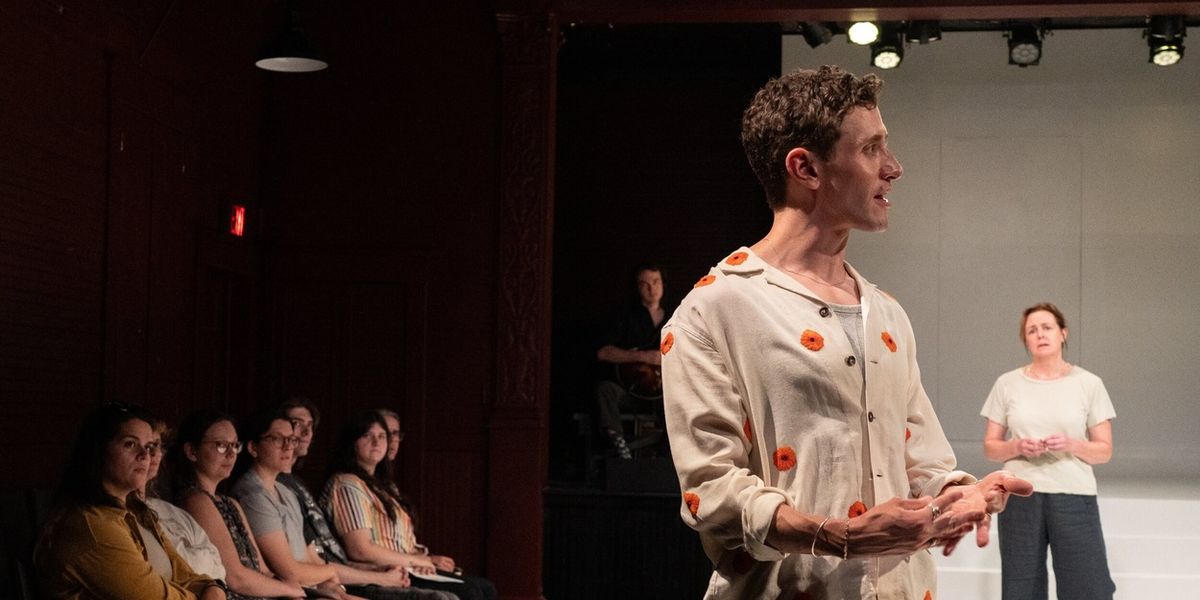
There is a particular pleasure to theater in our part of the world at this time of year, when the city empties out and the real discoveries are happening in barns, grange halls and converted mills up and down the region. Summer stock and regional theater are where the form keeps its nerve, and the finest of these companies are jewels tucked away down back roads. Ancram Center for the Arts is one of the best we have anywhere near here, and its production of Sarah Ruhl's Letters from Max, running only through this Sunday, is the sort of thing you spend the next year regretting if you let it pass.
A long three-quarter thrust runs the length of Ancram Center's Grange Hall, clinical white and raised barely two inches off the floor, the audience banked close on three sides so that we sit watching not only the actors but one another. In a theatre this size the arrangement takes away the mercy of distance, and it keeps reminding us that we are here together, in this room, listening. The runway is about ten feet wide; it begins near the hall entrance and travels the length of the space to a short flight of five white steps, which climb to the stage proper and carry the same white path upstage to a plain white wall. The design is deliberately spare, built to let the language do the work. Anyone who has seen the cover of the book version will know it on sight: small pages of paper adrift in the air, and here the whole white playing space laid out like a single sheet of it.
Ricciardi choreographs the two lives across this white, and the blocking tells you things the dialogue does not. Sarah comes and goes as she likes, always from the far downstage end near the entrance, and never once climbs the five steps to the stage proper. Max is never seen to arrive; the lights simply find him already up on the raised stage. From there he descends to her, so that the two of them pass most of the play together on the lower ground and meet, once or twice, on the stairs between. The crossing runs one way. He can come down into her world; she never goes up into his. That is the right place for Sarah Ruhl's Letters from Max to happen, since the play is finally an argument about thresholds: the space between teacher and student, and the narrower one between a young man battling cancer and the woman who meets him in between. What the play is really about, underneath the illness and the poems, is what most of us spend a lifetime hoping for and few of us are ever given: the one other person who reads us down to the root, who answers the letter we did not know we had sent. Ruhl and Ritvo met as teacher and student and became something the language barely has a word for. Friend is too small. Soul mate, if we are brave enough to say it, comes nearer. It is the rare and unreasonable luck of two people recognizing each other on sight and deciding, for whatever time they are given, to belong to one another. That is the devotion the evening honors, and it is why the room goes so still: we are watching not a mentorship but a communion that asks in return only that we keep writing back. The production has grasped that a threshold is somewhere you can stand, not only a line you cross.
The facts are familiar to anyone who followed the play's 2023 New York premiere. In 2012 the poet "and comedian" Max Ritvo turned up in Ruhl's playwriting seminar at Yale, a young man of ferocious verbal gifts and a cancer first diagnosed at sixteen. Their friendship, carried mostly in letters and later gathered into the 2018 book Ruhl assembled from the correspondence, ran through the years Ritvo spent battling cancer, until 2016, when he was twenty-five. Ruhl has adapted that record for the stage, and the adaptation makes a slightly dangerous wager: that two people writing to each other can hold a theater. The letters, Ricciardi has said, are "expressed as if it were dialogue," and the transposition works. What might have been an evening of recitation becomes two people trying to reach each other across a space that keeps changing its width.
For most of the first act that space holds two chairs. They are institutional chairs, the kind bolted into the memory of every seminar room, set center and angled toward each other so that Max and Sarah are always almost facing, never quite squared off. Andrus Nichols, as Sarah, sits in hers the way a teacher sits, provisionally, ready to lean in. Evan Horwitz, as Max, treats his as something that holds him up when the body has quit. Lily Guerin's scenic design gives them almost nothing else, and withholds the rest on purpose. When the chairs disappear in the second act, the two are left with only the bare white and the words going between them, the scaffolding of the mentorship struck.
Nichols is an intelligent stage actor, and she plays both Sarah and the Narrator without a trace of the reverence that sinks so many memory plays. Her Sarah is funny, a little vain about her own good sense, and slow, beautifully slow, to notice that the student has become the one doing the teaching. The role asks her to travel from the brisk authority of the classroom toward something closer to a mother's helplessness, and she does it without visible seams; you register the change only after it has happened. Horwitz has the harder assignment and meets it skillfully. He ages Max from a charmingly cocky nineteen into a young man bargaining daily with his own extinction, and he keeps the cockiness intact all the way down. Ritvo was not ennobled by battling cancer, and the performance declines to pretend otherwise. What Horwitz offers instead is a mind so alive to language that the tumors read as an interruption of a sentence meant to keep going.
Here Ruhl's imagination and Ritvo's meet, and the production is wise enough to slow down and let the poems be heard. Poetry is the register in which these two actually reach each other, the thing Max turns to when plain speech will not carry the load, and the thing Sarah, having taught it, receives back transformed. His mind bolts from a plain fact into an outlandish image without warning. The "cerulean light" of a new CT machine turns, mid-thought, into something worth marveling at. Illness grows its own adverb when he accuses himself of having behaved too "cancerily" with an old friend. What undoes you is that the despair and the delight come in together, the joke not lifting the dread so much as moving in and living inside it. This is the real argument the evening makes, that metaphor is not a finish laid over feeling, but the only instrument fine enough to hold feeling this size. Max hands Sarah an image, she hands one back, and the exchange does what no prognosis can, clearing a space where the unbearable can be turned over in the hands and even laughed at. When the two of them build a conceit together, brick by brick, you are watching a friendship conduct itself in the only language large enough for what is happening to it.
Then there is the third figure on the stage, and here Ricciardi makes another bold choice. Ruhl's script suggests music, but requires no particular instrument, and the Signature production in New York alternated on different nights between a piano and a guitar. Ricciardi hired Liam Bellman-Sharpe for his command of piano and guitar, but after several days improvising on each in rehearsal they settled on the electric guitar. The choice rewires the play. Bellman-Sharpe is not scoring a memorial. He is the current, the live wire of Max's own body, the healthy self that goes on speaking and moving and ringing out after the body has begun to fail. The electric guitar argues, bends and distorts refusing to settle, and what it carries is the preoccupation that runs through Ritvo's work and titles the book he called Four Reincarnations, the possibility he turned over and doubted and turned over again, that the self is not simply snuffed out but handed on, passed like a charge from one conductor to the next. Bellman-Sharpe, who designed the sound and composed most of what we hear, is set apart from the two actors, up on the stage at the right and never out of view. His compositions are beautifully sensitive, haunting one moment while wry and funny the next, and his steady presence works on the evening like that of an observer, or something closer to a heavenly one keeping watch. He plays the figure as something nearer a frequency than a ghost, a live current that keeps to the high place, while Max's body descends into the room, and that goes on sounding whether the body is there or not. When the music rises up under one of Max's lines, the evening stops being about a body battling cancer and turns into something about what outlasts its source.
The staging performs that faith rather than quoting it. Evan Anderson's lighting keeps company with the idea, drawing the white runway away from the flat neutrality of a classroom toward something votive as the night goes on, until the two figures seem to stand in a nave. Alicia Evans's costumes stay stubbornly ordinary, people in their own clothes, not effigies, and that plainness keeps the votive from curdling into solemnity.
Ricciardi directs with a restrained, taut hand, and the register he holds is brittle and lugubrious and joyful and uplifting by turns. He calls the evening a ritual, and the word is worth taking at face value, because ritual is what Ancram Center for the Arts has quietly gotten good at. The company has spent a decade learning what its own room can do, seventy seats in a Grange Hall in a Columbia County hamlet, and it has never once pretended the room is somewhere else. No one here strains to conjure a Yale seminar or a Manhattan hospital ward. The play happens in Ancram, spoken directly to the people of Ancram, and that plainness is a form of respect: for the writing, and for the audience gathered into the dark. A company that can hold seventy people inside a poet's battle with cancer and leave each of them feeling personally addressed is doing work the region can find nowhere else, and doing it at the height of its craft.
The run ends Sunday. Running time: 2 hours. Only a handful of performances remain, and the room is small by design, so the arithmetic punishes anyone who waits. Go you must, while the current is still live, and when you go, consider leaving something behind: Ancram Center is a not-for-profit, and a company that makes work this fine depends on the people who value it to keep the doors open. The play spends two hours insisting that nothing comes back in the same body twice, and then spends its last minutes, an electric guitar and two empty chairs, quietly taking it back.
There is more than one way to keep a place like this alive, and the most joyful is to come to the party. Ancram's Summer Bash 26 lands Saturday, August 1, from 6:00 to 10:00 pm at The Farm at Pond Lily in Elizaville. Last year's sold out, so the time to get tickets is now. The evening runs the whole arc of a good summer night: a cocktail hour with wine, drinks, and hors d'oeuvres, a buffet dinner, special performances that include a one-night-only show with The Bengsons, a paddle raise to carry the season ahead, and dessert and an after party to send everyone home happy. The setting alone is worth the drive, about as bucolic a corner of the county as you will find. Make your plans now.
And the stage does not stay dark for long. Up next is I'm Almost There, August 7 through 16. Love at first sight is easy; letting it through the front door is a goddamn Odyssey. All our hero wants is to let the perfect man in, but first he has to survive an unhinged neighbor, a seductive cult, a self-obsessed vampire, and a cat intent on dragging him to hell. The New York Times called it "a formally daring experiment in pared-down musical theater that connects with both mind and heart." On the strength of Letters from Max, Ancram has more than earned your trust for the trip.
Find tickets to Letters from Max and more shows at www.ancramcenter.org
Sources drawn upon: reviews and previews from Berkshire on Stage, Chronogram, and Exeunt Magazine NYC, and the Ancram Center for the Arts production listing.
Prefer BroadwayWorld in Google Search?
Add us as a preferred source so our stories show up more often in Top Stories and Google’s AI answers — for you.
Love Theater in Central New York? Join The Community!
Whether you've got past experience writing about theater or just starting, the BroadwayWorld Community offers a unique opportunity to become a champion for your local arts community, helping raise awareness of local offerings and adding another local voice to the conversation at a time arts coverage is shrinking in the press across the continent. Join us and become a pivotal part of the movement that celebrates and promotes the arts in the digital age.
Learn MoreSign up for all the news on the Fall season, discounts & more...
|
DRACULA: THE JOURNAL OF JONATHAN HARKER Bannerman Island (9/16-9/26) |
|
OFC Creations Theatre Presents: Hairspray! OFC Creations Theatre Center (9/24-10/11) |
|
Peter Samelson Up Close: An Evening of Theatrical Magic Bridge Street Theatre (9/25-9/25) |
|
Aztec Two-Step 2.0 Caffe Lena (9/26-9/26) |
|
Mamma Mia! Proctors Theatre (4/06-4/11) |

|
ROCK OF AGES The Merry-Go-Round Playhouse (9/16-10/03) |

|
A Christmas Carol Geva Theatre (11/25-12/27) |
|
OFC Creations Presents: Kiss of the Spider Woman OFC Creations Theatre Center (1/28-2/14) |
|
Our Town Nazareth University (10/08-10/10) |
|
Topdog/Underdog Geva Theatre (10/13-11/22) |

Reader Reviews
To post a comment, you must register and login.