


Review: THE PIRATES OF PENZANCE at St. Louis Opera Theatre
G & S classic in brilliant St. Louis Operra Theatre production
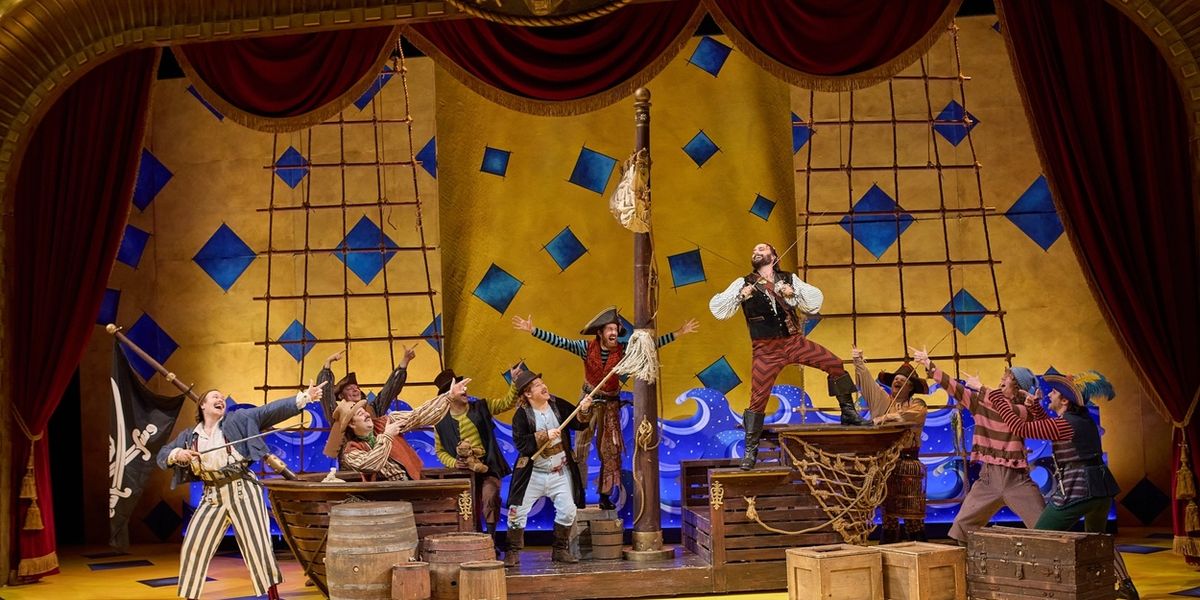
It's almost a century-and-a-half old, but it's as fresh and appealing as when it first bounded into the public eye on New Year's Eve, 1879. It's The Pirates of Penzance—perhaps the most irresistible of Gilbert and Sullivan's comic "Savoy" operas. Opera Theatre of St. Louis has opened a delicious production of this gem.
It’s a splendid way to kick off the fifty-first season of this decidedly world-class company.
Opera Theatre must have some kind of special arrangement with the weather gods. Once again (as has happened several times in past seasons) despite threatening rain forecasts the evening was lovely—and dry. Patrons happily enjoyed their elegant pre-show picnic suppers at tables set out on the beautiful grounds.
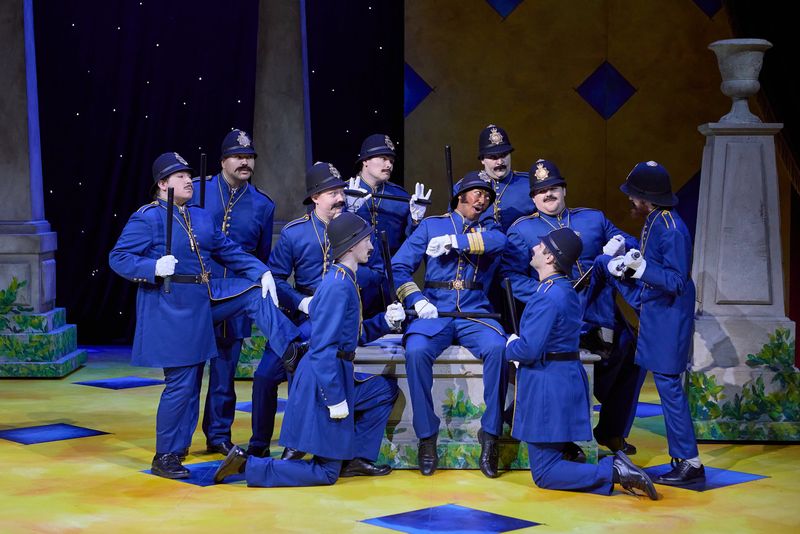
Pirates of Penzance is the wondrously improbable tale of Frederic, an orphan mistakenly apprenticed to a pirate. A victim of duty, he has honored his contract of indenture in this odious calling. But Frederic has now achieved his majority and is free to follow a more honest path. We meet the inevitable delightful bevy of maidens. They are the daughters of Major General Stanley. True love arises between Frederic and the lovely Mabel. The pirates plan to forcibly marry the other daughters. A squadron of police appears and does battle with the pirates. They are the goofiest constables you've ever seen—veritable Keystone Kops (though they preceded their cinematic counterparts by some forty years). In the end, of course, honor, patriotism, and true love triumph. Is this comedy? Well, it ends with thirteen marriages, so it must be. And it's as zany and irreverent and modern as Monty Python. There is an extended confusion with the words "orphan" (one without parents) and "often" ("frequently") that is pure John Cleese and Eric Idle.
The orchestra is composed of a tranche of the St. Louis Symphony Orchestra. Under the direction of George Manahan they give us on overture that is simply gorgeous! With glimpses of many of the show’s familiar and beloved songs, these musicians perfectly, comfortably, exactly fill the hall. Now, for me the overture in most musical theater is a thing to be patiently waited through—an amuse bouche, yes, but mostly a sort of fee we pay for entrance into the action. But last night the overture was a thing of great beauty to be appreciated for itself. Arthur Sullivan was, of course, a serious composer of classical and sacred music. His skills were loftier than was demanded for “common entertainment”. In fact in the premiere production of Pirates the orchestra threatened to strike for higher wages because Sullivan's music was closer to opera than to operetta. There’s much complexity, much subtlety, and very much real beauty in the score. Maestro Manahan and his musicians found and presented all that to us last night. Perhaps I was seated in an acoustical sweet spot, but I could perceive every instrument, every timbre, every subtlety of dynamics—yet all of this joined into one organic musical voice—which seemed to breathe these beauties into my ears. Wonderful work!
The set is a delight! The proscenium is Victorian, with curtain appropriately draped in red-velvet swag.
Act 1 shows us a Cornish seaside awash in bright cartoon colors: floor and sky of daffodil yellow, with crisp squares of the blue of Superman’s leotard. Stylized blue waves sport along the ground-row. A very make-shift rough-wooden pirate ship and its rag-tag crew roll in. All very jolly!
The pirates are a most feckless lot. (They’re precursors to Captain Hook’s crew of the Jolly Roger, which J. M. Barrie gave us twenty-five years later.) These pirates are too tender-hearted. Out of pity they refuse to take loot from anyone who claims to be an orphan. The Pirate King is dashingly played by William Socolof.
We meet young Frederic, our hero, who bids farewell to his comrades: he’s going straight. We meet the spirited Ruth, who was Frederic’s nursemaid—and has faithfully attended him all these years. Ruth is lustily sung by Meredith Arwady. (I well remember her strong performances in OTSL’s Emmeline and Dialogues of the Carmelites.)
Frederic is sung by Daniel Luis Espinal who has a fine, clear tenor voice that just seems to get even better as the evening rolls on. I think, though, that should he shave his neat little moustache it would add to Frederic’s necessary innocence and naiveté. (It would grow back so quickly!)
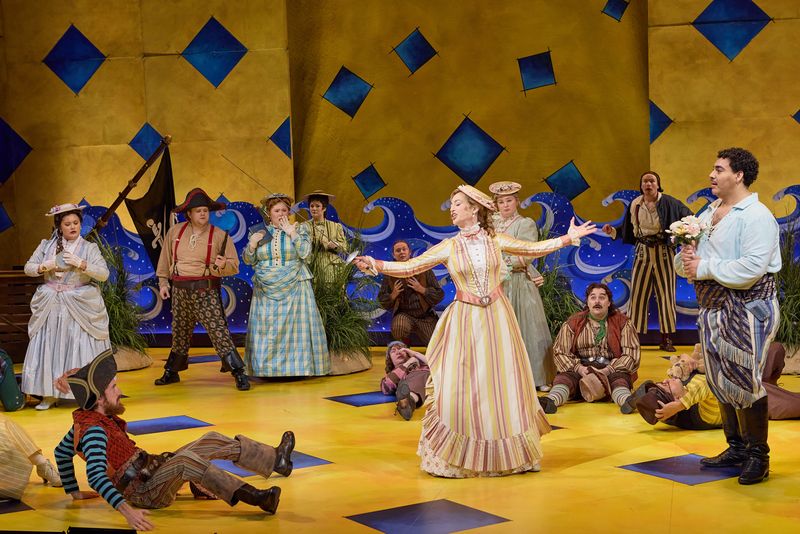
We meet a dozen lovely sisters with parasols, taking a stroll on the beach. (Might they be so daring as to remove their shoes and stockings to take a wade?!) The pirates are instantly smitten and plan to marry these maidens (by force).
“You shall quickly be parsonified,
Conjugally matrimonified,
By a Doctor of Divinity
Who is located in this vicinity.”
Among these girls Mabel is the youngest and most beautiful. She falls instantly in love with Frederic. Jana McIntyre has a voice for which this role is a real show-case. It’s by far the most “operatic” role in the evening—tricked out with stratospheric notes and lots bel-canto decoration. She absolutely nails it! She’s the musical high-light of the evening.
Enter Major-General Stanley (Robert Mellon), who stuns us with his lightning diction in Gilbert and Sullivan's very best "patter" song, "The Model of a Modern Major-General". Mellon, a St. Louis favorite, is master of all things comic.
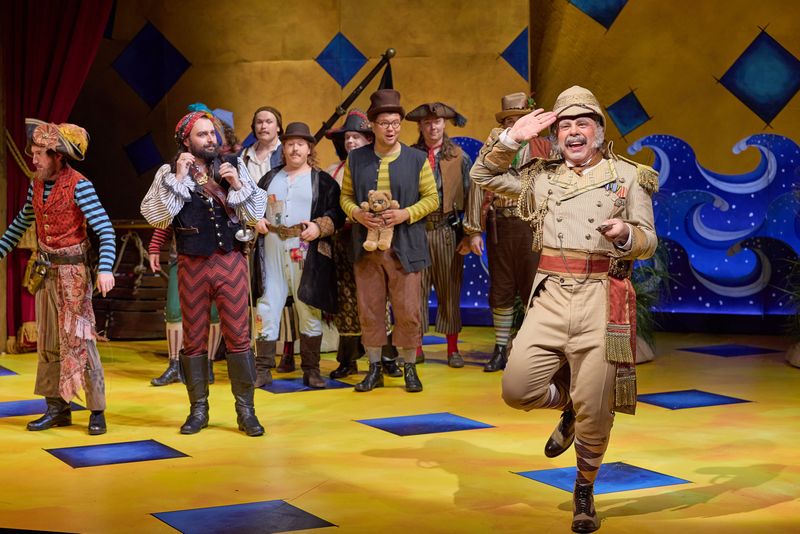
James Schuette designed the beautiful costumes—Victorian, with comic touches. To me there seemed a slight dissonance between the palette of the set (intense cartoon colors) and that of the costumes (rather more muted).
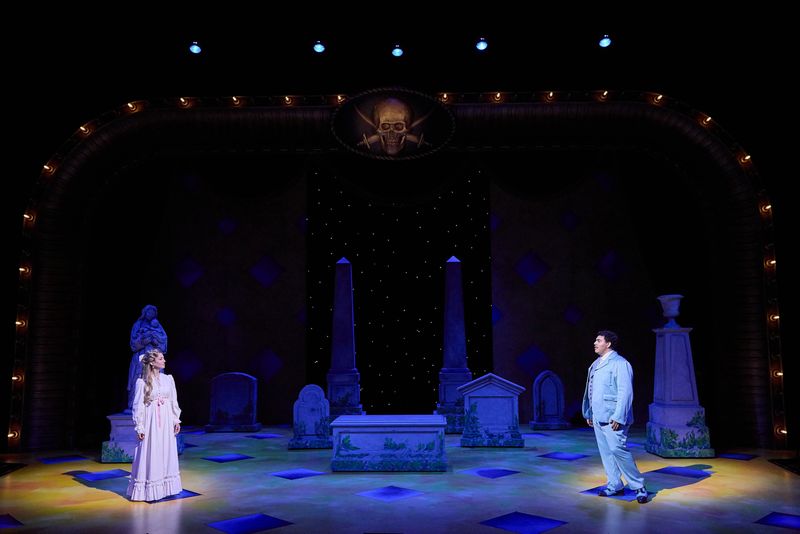
In Act 2, however, this dissonance vanishes. We find ourselves in a lovely graveyard on the Stanley estate: marble tombstones, obelisks, a statue, an urn—all in moonlight whites and grays and blues. The dark sky is filled with brilliant stars. The sisters, when they arrive, are all clad in long white night-gowns.
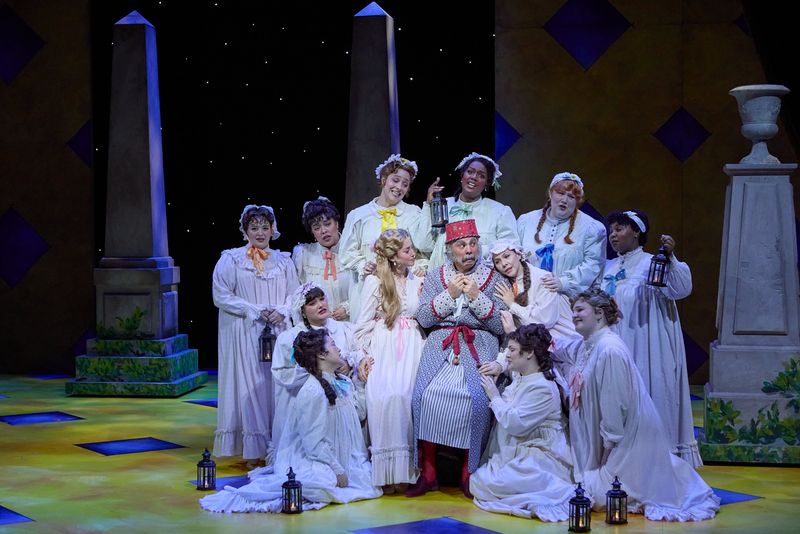
Major-General Stanley cannot sleep. His conscience is troubled because he allowed himself to tell a fib to the pirates in order to ward them off: he told them he was an orphan. Now he frets among the ghosts of his ancestors. (Well, he only recently bought the estate and it’s graveyard. He doesn’t know whose these ancestors were, but he knows that since the purchase they are now his ancestors!)
The pirates stealthily approach to wreak vengeance (and seize their brides). The Police arrive, led by their Sergeant (stalwartly sung by Shyheim Selvan Hinant, who has a gift for physical comedy). These bobbies all move in a uniform Chaplinesque toddley walk. Riotous comedy ensues.
All conflict is finally resolved by an appeal to the two character traits which formed the bedrock upon which the British Empire was built:
- an adamantine commitment to duty,
and - a profound love of The Queen.
Happily ever after!
(Only the Policemen go off without brides. Theirs is indeed, “not a happy lot.”)
OTSL’s Sean Curran directed and choreographed this production. When one person with a single vision provides both these functions for a show magic can happen. I recall Curran’s utterly wonderful work in Ariadne on Naxos some years ago. In Pirates he again shows masterful skills in both these aspects of the show.
This joyous production of Gilbert and Sullivan’s great and evergreen The Pirates of Penzance plays at Opera Theatre of St. Louis through June 27.
P.s. Don’t miss the pre-show talk at 6:30. This is given by Sharon Bjorndal Lavery. She’s the repetiteuse (rehearsal pianist) and she simply bursts with charm and charisma and fascinating information about the show.
Photos by Eric Woolsey
Prefer BroadwayWorld in Google Search?
Add us as a preferred source so our stories show up more often in Top Stories and Google’s AI answers — for you.
Sign up for all the news on the Fall season, discounts & more...

|
Alex Edelman’s Just for Us New Jewish Theatre (NJT) (10/01-10/18) |

|
Come From Away Kirkwood Pac (9/18-10/18) |

|
Mamma Mia! The Fabulous Fox Theatre (3/30-4/04) |
|
|
Mamma Mia! Fox Theatre (3/30-4/04) |

|
Parsons Dance Touhill Performing Arts Center (4/10-4/10) |
|
Wicked Fox Theatre (5/12-5/30) |
|
Amadeus Gaslight (2/05-2/21) |

|
Rocky Horror Picture Show Original Cast Spooktacular Tour with Barry Bostwick, Nell Campbell, and Patricia Quinn The Fabulous Fox Theatre (10/06-10/06) |
|
Ballet Hispánico New York Touhill Performing Arts Center (11/14-11/14) |
|
The Color Purple (The Musical) The St. Louis Black Repertory Company (9/09-9/27) |

Reader Reviews
To post a comment, you must register and login.