


Review: TOSCA at La Monnaie
A Bold Pasolini Inspired Vision That Intrigues More Than It Wounds
Before the curtain rises, a Pasolini quote appears. It’s a clear warning this TOSCA won’t simply walk through Puccini’s Rome. It’ll filter it through Italian cinema, religion, power, desire, and violence.
Then the curtain lifts and we see a beautiful white revolving set. It instantly takes us somewhere between Pasolini, Fellini, and the sharp visual language of Italian cinema. Emanuele Sinisi’s design is minimalistic and stylised. It turns, opens, slides, and reframes the characters with elegant precision. At its best, it helps the production focus our eyes exactly where they need to go.
Under Jordan de Souza’s musical direction, the La Monnaie orchestra sounds absolutely beautiful. Lush. Grandiose. Nuanced. It moves from subtle textures to full orchestral force with impeccable control, and Puccini’s score keeps its sweeping emotional architecture even when the staging pulls the story into a colder conceptual world.
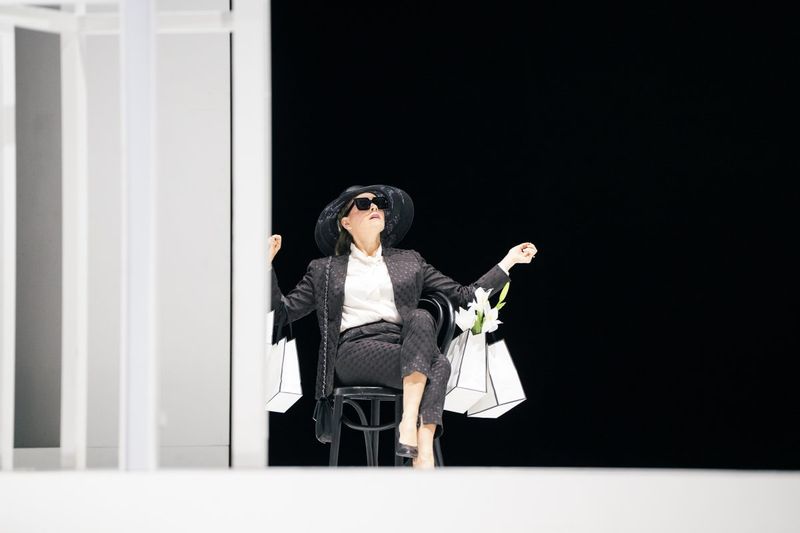
Vanessa Goikoetxea’s Tosca enters like a figure drawn from a 1970s Milan fashion magazine. She looks cinematic from the first second. Her voice is beautiful, and she sings the role with great musical quality, although nuance lacked in the softer sections of the score.
Atalla Ayan’s Cavaradossi also sings very well, and the chemistry between Tosca and Cavaradossi is strong whenever the staging allows them to connect. Vocally, they make a convincing pair. Aleksei Isaev’s Scarpia has a good voice, even though in some of the fuller orchestral moments, his sound gets swallowed by the pit. His energy, and that of his guards, sometimes feels too overactive. The tension disperses instead of sharpening. Scarpia should pull the room inward. Here, there are moments when the surrounding movement makes his danger feel less focused. He offers a good performance, yet he didn't align with what I imagine Scarpia to be.
.jpg?format=auto&width=800)
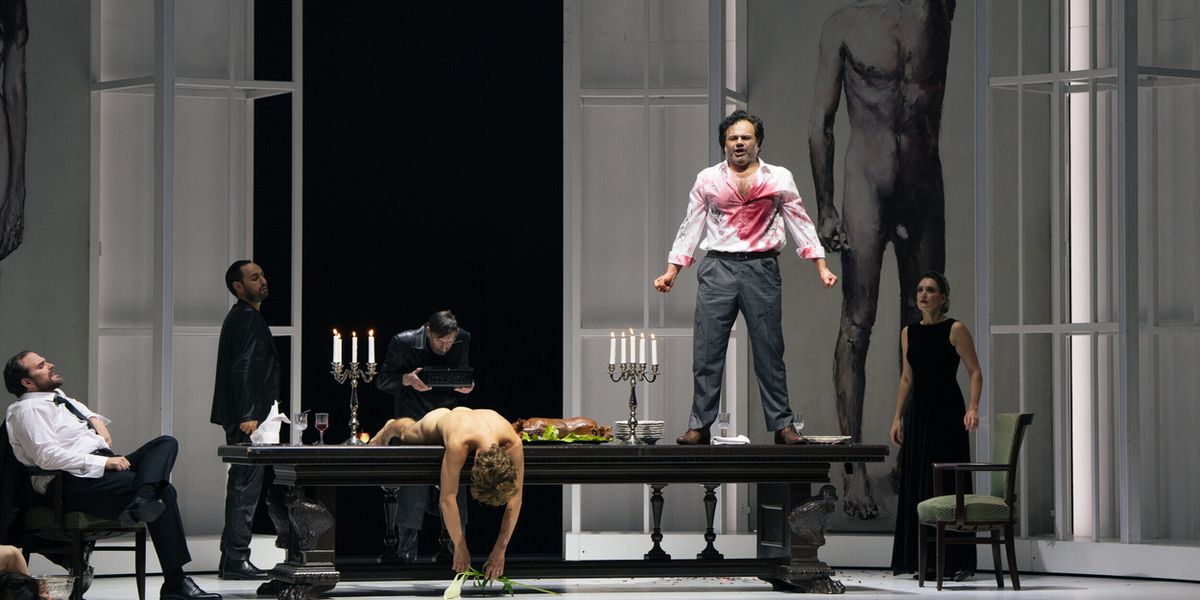
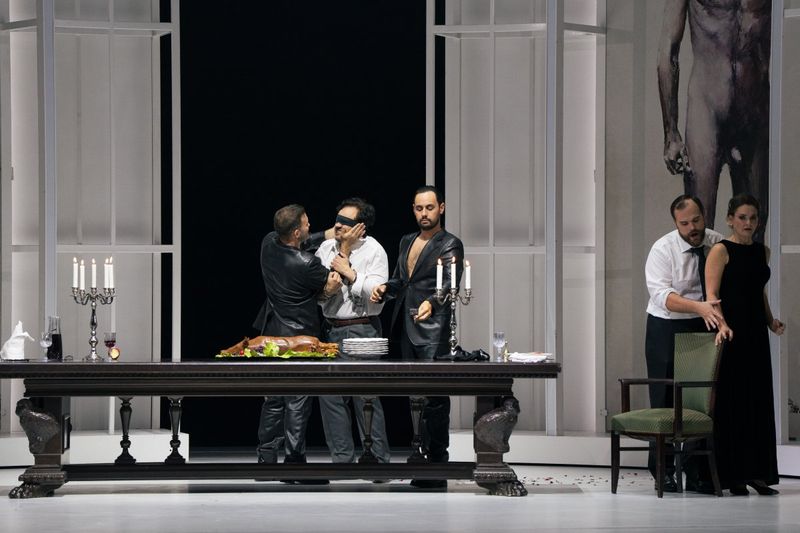
Act Two shifts to Rome, 1975. It starts with an unexpected musical parenthesis, two men dancing and flirting in one of the opera boxes. The idea fits the Pasolini atmosphere, and it creates an Italian cinematic frame around the action. The moment felt slightly too long and the music that didn't belong to Puccini's score didn't help. Then the curtain rises on Scarpia’s residence. Large images of naked bodies fill the background, immediately recalling Salò. The production’s intellectual route is clear. Pasolini, Sade, fascist sadism, Caravaggio’s violence, religion, power, and the dark theatre of domination all sit behind the staging. I understood the proposition. I’m just not convinced it always served Tosca’s emotional core. Sometimes when intelectual propositions take over, theatre suffers.
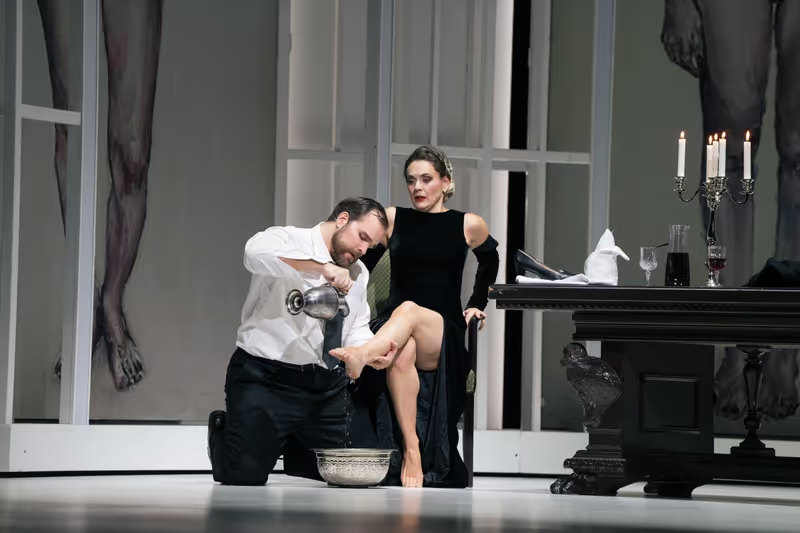
The two women onstage, one dressed in black and one in white, didn’t land for me. At that point, they distracted from the two figures who should have received our full attention, Scarpia and Cavaradossi. Tosca’s entrance, however, changes the energy. Once she and Scarpia are alone, the scene gains rawness. The gesture around her feet creates an uncomfortable physical intimacy, somewhere between devotion, possession, and humiliation. The torture scene pushes the Pasolini reference further. The altar boys return fully naked, one sitting in Scarpia’s lap, while Cavaradossi is being tortured. The image is constructed with clarity, and the reference to Salò and Sade is unmistakable. The question is whether that universe is fully compatible with Tosca. If Scarpia is this depraved and this twisted, then the way he throws himself at Tosca should follow that same terrifying logic. The production opens a very dark door, then seems hesitant to walk all the way through it. Would going further have been better? Definitely not. Did this choice make me rediscover Tosca with a different emotion? No. Was it new and unexpected? In a sense.
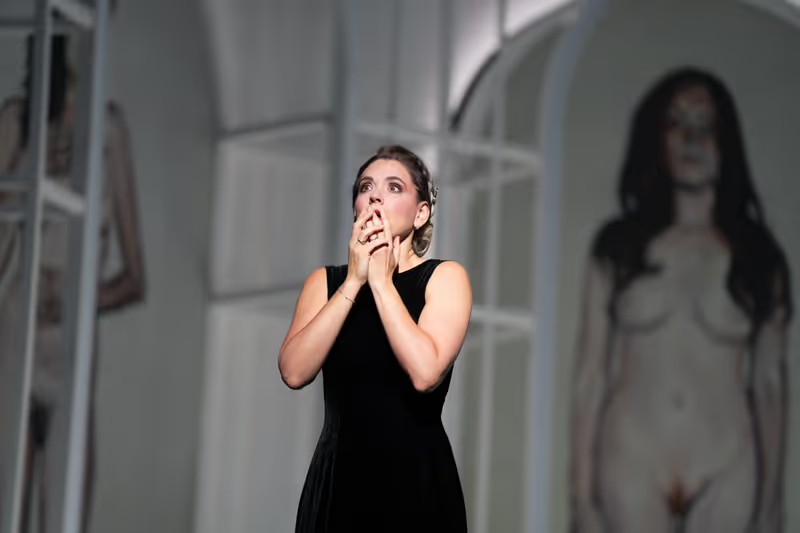
Goikoetxea sings Tosca beautifully, yet the acting didn’t take me on the devastating emotional journey the role can offer. In this staging, with so much brutality and sexualised power placed around her, the emotional arc needed to cut even deeper. I struggled to find the right emotions on her face and in her voice. Atalla Ayan’s “E lucevan le stelle” is the highlight of the evening. It’s sung with real beauty and feeling, and Puccini does what Puccini does.
There is also a question of theatrical consistency. After the strong blood effects used around Cavaradossi, Scarpia’s death happens from behind, with no real visible blood. That restraint may have been deliberate, yet it felt disconnected from the production’s own visual language. Then a very large painting drops, Caravaggio's Giuditta e Oloferne, in a different style and from another time. Facts about Pasolini’s life and death are projected. I understand the conceptual bridge, and I understand the desire to tie Tosca to a wider artistic and political history. For me, it pulled focus. Suddenly I felt I was watching two stories at once, Tosca and an artistic social documentary on Pasolini.
Felipe Ramos’ lighting is one of the production’s strongest achievements. It’s precise, elegant, and sculptural. It gives the white set depth, it cuts the stage into emotional zones, and it often does more to hold the tension than the blocking itself. Rafael R. Villalobos’ costumes help the production feel like a stylised object, purified and cinematic.
One special shoutout goes to René Laryea as the Jailor. It’s often difficult to give weight to a character who remains onstage without much outward action, but Laryea manages it with striking control. Beyond his deep, strong voice, he brings a quiet theatrical tension that enriches the scene through presence alone. He doesn’t need to do much to make the space feel charged.
The staging around the final act, however, didn’t work for me at all. Another character is present with Cavaradossi during the aria, interacts with him, then Tosca kisses that figure before he disappears. The idea may have a symbolic logic within the Pasolini frame, yet it harms the connection between Tosca and Cavaradossi at the exact point when that connection should become unbearable. They barely look at each other. Their physical contact feels limited. The acting logic becomes blurred, and the characters’ natural arcs lose force.
That is ultimately my main reservation about this TOSCA. The production has a strong vision, a courageous point of view, and a powerful visual personality. But it also creates distance from the emotional devastation Puccini’s opera can deliver. I was intrigued more often than I was moved.
Still, this is a high quality production, and La Monnaie deserves credit for bringing such a bold project to Belgian audiences. Villalobos doesn’t offer a decorative Tosca. He offers one with teeth, politics, cinema, and discomfort. I didn’t agree with every choice. I didn’t feel touched in the way I had hoped to be and the direction of the singers feels overshadowed by the intelectual concept of the vision. Yet this remains one of the highlights of La Monnaie’s season because of its strength, its courage, and its unmistakable personality.
Final rating: 7.5 /10 (Recommended for audiences who want a visually bold Tosca that challenges the opera through Pasolini, power, and cinematic brutality).
Prefer BroadwayWorld in Google Search?
Add us as a preferred source so our stories show up more often in Top Stories and Google’s AI answers — for you.
Sign up for all the news on the Fall season, discounts & more...

Reader Reviews
To post a comment, you must register and login.