Review: SOMEWHERE at Denver Center For The Performing Arts
A family drama that understands both the necessity and the cost of dreaming
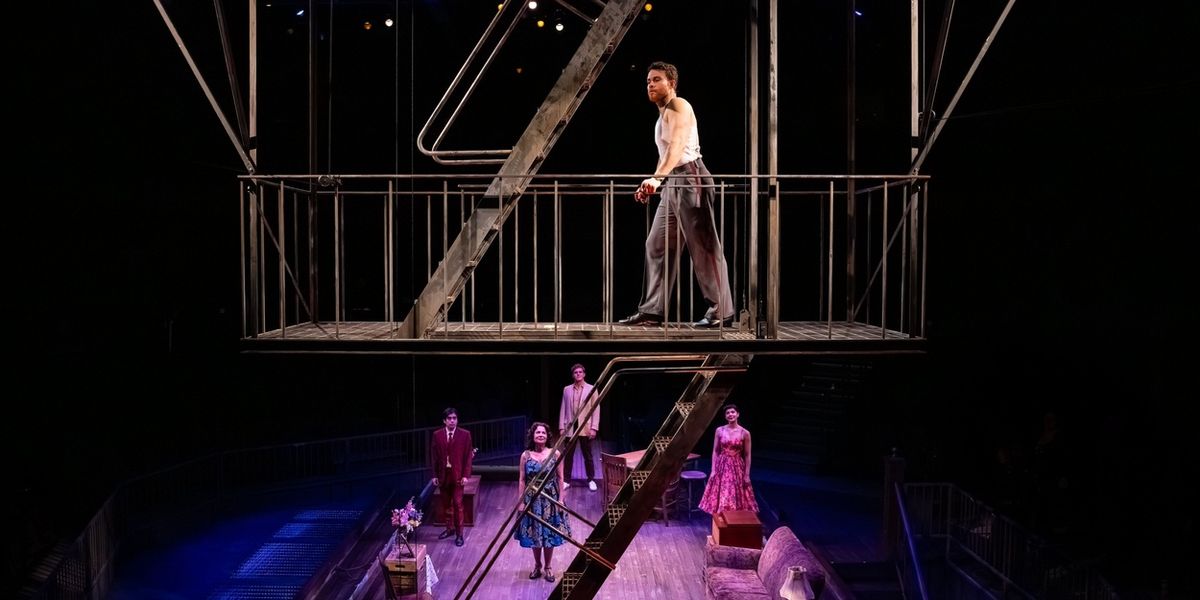
Set in 1959 Manhattan against the destruction of San Juan Hill to make way for Lincoln Center, Matthew López’s Somewhere follows a Puerto Rican family whose artistic ambitions collide with economic instability and the crushing realities of survival. Within the cramped walls of their apartment, dance, acting, and music are not hobbies, but lifelines. These artistic dreams sustain not only the family’s hopes for financial escape, but their emotional survival, keeping despair, stagnation, and hopelessness perpetually at bay. The Denver Center Theatre Company production renders these tensions physically visible, using choreography, staging, and performance to show the strain between artistic ambition and material survival. In Somewhere, every dream comes at a cost: homes are demolished for cultural institutions, mothers drain their savings for possibility, and sons surrender their ambitions to keep their families afloat. At its heart, the play asks how much one can sacrifice for art before the sacrifice consumes them.
At the center of the production is Inez, played with ferocious complexity by Adriana Sevan. Sevan understands that Inez’s devotion to art and beauty is not simple delusion, but a kind of survival mechanism, a refusal to surrender the dreams that have sustained her family through instability and disappointment. Sevan is outrageously funny throughout, able to pivot from tenderness to volcanic maternal fury at the drop of a hat. Her passive aggression toward her eldest son, Alejandro, lands as both loving and deeply infuriating, capturing the complicated intimacy of a mother who cannot understand why her child would abandon his gifts. This duality is most keenly expressed through her dance sequences with Ángel Lozada’s Alejandro, where movement allows Inez to express a softness and pride that words alone cannot fully reach. Even when the world around her begins to crumble, she clings to dreams, dance, and possibility with a conviction that is by turns inspiring, exasperating, and devastating. Sevan never flattens Inez into caricature; instead, she reveals the painful dignity beneath the character’s impracticality, allowing the audience to understand both the damage and the necessity of her dreaming.
Efren Delgadillo Jr.’s towering fire escape set gives Somewhere both its visual beauty and its emotional architecture. Steam curled upward from the streets below, sparse furniture gave the impression of numerous curb-side scavenges, and the in-the-round staging created the convincing density and verticality of New York City apartment living. (Though, judging from conversations in the lobby, some audience members found the atmospheric steam effects more obstructive than immersive.) Most strikingly, the production never lets the audience forget how physically cramped this family’s life is. The scuffed apartment floors suggest years of rehearsal, performance, and dreaming compressed into too-small quarters, making Mayte Natalio’s choreography all the more impressive. Dancers throw themselves through combinations in spaces that barely seem capable of containing them, causing every burst of movement to feel both joyous and precarious. The fire escape itself creates multiple playing levels, with characters constantly ascending and descending staircases in search of space, air, and momentary freedom from the cramped apartment. The result is a production where dance feels inseparable from environment: artistry erupting stubbornly from cramped apartments and unstable homes.
The other performances similarly ground the production’s larger theatricality in recognizable human behavior. Danny Gómez is electric as Francisco, radiating chaotic teenage energy with the rough-edged charm of a kid perpetually one bad decision away from disaster. Gómez’s performance weirdly recalls Max Casella’s swaggering adolescent bravado in Doogie Howser, M.D.—equal parts troublemaker and desperately lovable scamp. His comic instincts land beautifully throughout, particularly during an absurdly riotous fake death sequence, though he proves equally capable of grounding the play’s quieter emotional moments. Keaton Miller brings warmth and remarkable physical precision to Jaime, his dancing effortlessly expressive without ever losing emotional specificity. Bella Serrano’s Rebecca occasionally struggles to achieve the same emotional specificity as the surrounding performances, with both the characterization and performance leaning heavily into youthful naïveté at the expense of greater complexity. Ángel Lozada smartly restrains his performance as Alejandro for most of the play. He withholds the full force of Alejandro’s movement, carrying himself with the tension of someone perpetually suppressing a more expansive version of himself. That restraint makes his long-simmering frustration with the rest of the family feel deeply lived-in. In the production’s final moments, when Alejandro finally permits himself to dance fully, the release feels genuinely transcendent.
What makes Somewhere so affecting is that it understands sacrifice not as tragedy, but as necessity. The destruction of San Juan Hill to build Lincoln Center hangs over the play as both irony and warning: great cultural institutions are often built on the backs of the very communities excluded from them. Within the family itself, sacrifice becomes similarly complicated. Alejandro quietly surrenders his own ambitions to keep the household afloat, bearing responsibilities his younger siblings are still free to dream beyond. Inez, however, understands something equally essential: without risk, aspiration, and artistic ambition, life itself begins to narrow. For this family, art is not simply spiritual nourishment, but economic possibility—a means of survival as much as transcendence. Somewhere ultimately asks who carries the cost of making art possible, and how long any one person can bear that burden alone. By the production’s final moments, when Alejandro finally permits himself to dance fully, the release feels overwhelming precisely because the play has taught us how physically painful his self-denial has become. In motion once again, Alejandro ceases to feel like a financial instrument for his family’s survival and becomes fully human, his years of sacrifice finally returned to him as an act of love.



Reader Reviews

Videos