


Review: FIDDLER ON THE ROOF at Union Avenue Opera
"The Fiddler on the Roof" runs at Union Avenue Opera through July 11.
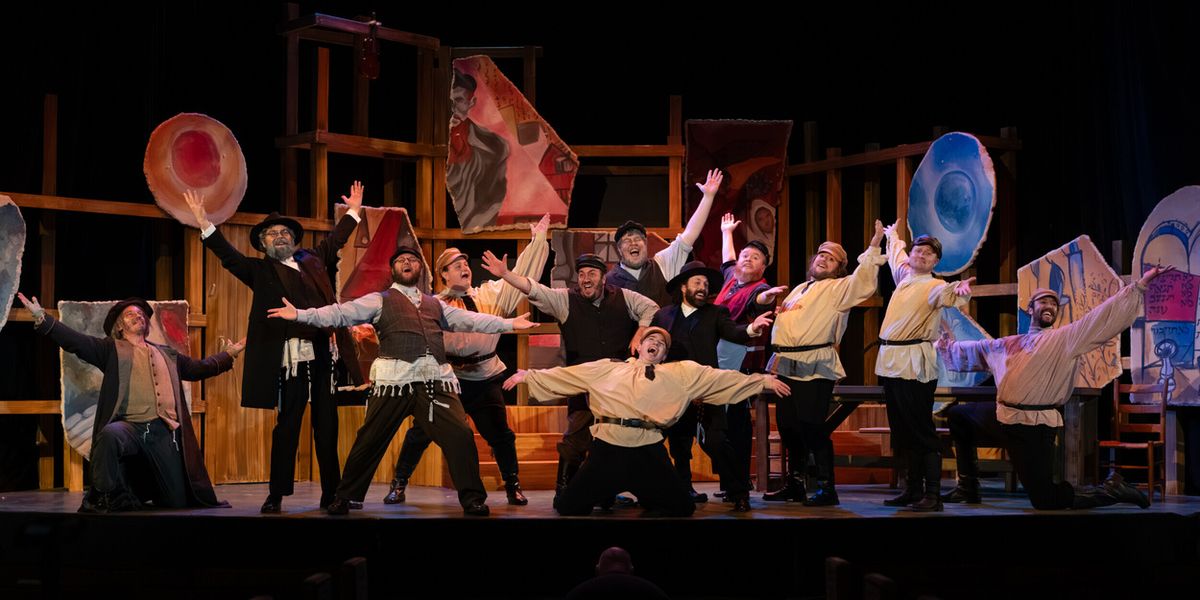
The Union Avenue Opera gives us brilliant voices in an intimate space. It’s done that for thirty-two years now. Their current production is an enormously gratifying Fiddler on the Roof. Now, everybody is familiar with Fiddler. With music by Jerry Bock, lyrics by Sheldon Harnick, and book by Joseph Stein it opened on Broadway in 1964. It won Tonys for Best Score, Best Book, and Best Musical.
The story is set in Anatevka, a tiny shtetl—a poor Jewish village in what was once Poland, then Russia (and now Belarus).
It’s 1905. The times are changing.
Traditions have always guided our daily lives. But times of change put stresses on tradition. In Fiddler two ancient traditions are being challenged:
- Jewish life, across the diaspora, was faced with the modern world. Arranged marriages, which had been the rule for centuries, were called in question.
- Tsar Nicholas II was faced with rebellion. He could not permit himself to let the autocracy die. He feared communism. He crushed the 1905 rebellion. The Jews, long viewed as harboring leftist sympathies, were suppressed.
Two deeply Jewish souls hovered over the birth of Fiddler on the Roof:
- Sholem Aleichem (née Shalom Rabinovich), raised in the shtetl of Voronkiv (now in Ukraine). He wrote the beloved series of “Tevye stories” which inspired the show.
- Marc Chagall (née Moishe Shagal), raised in the shtetl of Vitebsk, 186 miles from Voronkiv. He would have been 18 in 1905. Throughout his varied career (a critic commented) “he remained most emphatically a Jewish artist, whose work was one long dreamy reverie of life in his native Vitebsk." The very title of the show was inspired by several Chagall paintings.
Anatevka, at Union Avenue Opera, rises before us—a lovely, open structure of rough wooden beams, a door, some steps, a platform or two. The set is by the brilliant Patrick Huber with Scenic Artist Tobias Reynolds. On the walls we see eight or ten roughly shaped picture fragments in the manner of Marc Chagall.
We meet Tevye, the milkman, and his wife Golde. They have five daughters: Tzeitel, Hodel, Chava, Shprintze, and Bielke. And of course they can afford no doweries. Yente, the matchmaker, will do the best she can. But can she fight the power of love?
Fiddler is a most unusual piece of musical theater. Where most musicals have showy production numbers with dancing girls in bright costumes, Fiddler’s idea of a dance number is men dancing with men—all dressed in black. A melancholy Eastern European flavor dominates the music. And the ending, where the village is dispersed by a pogrom, is far from the happy resolution of many musicals. But Fiddler, certainly with this splendid production, grabs your heart. It’s sometimes blatantly sentimental: what parent of grown children can listen dry-eyed to “Sunrise, Sunset” as Tevye and Golde watch their daughter marry. “I don’t remember growing older,” they sing. “When did they?” It’s crushingly beautiful.
“Anatevka”, the song about leaving the village, is heartbreaking in its simplicity. It conveys all the emotional attachment we have to home, however humble. And the final exodus of the villagers—a long, circling trek—ends sadly in their gradual dispersing in all directions—a real diaspora. At Union Avenue, with a cast of over thirty, this takes a beautiful while. As the final villagers enter they begin that solemn walk round and round. As they leave they remove the Chagall sketches that have embraced this village—and carry them off.
Anatevka is erased. But it goes with these people to live in memory in … Chicago? New York? Israel? Wherever. It’s a quite beautiful directorial touch.
The cast, as usual with Union Avenue, is bursting with talent.
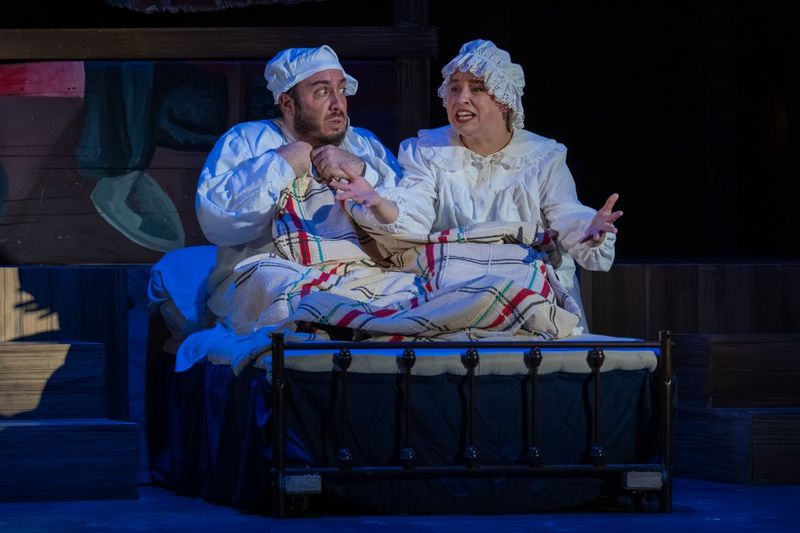
Tevye is, of course, the key to any success of Fiddler. E. Scott Levin made his professional debut with Union Avenue nineteen years agon. Here, though perhaps not so wildly “larger than life” as Zero Mostel, Levin makes Tevye deeply as real as life. He captures the wry humor of this man, as well as his anguish and his real love for his daughters. He relishes the role—and this life!
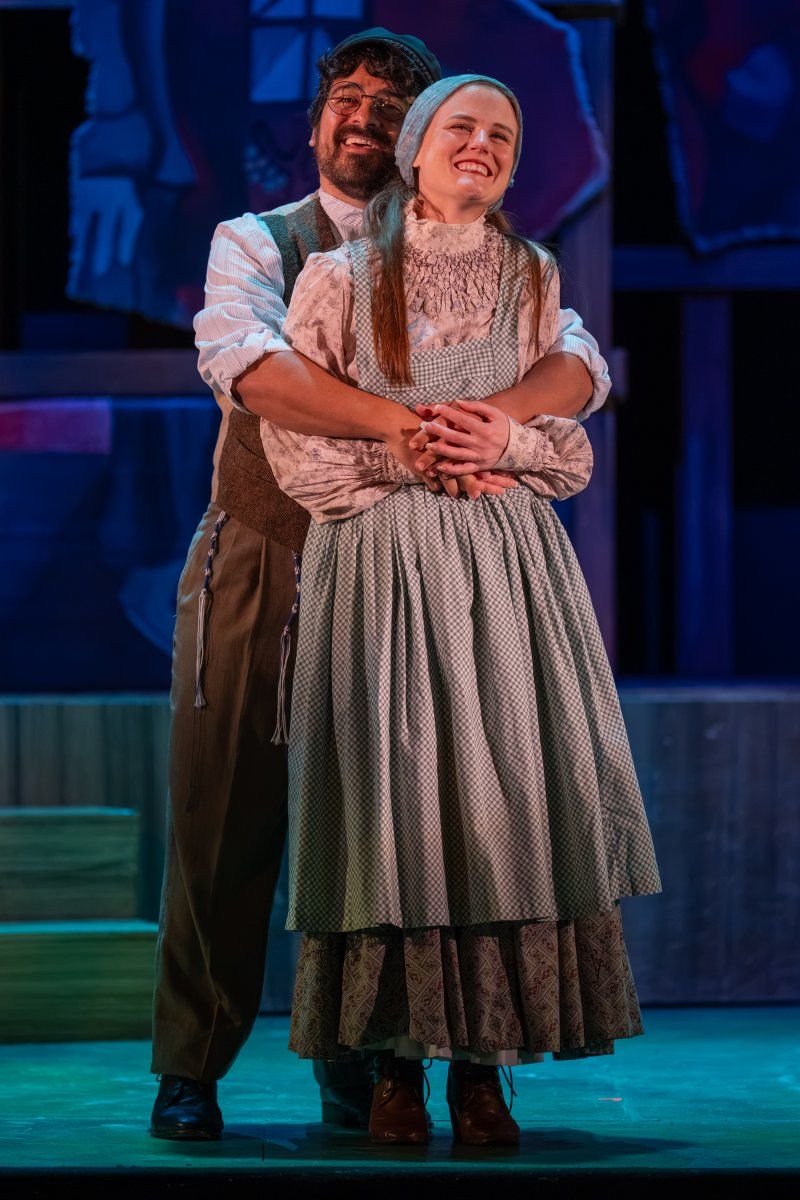
Levin is surrounded by deep talents: Kate Tombaugh (Golde), Brianna Murray (Tzeitel), Vianca Alejandra (Hodel), Arielle Pedersen (Chava), Sophie Azra Yilmaz (Shprintze), and Audrey Sondag (Bielke) embody the warm love that binds the family. Suitors for the older daughters are splendidly sung by Eric Botto (Motel, the tailor), John Tibbets (Perchik the radical student), and James Stevens (Fyedka. Oy, vey! A Russian!) In each of these courtships tradition is challenged and the stakes rise: Motel is a familiar face in the village; Perchik is an outsider and a trouble-maker, but he’s Jewish; Fyedka is a Christian and a Russian (the enemy!).
This is a very tiny village, yet with a population too large to allow me to detail the many beauties arising in the various roles: Amy Maude Helfer makes Yente a charming gossip; Spencer Reichman gives Lazar Wolf, the disappointed suitor, both temper and a heart; Joel Rogier makes an endearing Rabbi; Ryan Cooper, as the Rabbi’s son, shows a fine actor’s deep investment; Samuel Wright gives the Constable real authority; Gina Malone delights us again as the wild and frightening ghost of Fruma-Sara. Philip Touchette (an innkeeper), Bradley Behrman (a bookseller), Cole Gutmann (a beggar), Stephanie Tennill (Grandma Tzeitel), Kay Love (Motel’s mother), Charles McCall (Yussel), Trevor Scott (Sasha), and Collin Littlefield (the Fiddler) all maintain the very high quality seen throughout this show.
The voices filling the theater are highly burnished voices capable of fulfilling the demands of opera. They are, if you will, Olympic voices—here in a Broadway show. The principals, again and again, find moments in these songs where that training rises to the surface and makes this show more musically gorgeous than one expects. One example is in the “To Life” number, when one of the Russians interrupts the general merriment. Here Trevor Scott rises, opens his mouth, and out comes a tenor beam of sunlight—that seems unlikely ever to end! Such beauty, almost accidentally found! (I was reminded of the moment in Cabaret when the handsome young Nazi sings a breathtakingly lovely “Tomorrow Belongs to Me”—as if it were a Schubert lied.)
But the most remarkable effect of this collection of really fine voices appears in the chorus numbers. “Tradition” at the very beginning, “To Life”, the “Sabbath Prayer”, “Sunrise Sunset”, and especially the final “Anatevka” are gorgeous in ways I never heard before.
The considerable dancing is most impressively done. Yes, it’s mostly not “co-ed”, but it’s lively and authentic and admirably executed. Even the famous “bottle dance” at the wedding is magically done without the loss of a single bottle! Kudos to choreographer Andrea Reed and to lead dancer Charles McCall.
Lighting by Zak Metalskis adroitly follows the action, follow-spots isolate private moments. One lovely touch is a subtle change in intensity and color when Tevye has his little conversations with God.
Teresa Doggett’s costumes once again hit the bulls-eye on historic and ethnic authenticity. Another superb job for this large cast.
The orchestra finds all the beauty (and the humor) in the score. It’s led by Artistic Director Scott Schoonover.
But perhaps the greatest praise is earned by Director Kasey Cox. She so gracefully handles this cast—so numerous, so mobile—in this limited space! And every single chorus member is an individual person! Well, this is the fourth time Ms. Cox has directed Fiddler. They say “third time’s a charm”; well, this fourth time is a real “Wow!”
Yes there are some somber moments in the show, but the evening is a joyous one. Fiddler on the Roof at Union Avenue Opera. It continues through July 11. I highly recommend it.
(Photos by Dan Donovan)
Sign up for all the news on the Fall season, discounts & more...

|
Alex Edelman’s Just for Us New Jewish Theatre (NJT) (10/01-10/18) |

|
Come From Away Kirkwood Pac (9/18-10/18) |
|
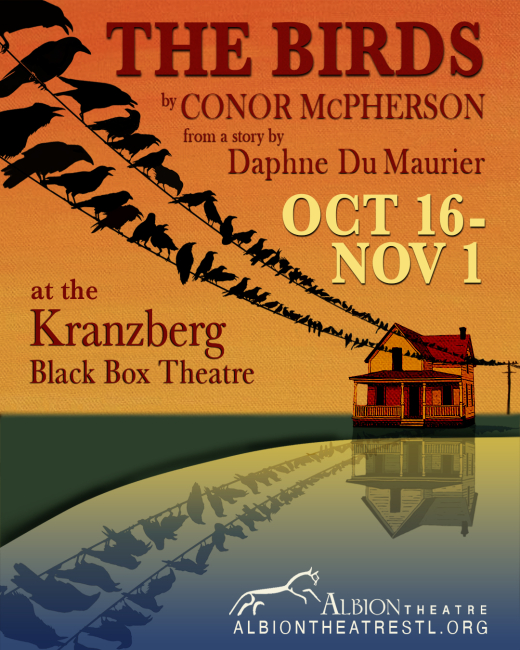
The Birds Albion Theatre (10/16-11/01) |
|
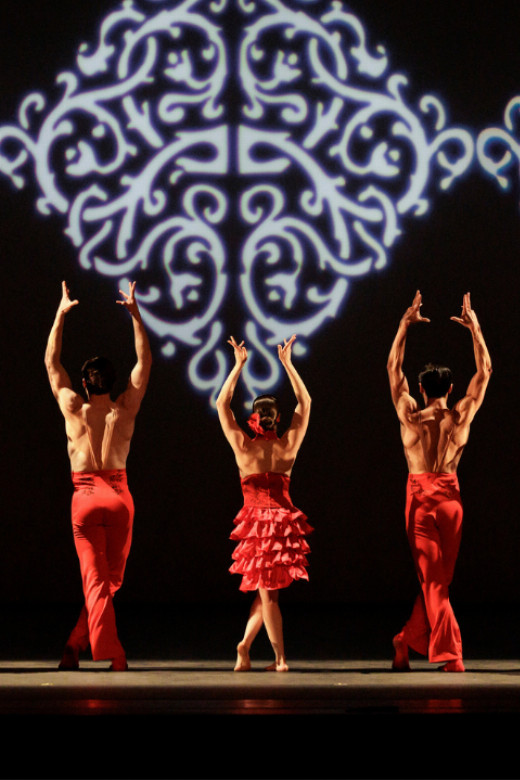
Ballet Hispánico New York Touhill Performing Arts Center (11/14-11/14) |
|
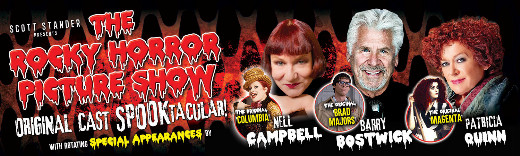
Rocky Horror Picture Show Original Cast Spooktacular Tour with Barry Bostwick, Nell Campbell, and Patricia Quinn The Fabulous Fox Theatre (10/06-10/06) |

|
Gateway Dirt Nationals – 3 Day Pass The Dome at America's Center (12/03-12/05) |
|
Ludo The Pageant (10/24-10/24) |

|
Dawn Weber Kirkwood Performing Arts Center (10/06-10/06) |

|
Joyful COCA - Catherine B. Berges Theatre (12/18-12/19) |
|
COCA Live & Unscripted! Staenberg Performance Lab at COCA (11/21-11/21) |

Reader Reviews
To post a comment, you must register and login.