Review: Barber’s VANESSA – or Is It ERIKA? – Returns with Heartbeat Opera
Reinventing the Opera for Modern Audiences in a Stark, Sleek Production
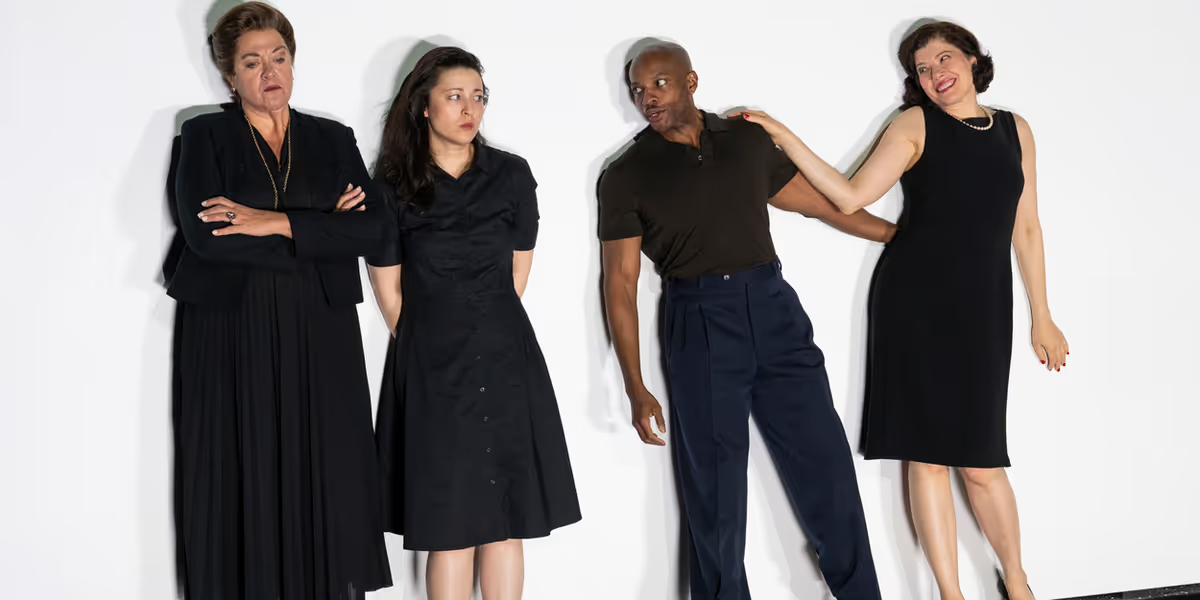
I caught up with Heartbeat Opera’s reinvention of Samuel Barber’s 1958 opera, VANESSA, to Giancarlo Menotti’s libretto, a few days after its debut at the Baruch Performing Arts Center in New York, after premiering last summer at the Williamstown (MA) Theatre Festival.
It is fascinating, to say the least, and smartly reconceived. It also brings up some questions that have been asked about the opera since before its premiere. Most specifically: Who’s the star of the show—the title character or her niece Erika, who gets the work’s most famous aria, “Must the winter come so soon”?
(More about that in a minute, though I can’t help but bring up Maria Callas’s perhaps apocryphal thoughts on it: There's a story of her being initially offered the title role and turning it down because she felt Erika was the main character and she was not about to NOT be the main character!)
The Met does so many contemporary pieces these days (mostly recently, the Frank-Cruz EL ÚLTIMO SUEÑO DE FRIDA Y DIEGO), that it’s hard to remember that a new work was a rara avis at the old Metropolitan Opera. VANESSA came under that heading in its day but nonetheless had an acclaimed debut, though it brought just a single revival before vanishing like a puff of smoke, more or less.
Oh sure, it has been done a number of times in other places—I saw it once at the old New York City Opera—and it has had something of a Renaissance over the last decades. It does not, however, seem likely that any large-scale revivals loom on the horizon.
Does this production give a better idea of whether it was worth waiting for its return? Or more correctly, was it worth all the loving care that Heartbeat gave to resurrecting it, as adapted by artistic director/conductor Jacob Ashworth, and newly arranged by music director Dan Schlosberg under the direction of RB Schlather?
The redaction of the score by Schlosberg—which has tinges of dissonance among the more lyric stretches—certainly works well, under Maestro Ashworth and the seven musicians of the deft ensemble: starting with the two versions of “Must the winter” (at the beginning and near the end), to the Vanessa-Anatol duo, “I have always known you would come back to me, Anatol”, to the final quintet, “To leave, to break.” From what I’ve read about Menotti’s original libretto, Ashworth and Schlather worked wonders in cutting its length while making it more interesting.
The cast moves skillfully through the music, with the luxurious mezzo of Kelsey Lauritano making a particularly strong impression as Erika (of course it helps that she has some of the best music), caught between the demands of her family and trying to live a life of her own. Soprano Inna Dukach is a fine Vanessa, tethered between the two extremes of emotion caused by her unrequited love and its resolution.
Tenor Freddie Ballentine’s upstart Anatol (NB: he's the son of Vanessa’s original lover who was also named Anatol, confusing Vanessa as well as the rest of us) made the best of an unappealing character, having impregnated Erika and led Vanessa on. Soprano Mary Phillips was a formidable Baroness, giving stature to another rather unlikeable character. As the Doctor, baritone Joshua Jeremiah did well in this character role.
I’ve long been a fan of Heartbeat, which is known for rethinking and cutting major works down to size, often revealing a different, sometimes smarter version hidden within. Among my favorites: Beethoven’s FIDELIO, Tchaikovsky’s EUGENE ONEGIN, Strauss’s SALOME and Weber’s DER FREISCHUTZ.
But the production of VANESSA, which I saw Sunday afternoon, directed surely and finely by Schlather, is a horse of a different color—an animal of a slightly different breed—because of the Vanessa vs. Erika as the heart(beat) of the story.
I brought up that question to Jacob Ashworth, who has strong thoughts on the issue, as he expressed in an email I received.
"It's very much the result of the adaptation. RB (Schlather) and I both shared this idea that Erika could be more of the main character, and the way I cut the piece emphasized that. Vanessa is fascinating beyond belief, but Erika has the more protagonist arc in our version.
“To me, they are very equal in our version, which makes it exciting, and makes Anatol's [engaged to Vanessa but the baby-daddy to Erika’s child] approach to each of them such an enthralling game to watch. It's probably important... to know that the reprise of 'Must the winter come so soon' at the end is not in the original. That's from me! It was an idea I had, and it came to me as part of this very discussion.
“I always felt the aria came too early in the show, because we don't know Erika yet, and after that she doesn't have a real aria. At one point I considered moving it to the end, but then came up with this version where it happens in its original place, but then there's this reprise at the end.”
Having seen photos of the plush original production, I found the stark scenic design by Jiaying Zhang, with Yuki Nakase Link’s lighting, quite modern and austere, as were Terese Wadden’s costumes.
VANESSA will be performed at the Baruch Performing Arts Center through May 31. For more information and tickets, see Heartbeat's website.
Caption: (from left) Mary Phillips as the Baroness, Kelsey Lauritano as Erika, Freddie Ballentine as Anatol, Inna Dukach as Vanessa
Credit: Photo by Russ Rowland
Reader Reviews
Videos