


Interview: Theatre Life with Bill Sherman
The superb Orchestrator/Arranger on his work for Signature Theatre's new musical Safety Not Guaranteed and more.
.gif)
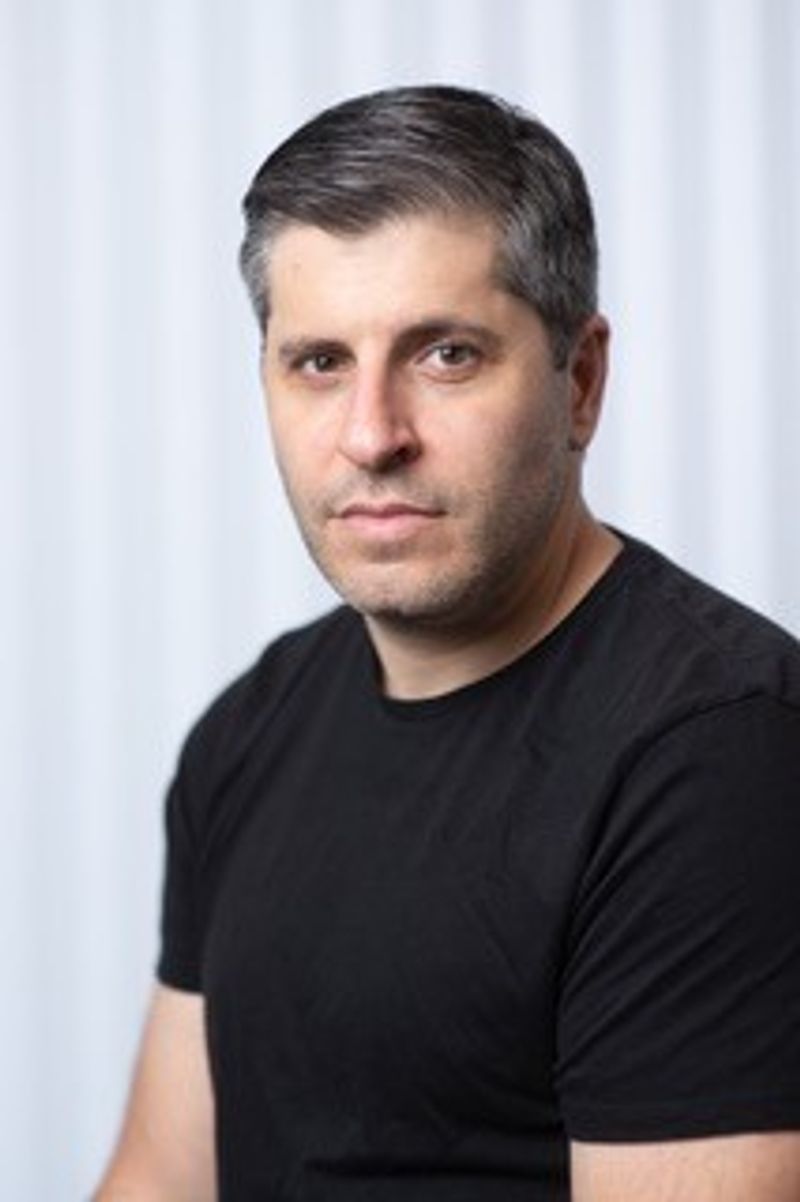
Today’s subject Bill Sherman is currently living his theatre life as the Musical Supervisor, Orchestrator, and Arranger for Signature Theatre’s new musical Safety Not Guaranteed. The production plays through April 12th in Signature’s MAX space.
Bill’s Broadway credits include Freestyle Love Supreme, & Juliet, and In The Heights (co- Orchestrator with Alex Lacamoire.) Regionally Bill’s work was heard at La Jolla Playhouse in Fly.
For the past seventeen years, Bill has been the Musical Director/Arranger for Sesame Street. Read on to see how brings the songs of the show’s original composer Joe Raposo to a whole new generation.
On the big and small screens Bill’s work has been heard on In The Heights, Tick, Tick... Boom!, The Muppet Show, and AMC’s Storymakers and more.
Bill Sherman is one of our top modern-day orchestrators to be sure. He is the next generation of a field that includes such legends as Jonathan Tunick, Larry Blank, Larry Hochman, Doug Besterman, and Robert Russell Bennett to name just a few. That is some company to be included in wouldn’t you say?
Grab your tickets to Safety Not Guaranteed at Signature Theatre and listen to the audible delights supplied by the work of Bill Sherman. A new musical with a great cast, score, and orchestrations!! What more could you possibly need?
Bill Sherman is truly living his theatre life to the fullest.
Being an orchestrator is a very specific trait. How did you get interested in this facet of musical theatre?
Orchestration was not something I set out to do or even studied much while at college. For me, music exists in several different dimensions. Orchestrating gives you the ability to manipulate all the different sounds and dimensions that contribute to the overall sound of the piece. It’s not just about the piano or the voice or the bass. What interests me most about orchestrating is finding a way for all the instruments and voices to co-exist while also contributing to the overall tone and dynamic of the music.
Along those same lines, which orchestrators of the past had the biggest influence on you becoming one yourself?
I grew up playing the saxophone so I was enamored with the great orchestrators of the big band and swing eras including Count Basie, Duke Ellington, and Artie Shaw. As time went by, I got hipped to some of the more modern big bands with orchestrators like Thad Jones, Quincy Jones, and Bob Mintzer. Later, when I got into film scoring, I loved listening to John Williams, Michael Giacchino, and Ennio Morricone. From Broadway I would say my contemporaries Alex Lacamoire, John Clancy, and Brian Usifer.
Where did you receive your training?
I earned a degree in music from Wesleyan University where I focused on the popular music of West Africa, specifically Ghana.
While in high school, I had two incredible teachers who guided my early musical education. They both are truly responsible for igniting a passion in me to pursue music while also teaching me the building blocks of melody, harmony, arrangement, and orchestration.
What was your first professional job?
Wow, I think my first professional job (that I actually got paid for) was playing the saxophone at the cocktail hour of a family friends Bar Mitzvah on Long Island.
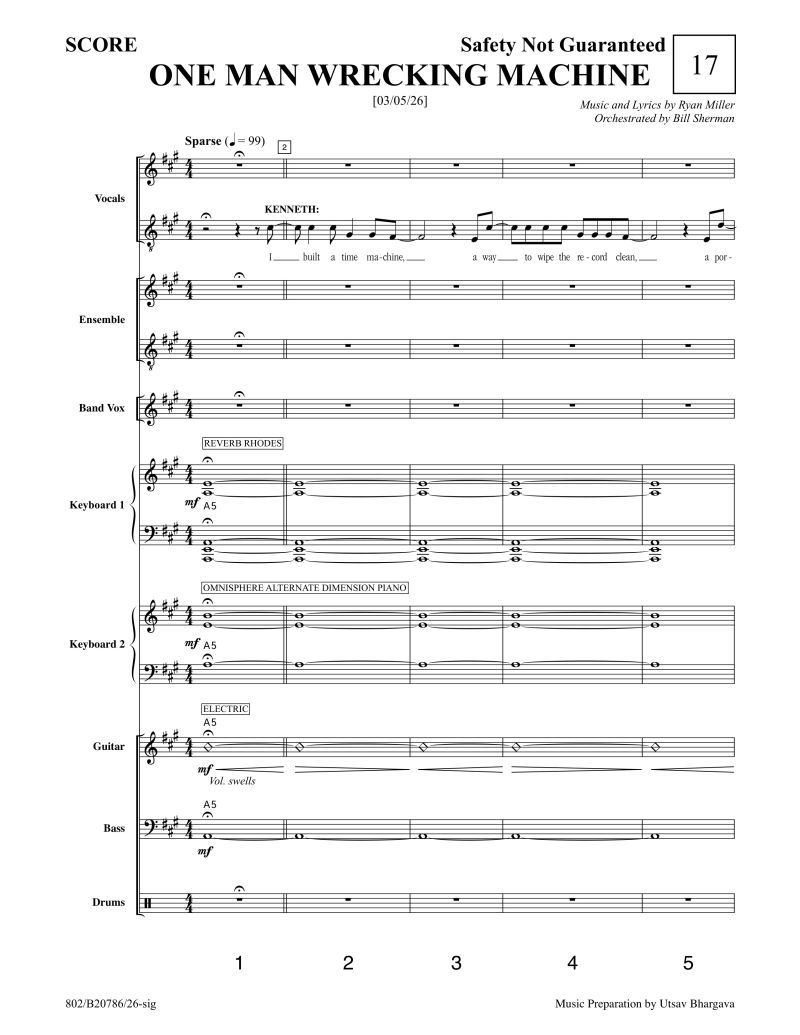
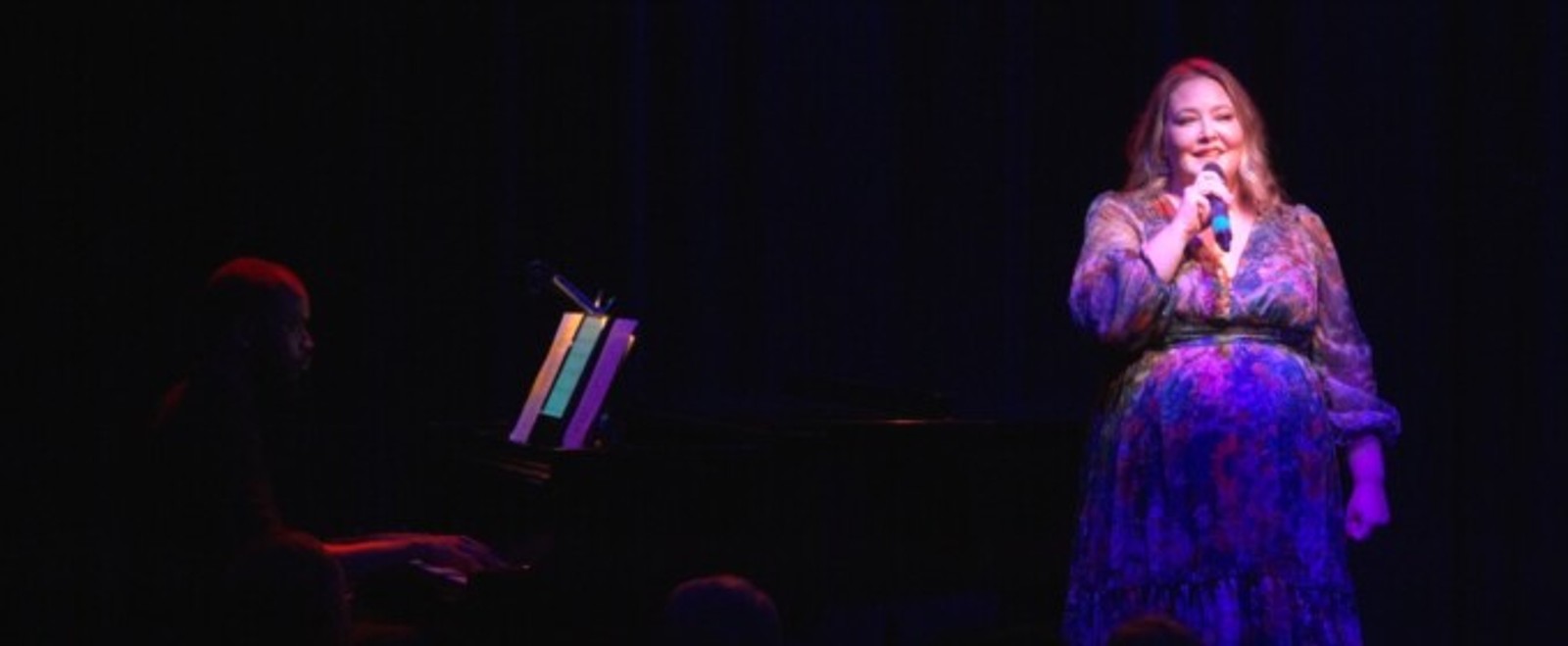
"One Man Wrecking Machine" from Signature Theatre's
production of Safety Not Guaranteed.
Image courtesy of the artist.
Can you please talk about how you arrived at the overall sound for the score of Safety Not Guaranteed? What fueled the decision on what the instrumentation would be?
When I first met with book writer Nick Blaemire and composer Ryan Miller, the phrase that kept on coming up was “sci-fi indie rock.” While “sci-fi indie rock” isn’t a standard genre, several sound ideas kept coming to my head: arpeggiated synthesizers, tremolo guitars, and distorted drums. At the same time, I had come into the project as a fan of Ryan’s music in his band Guster so I knew that their sound would have to permeate the score as well. For Safety Not Guaranteed, I knew we really wanted to lean into the live rock concert experience so for me, that usually signifies drums, bass and guitar. Then, to fit the sci-fi aesthetic into that sound, I knew that I needed keyboards to round out the sonic vision.
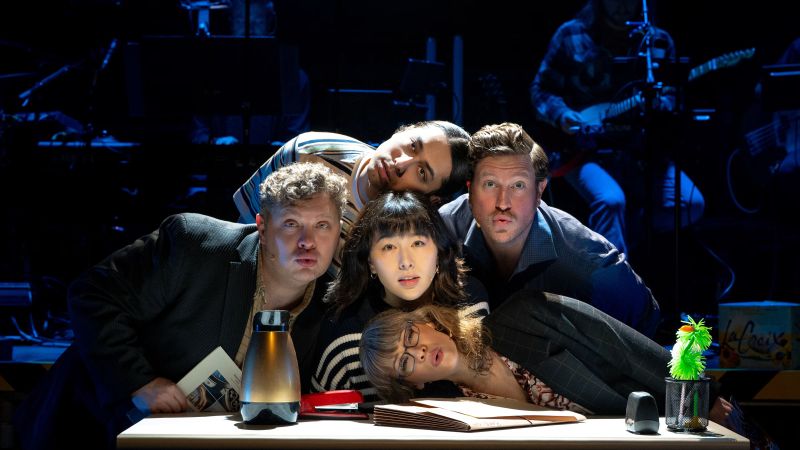
in Signature Theatreis production od Safety Not Guaranteed.
Photo by Daniel Rader.
From being approached to work on Safety Not Guaranteed to first preview, how long has the process been to orchestrate/arrange Safety Not Guaranteed.
I started working on Safety Not Guaranteed at the beginning of last year and ushered it through a workshop in October. When I actually sat down to orchestrate it for the Signature Theatre production it took about three weeks.
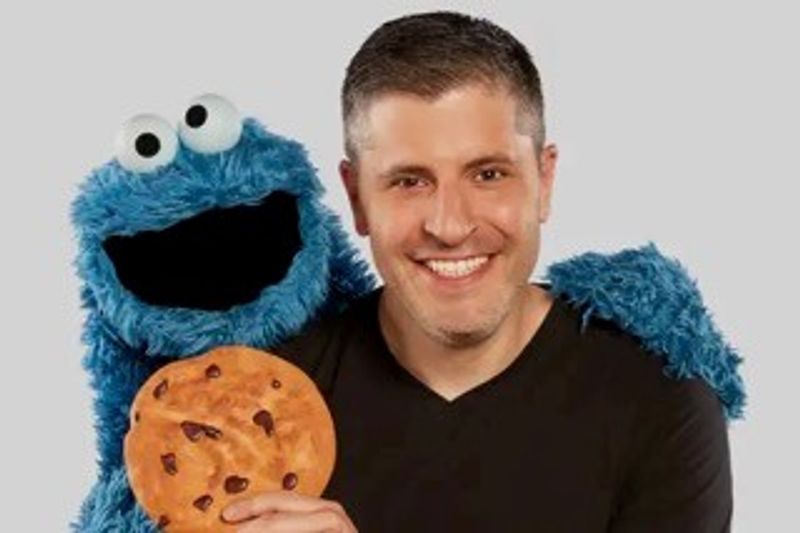
Photo by Sesame Workshop.
Photo courtesy of the artist.
You are currently the Musical Director/Arranger for Sesame Street. The songs on that show are iconic for many reasons. When you were offered that job, how did you approach the idea of putting your own spin on songs like “Sing” while honoring the memory of the show’s original composer/arranger Joe Raposo?
This year marks my 17th season as the Music Director of Sesame Street, a job I never would have dreamed of having. Sesame Street comes with an incredible history of songs and education that redefine the way children have learned for generations. What was important to me when I took the job was to retain the qualities that Joe Raposo began with in 1969. Joe’s songs always stressed catchy melodies that would stick in a child’s head, so they weren’t just singing along but also learning as well. It was his magic trick.
The way I look at my job today is to adhere to Joe’s concept of melody and harmony, while pushing the overall tone and sound of the show into what children are listening to today. Music has evolved so much over the past sixty years, and children’s ears have become so sophisticated and so open to different sounds. Whenever I’m told that a Sesame Street song should be on the radio and is teaching something at the same time, I consider it a success.
When a Broadway musical tours, there is generally an adjustment made to the orchestration. This could include cutting the string section or other “brilliant” budget saving ideas. Are there ever any discussions between the orchestrator and producer over which instruments will be cut before you start making the changes or is it a done deal that you have no say over?
In an ideal situation, it is a discussion. All the creatives involved in a touring production always want it to feel like the original. Due to the nature of the touring business, cuts are always made whether it’s to the costumes, set, or band. The greatest success you can have on a touring production when the band is cut down is to still be able to retain the overall sound of the show. Most often that means moving some solos around to different instruments or using the instruments you have to pad the sections that may not sound like they once did.
What is next for you in 2026 workwise?
Well, I thought that 2026 was going to be more of a slow year, but the minute I thought that everything seemed to change. I’ve got a couple musicals in the works that will be doing readings and development as well as a new movie that I am incredibly excited for. And as always, something else might come up when I least expect it.
Special thanks to Signature Theatre's Publicist and Marketing Manager Zachary Flick for his assistance in coordinating this interview.
Theatre Life logo designed by Kevin Laughon.
Sign up for all the news on the Fall season, discounts & more...
|
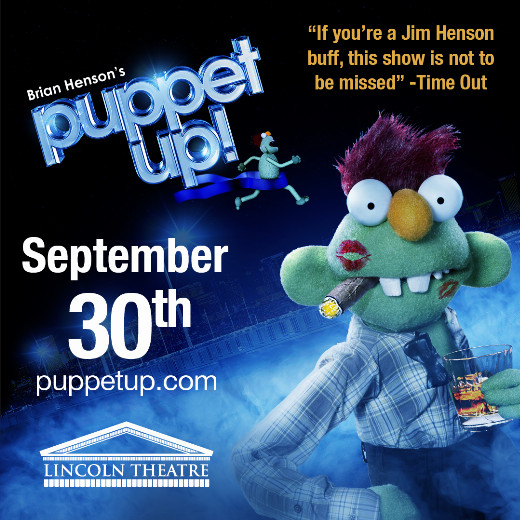
Brian Henson's Puppet Up! Lincoln Theatre (9/30-9/30) |
|
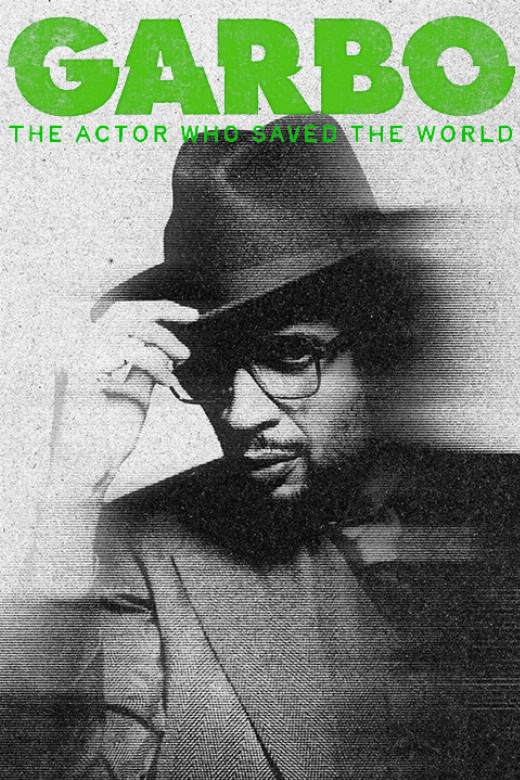
GARBO: EL ACTOR QUE SAVÓ AL MUNDO (Garbo: The Actor Who Saved The World) GALA Hispanic Theatre (9/03-9/27) |

|
Mr. Burns: A Post-Electric Play Clarice Smith Performing Arts Center (10/09-10/18) |
|
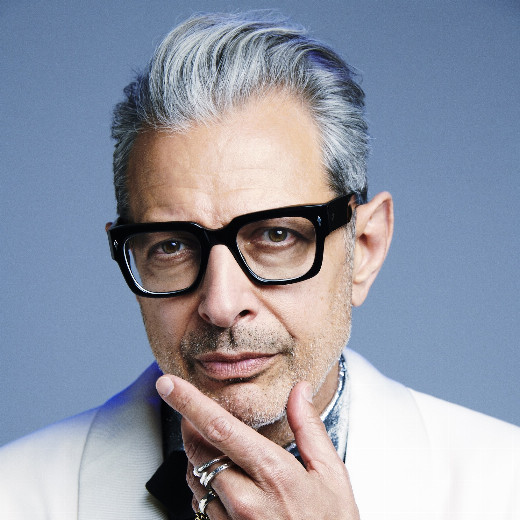
Special Event: ARTS By George!: Jeff Goldblum and the Mildred Snitzer Orchestra Center for the Arts (10/03-10/03) |
|
The Second-Best School Shooting NextStop Theatre (9/17-10/11) |

|
Coming to America: An Immigrant Cabaret ExPats Theatre (9/30-10/18) |

|
Some Like It Hot Bernard Family Theatre, Olney Theatre Center (9/18-11/08) |
|
Stonewall's Bust The Writers Center (10/09-10/25) |
|
"Treasure Island Reimagined: Jane Hawkins and the Pirate's Gold" The Alden Theatre (10/13-10/13) |

|
Moxie Events presents "The Fleetwood Mac Experience" F. Scott Fitzgerald Theatre (10/23-10/23) |
