


From Concert Stage to Cultural Institution: Dr. Xiaohui Yan Builds a Broader Chamber-Music Community
The Almost Quintet has appeared at Carnegie Hall, the Curtis Theatre, the East Room of the Richard Nixon Presidential Library and Museum, and Neidorff-Karpati Hall.
Written by Michael Anderson
When the Almost Quintet received recognition as a 501(c)(3) nonprofit organization, it marked more than a change in legal status. For Dr. Xiaohui Yan, the ensemble’s co-founder, it represented the next stage of a longer effort to create lasting institutions around music—organizations capable not only of presenting concerts, but also of supporting artists, expanding the repertoire and bringing different cultural traditions into sustained dialogue.
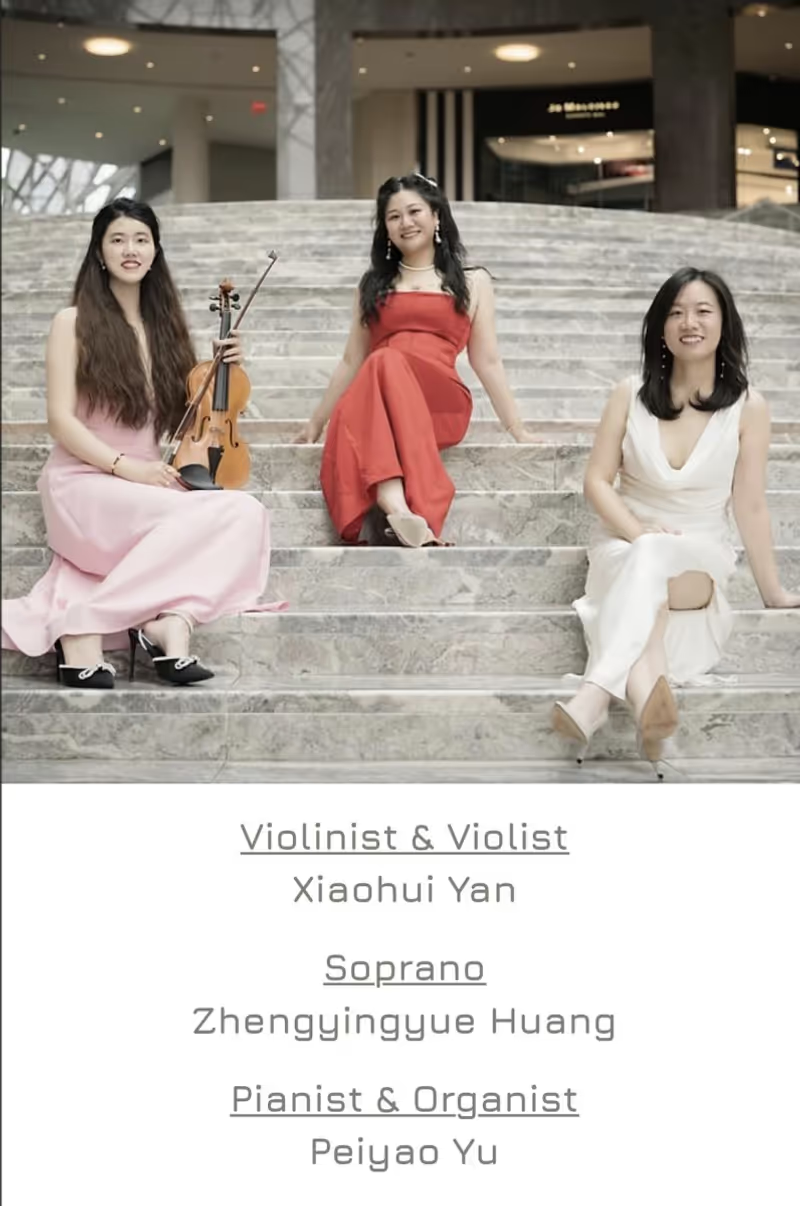 Dr. Yan, a violinist and violist, founded the Almost Quintet in 2025 with pianist and organist Dr. Peiyao Yu and soprano Dr. Zhengyingyue “Elaine” Huang. All three are alumni of the University of Kansas. Their reunion in California soon developed into an ensemble built around a shared interest in overlooked composers, flexible instrumentation and programs that connect music across cultural and historical boundaries.
The name “Almost Quintet” reflects the group’s unconventional structure. Although its core consists of three musicians, the members’ combined instrumental abilities allow the ensemble to move among different chamber configurations. Rather than beginning with a fixed roster and searching for music that fits it, the group often begins with an artistic idea and assembles the combination of instruments and performers that can best realize it.
That flexibility was evident in the ensemble’s recent New York concert tour, “Love, Earth, Death”. For the tour, Yu and Huang were joined by guest violinist and violist Dr. Xenia Deviatkina-Loh, a UCLA alumna whom the ensemble invited to broaden the program’s instrumental and expressive range. The collaboration brought together works from different periods and cultural backgrounds around themes of love, ancestry, struggle, mortality and the natural world. The New York performances received an enthusiastic response, affirming the ensemble’s ability to present contemporary and less frequently performed music within a program that remained cohesive and accessible. The successful integration of a guest artist also demonstrated the practical strength of the Almost Quintet’s model: its personnel can change in response to the repertoire without sacrificing the intimacy and responsiveness central to chamber music.
For Dr. Yan, inviting a guest musician is not simply a matter of adding another instrument. It requires identifying the right artist, shaping repertoire around the resulting ensemble, coordinating rehearsals and ensuring that individual compositions contribute to a unified program. Dr. Yan’s role has consequently expanded beyond performance to include artistic planning, collaboration-building and organizational development.
A central work in the 2026 program was “BORN FREE”, originally commissioned by the Wolf Trap Foundation for the Performing Arts. The composition sets poetry by Margaret Walker, the influential Black poet whose writing addressed ancestry, oppression, endurance and freedom. Its four movements— “Sorrow Home,” “Lineage,” “The Struggle Staggers Us” and “Southern Song”—trace an emotional path through grief, historical memory, resilience and dignity.
“New York Concert Review” described “BORN FREE” as “the work of a promising and talented composer.” The review highlighted its blues influences, emotional intensity and passages of plaintive despair, as well as its “stately dignity of voice and purpose.” The work was presented alongside music by composers including Dorothy Rudd Moore, Bright Sheng, Qingjia Lin, Rama Liu, Yi Zhou, and He Zhanhao and Chen Gang.
By placing Black and Chinese composers within the same concert framework, the Almost Quintet did not treat cultural representation as a separate category added to an otherwise conventional program. Just as the concerts and composer presentations organized through ACMI, which Dr. Yan previously founded, brought together the music and creative perspectives of composers from diverse backgrounds and traditions, every concert and musical exchange placed a deep commitment to fostering originality at its core. This approach has defined the ensemble from its beginning. Its inaugural 2025 season focused on living women composers and included the world premiere of art songs by internationally recognized American composer Lori Laitman. In 2026, the ensemble expanded its focus to Black and Chinese composers, developing programs concerned with culture, memory and artistic identity.
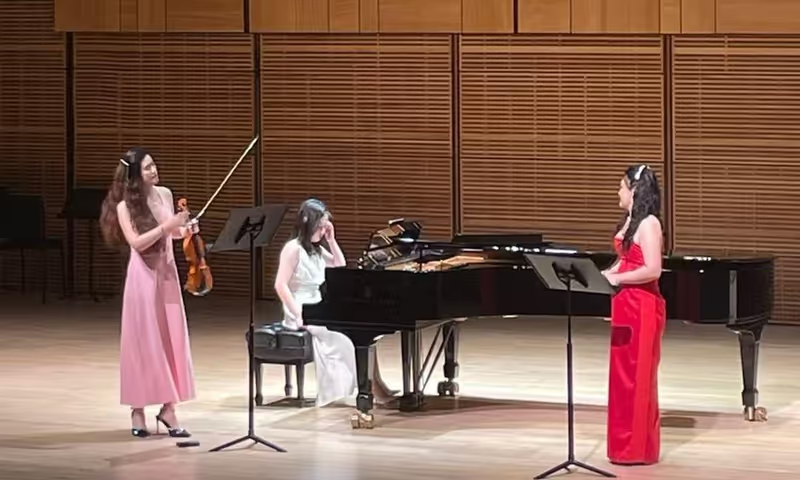
Its guiding aspiration is to help create a musical environment in which composers no longer need to be introduced principally as “underrepresented.” The Almost Quintet pursues that goal through specific artistic decisions: whose music is programmed, which artists are invited, where the works are performed and whether those works continue to be heard after a single concert.
Following its New York presentation, the ensemble brought the Los Angeles-area premiere of “BORN FREE” to the Richard Nixon Presidential Library and Museum in Yorba Linda on Aug. 30, 2026. Carrying the work from New York to Southern California gave it a continuing performance life and introduced it to audiences on both coasts.
Since its formation, the Almost Quintet has appeared at Carnegie Hall, the Curtis Theatre, the East Room of the Richard Nixon Presidential Library and Museum, and Neidorff-Karpati Hall at the Manhattan School of Music. For an ensemble established only in 2025, this geographic reach reflects both artistic ambition and the capacity to develop relationships with presenters, performers and audiences in different parts of the country.
.jpg?format=auto&width=800) The group’s nonprofit status now gives that activity a more durable foundation. An informal ensemble can organize individual concerts, but a nonprofit organization can plan across multiple seasons and build programs that extend beyond performance alone. The structure can support fundraising, grant applications, tax-deductible contributions, educational outreach, community partnerships, commissions and repeat performances of works that might otherwise disappear after their premieres.
The group’s nonprofit status now gives that activity a more durable foundation. An informal ensemble can organize individual concerts, but a nonprofit organization can plan across multiple seasons and build programs that extend beyond performance alone. The structure can support fundraising, grant applications, tax-deductible contributions, educational outreach, community partnerships, commissions and repeat performances of works that might otherwise disappear after their premieres.
For the broader music profession, this kind of organization can help address a persistent problem: worthy repertoire often remains unheard not because of its artistic quality, but because it lacks an institution committed to presenting it repeatedly. By building a nonprofit around this work, Dr. Yan and her colleagues are creating a mechanism through which composers, guest artists and culturally significant works can receive sustained rather than temporary attention.
The transition also brings greater responsibility. A 501(c)(3) organization must connect its activities to a defined public mission and develop the governance, fundraising and long-term planning needed to sustain that mission. Following the Los Angeles performance, Dr. Yan reflected on what the ensemble’s new nonprofit status meant for its future. “Our work is no longer only about choosing repertoire or preparing for the next concert,” she said. “We are building a structure that can give these artistic ideas continuity, remain accountable to the communities we serve, and create lasting opportunities for musicians and audiences.”
This is not Yan’s first experience building an institution around cultural advocacy. Before establishing the Almost Quintet, she founded the Asian Classical Music Initiative and served as its president from 2021 to 2023. The initiative created opportunities for musicians connected to Asian classical music and encouraged dialogue among performers, composers, scholars and audiences. Under her leadership, it developed activities that extended beyond individual performances and culminated in collaborative programming, including the 2023 initiative hosted in connection with Rutgers University.
Her work with ACMI established a pattern that continues in the Almost Quintet. In both organizations, Dr. Yan identified a need within the musical community and responded by building a platform rather than limiting her contribution to her own performances. She brought artists together, helped define an artistic mission and created settings in which musicians and cultural perspectives could reach wider audiences.
The two organizations are distinct in focus, but they form a continuous arc in Dr. Yan’s professional development. ACMI centered Asian classical music and cultural exchange; the Almost Quintet extends that commitment into a broader chamber-music context, presenting women, Black and Chinese composers while developing collaborations across institutions and regions. What began as advocacy for a particular musical community has grown into a wider model of repertoire-building and intercultural programming. Dr. Yan’s experience as both a violinist and violist shape the Almost Quintet’s flexible structure. Its instrumentation and collaborators adapt to each artistic project, allowing advocacy to continue through performance.
The successful New York tour brought these elements together: a guest artist was incorporated into the ensemble, contemporary music was placed within a coherent narrative, and “BORN FREE” received a prominent position alongside works representing several cultural traditions. The subsequent Southern California performance demonstrated that the project was conceived not as a single event but as part of a continuing national effort.
The Almost Quintet is still a young organization, but its growth from a three-musician collaboration into a 501(c)(3) presenting projects on both coasts has created a lasting platform for repertoire, collaboration and new audiences. A similar impulse shaped Dr. Yan’s earlier work in founding the Asian Classical Music Initiative. Through ACMI’s concerts and composer presentations, works and creative ideas from composers of different backgrounds and traditions were brought into conversation, placing originality at the heart of each performance and musical exchange. The Almost Quintet carries that work forward in a new form. What connects the two organizations is a sustained commitment to creating spaces where artists can meet, neglected music can be heard more than once and cultural exchange can continue long after the final notes of a concert have faded.
.jpg?format=auto&width=800)
Prefer BroadwayWorld in Google Search?
Add us as a preferred source so our stories show up more often in Top Stories and Google’s AI answers — for you.
Sign up for all the news on the Summer season, discounts & more...
|
Carnegie Hall Presents: Santiago Cañón-Valencia and Victor Santiago Asuncion Carnegie Hall (11/10-11/10) |

|
NYFOS Next: This Now Naked Life The Theater at 150 W 17th Street (11/15-11/15) |
|
New York Festival of Song: First-Name Basis New York Festival of Song: First-Name Basis (10/20-10/20) |
|
American Composers Orchestra: Hello, America: We Gather Here at Carnegie Hall Carnegie Hall (10/27-10/27) |
|
American Composers Orchestra: New Virtuoso: Low End Theory at Carnegie Hall Carnegie Hall (3/18-3/18) |
|
NYFOS Next: A Perfect Rose: Dorothy Parker Songs The Theater at 150 W 17th Street (9/27-9/27) |
