The Guardian Angel of the Cats Who Lost Everything on October 7
Bado’s and Sverdlov’s film is still in editing, but its final shot has yet to be filmed.
Written by: Tom White
A rural community surrounded by fields, birds chirping, and narrow paths winding between houses. A pleasant breeze blows — an autumn breeze — stirring fallen leaves. A short woman walks along the path, pushing a black baby stroller, moving briskly forward. Is she on her way to kindergarten? To the playground? A ginger cat spots the woman from afar and hurries toward her, rubbing against her legs and asking for a pet. The woman stops, bends down, and gives the cat what it wants. “Chucha,” she says affectionately, and the cat purrs. Up to this point, a completely ordinary scene, one that could take place in thousands of rural communities around the world — except that there is nothing ordinary about this scene.
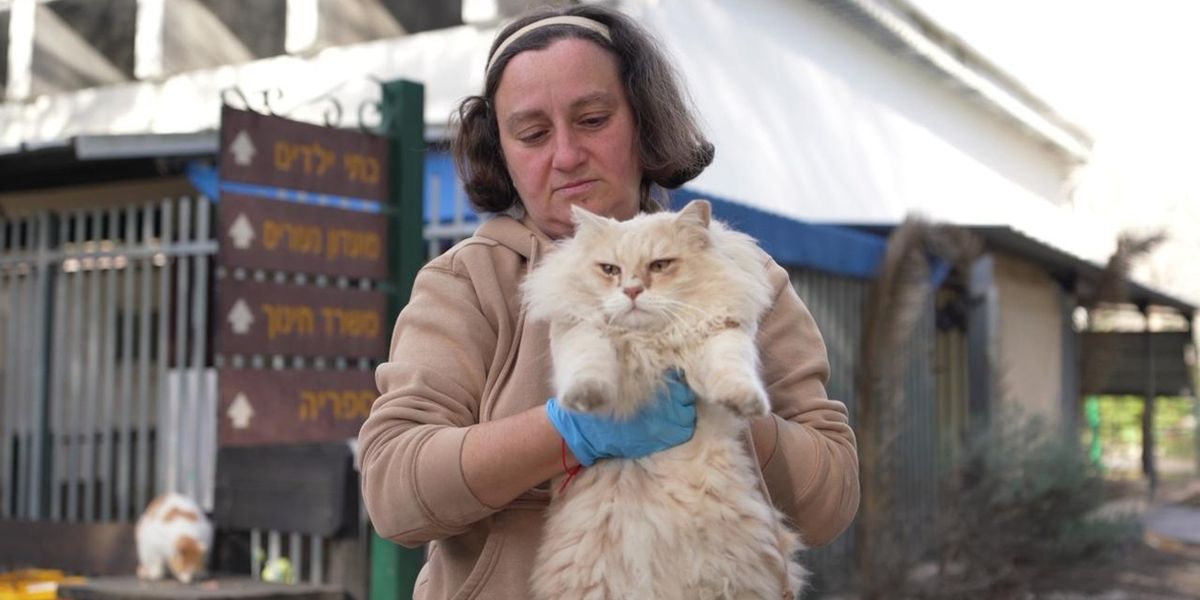
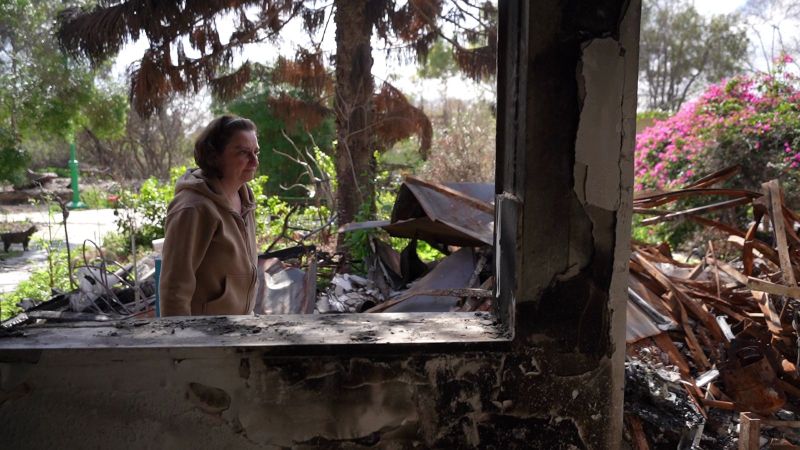
The camera zooms out and we see Yelena Trufanov, a woman in her early fifties, her hair pulled tightly back with a headband so it won’t interfere with the task she has come here to perform: feeding cats. There is no baby in her stroller, only plastic bags filled with cat food and cans of wet food. On her hands are blue disposable gloves, which she uses to rummage through the bags and scoop out another portion of food. Behind her, in front of her, and on either side are low houses — empty, blackened, burned. Around them lies debris that only two and a half years ago was patio chairs, a red plastic slide, and decorative flowerpots. Nothing grows in those dusty pots, no one slides down the slides, no one waves to Yelena as she passes by. There is not a living soul in the streets of this rural community that was once her home.
Gregory Bado, a cinematographer whose intuitive grasp of the narrative often elevates him to a producing role, first saw this scene just a few days after Yelena, a resident of Nir Oz, was released from Hamas captivity. She returned to her kibbutz after 54 days of fear and uncertainty, only to discover that she no longer had a home and no longer had a kibbutz: her husband was murdered on October 7, her son was taken captive, and her cats were burned to death. Bado arrived at the kibbutz capturing footage alongside a reporting team for a television channel, along with an army of journalists and documentarians from around the world, to hear Yelena describe the ordeal she went through on the morning of October 7. She woke up to sirens, chaos, and massive gunfire, and within a few short hours the kibbutz was completely overrun. Dozens of Hamas militants, she said, along with residents of Gaza who came to loot property, did as they pleased in Nir Oz.
“They came into our home and led me on foot to the Gaza Strip,” she told Bado in an interview, “even though they took our car.” Her humor, as well as the circumstances that brought her back to the kibbutz — to feed the cats left behind after their owners were murdered, kidnapped, or evacuated — captured his heart. When the last of the journalists left the area, he stayed with Yelena, quietly managing the production's logistics while walking with her again and again along those paths, in unimaginable loneliness and with stubborn devotion to the mission she had taken upon herself. Walking, framing the shots, and documenting.
“I’ve never seen such dedication,” he says, smiling at the flickering images on the editing screen — cats of all colors chewing and practically smiling at the camera. “I suppose this is Yelena’s way of clinging to what remains of the life she built, to the memories of her husband, who shared her love for cats before he was murdered. I’m fascinated by this woman, and the fascination that my partner on the film, Isaac Sverdlov, and I feel comes through clearly in our cinematic choices. Everyone who’s seen the trailer we structured and made or been exposed to the raw footage wants to hug Yelena and pet the orphaned cats. It’s amazing to see,” says Bado, and returns to editing.
Yelena Trufanov, who immigrated to Israel from the former Soviet Union, spent her captivity in Gaza in the company of her elderly mother and Sasha’s partner — Sasha being her only son. She speaks little about what happened there, and when Bado asked to lens and creatively helm a film about her, he promised he would not probe the wounds of captivity or harass her with invasive, voyeuristic questions. He wants to focus on the cats and absorb her journey in a completely authentic way.
“I wanted to give voice to her loss, and to the loss of Nir Oz, through the furry creatures that were left behind,” Bado recalls. “Yelena told me she was updated very quickly about the fate of her neighbors and friends in the kibbutz, but the news didn’t say what happened to the cats. That she had to find out on her own, slowly — and astonishingly, she’s still finding out. There are cats she knows very well, and others who joined the original group over the years. Did they come from Gaza? From neighboring communities? Did they live in a distant neighborhood and somehow ‘hear’ about Yelena? That’s another mystery surrounding her tours with the baby stroller.”
Would a person who hadn’t gone through what Yelena went through travel by public transportation and hitchhiking, twice a week, from Ramat Gan — where she was evacuated — to Nir Oz, to care for those left behind? Possibly. Cats are especially adept at winning human hearts, and there are people who devote their entire lives to caring for street cats. But Yelena’s case is different. When Bado’s camera sticks close to her, Yelena introduces them to the assortment of cats (and one pesky peacock) who suddenly became her cats. While everyone else moved on with their lives, these cats — living in tense anticipation of their owners’ return, yet for now making do with Yelena’s care — froze on October 7.
“A person needs meaning,” says Bado, “a sense that their actions have value and impact. When I listen to Yelena explain the cats, I understand the forces driving her. She’s compensating them for the disaster that happened to them; she’s keeping them alive, physically and emotionally, in the new reality forced upon them — to live in a ghost town. She’s there for them.”
Back to the film: here is Yelena introducing a black cat, plain-looking, and explaining that she calls him “Black” because she has no idea what his owner called him and never will. “This cat came to his owner’s funeral,” she tells the camera, “because the owner was murdered on October 7. After that, the cat sat for weeks on a bench opposite the cemetery and waited. When he gave up, he turned around and went back to his home — which had nothing left of it — because that was the only place he knew.” Yelena was the only human there for him, even if she arrived with an elegant delay of 54 days because she herself was in captivity. And even today she comes to him — to his home — and takes care of him in a world that has been erased.
“You never know what will grab you in the documentary world,” says Bado. “Sometimes it’s a moment of magic, something that immediately connects to your values, your fears, and forgotten feelings of guilt. In Yelena’s case, the cats’ cries on the one hand and the sheer practicality of this woman — whose husband was murdered and whose son languished in captivity for many months — captivated me. At first I couldn’t understand how, instead of mourning her bitter fate and withdrawing into private grief, she chose to return every week to this harsh place and walk the kibbutz’s tragic paths with her stroller. But very quickly I understood. This is her healing, her comfort. Her own cats were burned alive, but her neighbors’ cats survived. When she feeds them, she’s fighting for justice for the neighbors and for the cats. They are not to blame for October 7, and therefore they should not pay the price.
.jpeg)
“I remember a cat I raised when I was ten years old, who felt unwell and was in distress. I carried him in my backpack to the veterinarian, in a terrible cold that I remember to this day, but I didn’t make it in time and they couldn’t save him. That feeling — of helplessness, of a beloved animal dying before your eyes because you didn’t react fast enough and didn’t run fast enough — has haunted me. Yelena made it. She got to Nir Oz in time. She keeps the cats alive and gives them love because their owners can’t. Her sense of fulfillment is immense, and I can understand it and fully identify with it.”
Bado’s and Sverdlov’s film is still in editing, but its final shot has yet to be filmed. They are waiting. “We don’t know how this film will end,” they say, “because it’s not destined for a happy ending. True, Yelena’s son has returned from captivity, thank God, but the wound shared by everyone hasn’t healed. Vitaly, Yelena’s husband, was murdered, and his absence condemns both of them to orphanhood and loneliness. The memories of captivity linger. The longing for the vibrant kibbutz life is agonizing.
“Perhaps Sasha’s upcoming wedding will be the final scene — a moment of great consolation for a shattered family. Perhaps the residents of Nir Oz will one day return home, when the state decides to rehabilitate the kibbutz; some cats will be adopted and Yelena will once again become the local ‘cat lady,’ combining the feeding of street cats with her daily routine. Perhaps someone will take it upon themselves to evacuate the cats to the center, to some organization that will find them homes and disperse them across the country. We truly don’t know, and we don’t want to rush reality into making decisions. If Yelena has patience, then certainly so do we.”
Photo Credit: Gregory Bado