


St. Charles Singers Will Perform SACRED SPACES A Cappella Program Before Italy Tour
Conductor Jeffrey Hunt leads the choir in works by Aaron Copland at St. Michael Catholic Church and Baker Memorial UMC
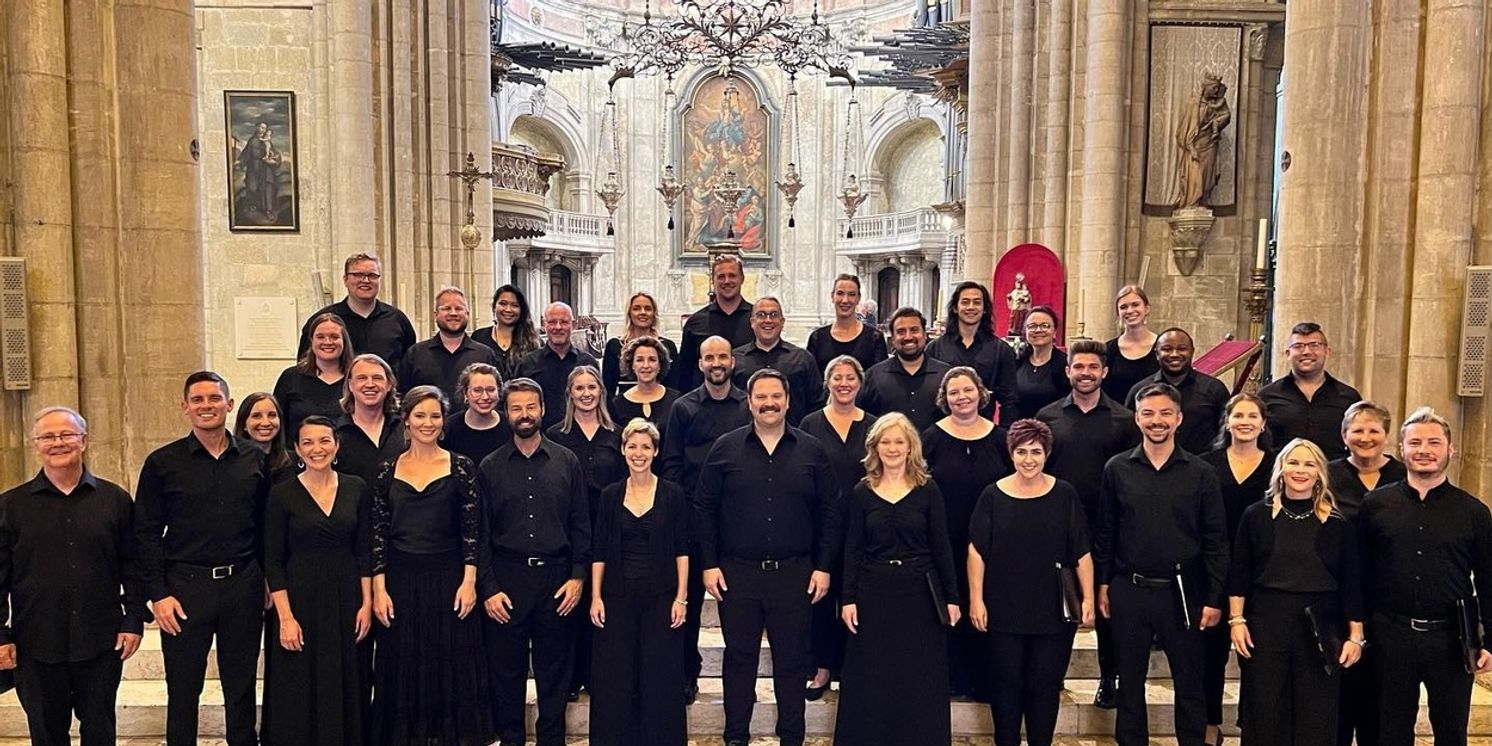
The St. Charles Singers will conclude its 41st season June 11-12, 2026, with a program of sacred a cappella works that the critically acclaimed mixed-voice chamber choir will perform later in the month on its first concert tour in Italy.
Founder and music director Jeffrey Hunt will conduct the choir in a program titled "Sacred Spaces" 7:30 p.m. June 11 at St. Michael Catholic Church, 301 S. Wheaton Avenue, Wheaton; and 7:30 p.m. June 12 at Baker Memorial United Methodist Church, 307 Cedar Avenue, St. Charles.
Hunt and the St. Charles Singers will travel to Italy June 15 for a tour that will see them singing in sacred spaces in Venice, Padova, Vicenza, and Rome, including Vatican City's St. Peter's Basilica.
"Audiences will hear a program of historical and geographical depth and great emotional variety," Hunt says. "There are moments of quiet contemplation, grandeur, and jubilation. It's a testament to how sacred music continues to speak to us across the centuries and national borders and through diverse cultures and styles."
Hunt says the a cappella program recalls the St. Charles Singers' 1980s roots as the Mostly Madrigal Singers. "Unaccompanied choral music echoes our origins and continues to represent an important part of who we are."
American composers, many with Midwest connections, figure prominently in the program. The concert's centerpiece is Aaron Copland's rarely heard "In the Beginning," a dramatic depiction of the creation story from the Book of Genesis. "It demands 17 minutes of virtuosic, unaccompanied singing," Hunt says. Ensemble member Margaret Fox, mezzo-soprano, will be the soloist. This will mark the St. Charles Singers' first performances of the work.
Grammy-nominated Jake Runestad, a Rockford, Illinois, native now living in Minnesota, based his uplifting "I Will Lift Mine Eyes," on Psalm 121. The score offers distinctive contrasts between intimate and extroverted moments.
"Give Me Jesus" is American composer, conductor, and educator L. L Fleming's best-known work. "His arrangement of this deeply moving spiritual is remarkable for its quiet intensity," Hunt says. He recalls singing the piece as a St. Charles High School chorus member and says it influenced him as a singer and conductor. Fleming served as director of choral activities and director of chapel music at Valparaiso University, Valparaiso, Indiana, and later founded the National Lutheran Choir.
Alabama-born William Dawson's "Ezekial Saw De Wheel" is an arrangement of an African-American spiritual. It's noted for its compelling call-and-response character and exhilarating momentum. Dawson earned a master's degree in composition from Chicago's American Conservatory of Music, studied conducting at Chicago Musical College, and served as first trombonist with the Civic Orchestra of Chicago from 1927 to 1930.
From Westmont, Illinois, comes revered choral musician Robert Boyd's warm and lyrical arrangement of "How Can I Keep from Singing," an American Christian hymn from the 1860s later popularized as a folk song. Hunt says Boyd's version "fosters a sense of spiritual resilience and shared optimism."
Southern California-based composer Shawn Kirchner, a native of Cedar Falls, Iowa, is an accomplished tenor who has sung with the Los Angeles Master Chorale and the Los Angeles Philharmonic. His bright "Unclouded Day" combines traditional bluegrass vocal stylings with counterpoint and fugue, building to a thrilling finale.
England is represented by late-Romantic composer Charles Villiers Stanford and Sir John Rutter, who has written for and conducted the St. Charles Singers on multiple occasions.
Stanford's lyrical "Beati quorum via" (Blessed are those whose way is blameless) from his "Three Latin Motets," Op. 38, projects the noble melodies, elegant interplay of voices, and polished harmonies he's known for.
Rutter's "Open Thou Mine Eyes" is his original setting of a 17th-century sacred text, with intricate vocal lines.
"We're immensely proud of and grateful for our long and close association with John Rutter," Hunt says. "His music and his musicianship are a core part of our identity as a choir."
The program offers works by two early Italian composers. Giovanni Pierluigi de Palestrina's "Tu es Petrus" (You are Peter), with its radiant interplay of voices and serene grandeur, is a signature work of the Italian Renaissance. Palestrina's music was greatly admired by J. S. Bach, who closely studied his scores.
Claudio Monteverdi straddled the formal, disciplined Renaissance approach to composition and the emerging, more emotionally exuberant Baroque style. His poignant "Adoramus Te" (We adore Thee) is a vivid miniature masterwork.
A graduate of the Paris Conservatoire, Maurice Duruflé blends medieval Gregorian chant with 20th-century French Impressionist harmonies in his 1960 motet "Ubi Caritas" (Where There Is Charity).
Germany's Felix Mendelssohn wrote his popular Romantic-era motet "Denn er hat seinen Engeln befohlen" (For He Shall Give His Angels Charge) for eight-part choir using verses from Psalm 91. He later made it part of his famous oratorio, "Elijah."
Contemporary South Korean composer Hyo-won Woo's "Cum Sancto Spiritu" (With the Holy Spirit) is a movement from her "Gloria." She combines Western musical ideas with the traditional Korean musical scale and rhythmic patterns. "It's an impressively dynamic setting of a well-known Latin text," Hunt says.
Videos