REVIEW: Impressive Singing in Strauss’s EGYPTIAN HELEN, but the Story’s a Mystery at SummerScape
Botstein Leads the ASO in Rath’s Knotty Production at Bard’s Fisher Center in Westchester
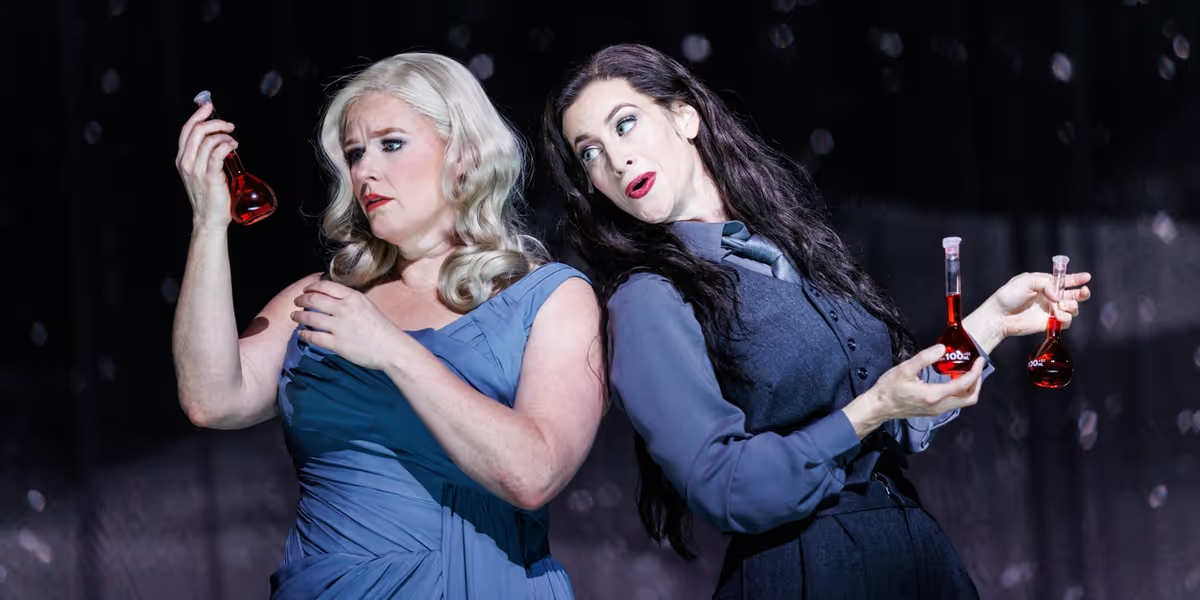
If you ever wondered about the private life of the legendary Helen of Troy—aside from being a fabulous beauty whose face reputedly launched a thousand ships—you might look for answers in Richard Strauss’s opera DIE AEGIPTISCHE HELENA (THE EGYPTIAN HELEN). But you wouldn’t have found them in the production that just finished up an entertaining yet mystifying five-performance run, in Christian Rath’s knotty vision at Bard’s SummerScape Festival in Annandale-on-Hudson.
It’s true that we heard a sometimes outrageously robust orchestral performance by the American Symphony Orchestra (ASO) under conductor Leon Botstein, alongside some wonderful singing at the performance I heard, including the Bard Festival Chorale, under James Bagwell.
Three cheers for introducing us to a powerful trio of principals: soprano Hailey Clark as Helen, who seemed to unleash unceasing resources; the muscular tenor of John Matthew Myers as Menelaus; and the lyric soprano Jana McIntyre as the sorceress Aithra, who occasionally pushed the limits of her attractive voice.
The stellar supporting cast was notable for baritone Blake Denson’s impressive prince, Da-Ud, suitor of Helen, and the supple tenor of Shawn Roth as his son, mistaken for Paris and killed by Menelaus. Mezzo Deborah Nansteel did fine work as the Omniscient Seashell (yes, that’s what I said) as well as Aithra’s Second Servant, alongside soprano Catherine Creed’s First Servant.
I had high hopes at the start of the score, which reminded me of some of the composer’s greatest works. But, as a whole, even his most passionate admirers wouldn’t call HELENA one of his best, next to SALOME, ELEKTRA, DIE FRAU OHNE SCHATTEN, DER ROSENKAVALIER, or even ARIADNE AUF NAXOS. Yes, undeniably, there is some stunning music in Strauss’s score, placing incredible demands on the singers that they met fearlessly, even if the level of intensity, at times, reached the “overwhelming” reading on the loudness meter.
Happily, there was enough of Strauss at his best to carry the performance to a successful conclusion.
Yet, in evaluating the rewards of the piece—or its shortcomings—the “buck” must stop with the composer for accepting Hugo von Hofmannsthal’s libretto, at least not as presented in director Rath’s production. (Rath is also credited as co-scenic designer with Daniel Unger, with projections by Elaine J. McCarthy, lighting by Tyler Micoleau and choreography by Catherine Galasso. Costumes were by Mattie Ullrich.)
To say that the story was incomprehensible would be an understatement, a delusional look at marriage through the eyes of Helen and her husband Menelaus, as interpreted by Aithra. As a Broadway critic once wrote about a lesser evening at the theatre, the author “didn't have an idea for a play this year, but he wrote it anyway." That’s what the story seemed here.
This was the last completed collaboration between Strauss and von Hofmannsthal (the brilliant librettist died before ARABELLA was completed) and I have no idea what his health was like during its writing and how that may have affected it. What we saw was, well, kind of a mess dramatically.
Caption: (from left) Hailey Clark and Jana McIntyre
Credit: Maria Baranova