



Season 2, Episode 5: Behind every summer is a community that keeps Fire Island alive. This episode explores the history of the beloved Pines Pantry through the eyes of its iconic Pantry Girls, alongside the volunteer firefighters of The Pines and Cherry Grove who protect the island from fires, hurricanes, beach erosion, and an uncertain future.
Interview: Atlanta Opera’s Tomer Zvulun on Wagner’s TWILIGHT OF THE GODS, the Finale of His RING Cycle
GOTTERDAMMERUNG If I Know for Whom the RING Tolls!
By: Richard Sasanow
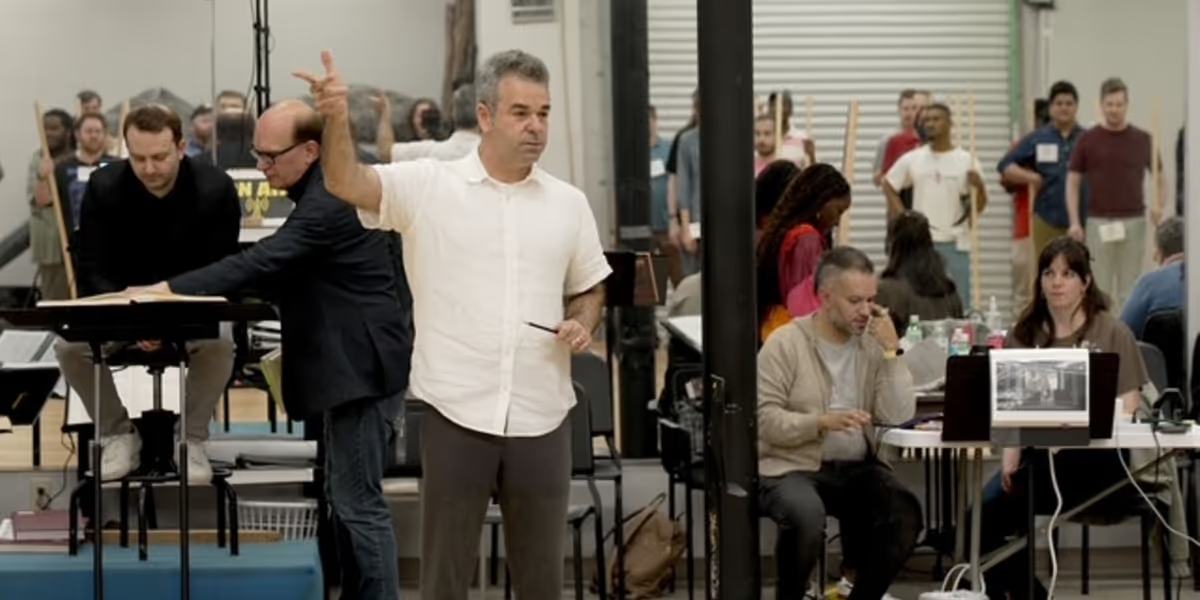
“Stories are stories are stories, whether it’s Wagner’s Wotan and Fricka (in the Ring), Handel’s Jupiter and Juno (in Handel’s SEMELE) or Broadway’s Tevye and Golde (FIDDLER ON THE ROOF) and they repeat in different cultures and traditions,” General Manager and Artistic Director of the Atlanta Opera, Tomer Zvulun, said to me. “And whether it’s talking about siblings or spouses, or parents and children, we always end with similar concerns.”
Our conversation was about his company’s new production of Wagner’s TWILIGHT OF THE GODS, better known to Wagner aficionados as GOTTERDAMMERUNG, which opens on May 30 at Atlanta’s Cobb Performing Arts Center. The production, designed by Erhard Rom with costumes by Mattie Ulrich, stars notable Wagnerians Stefan Vinke and Lise Lindstrom, and is conducted by Robert Kalb.
This is the climax of the composer’s tetrology, DAS RING DER NIBELUNGEN (The Ring of the Nibelungen), which tells of man’s desire to be immortal and the realization that he’s not. The cycle—the first in the Southeast—has been directed by Zvulun.
Because he’s been working on this Ring for a number of years—the production of DAS RHEINGOLD premiered in Dallas over three years ago--I start at the beginning of things, asking him whether he had the multi-night piece mapped out in his head from the very start.
TOMER ZVULUN: To a certain degree the answer is ‘yes,’ but the discoveries along the way have been mind blowing. We were lucky to build our RING over years rather than all at once, because it takes time for things to simmer and develop. To see things through different lenses: I think that’s the way to do it.
With what you’ve discovered, has it changed much since how you originally thought of it? If you were to go back to, say, RHEINGOLD, would you think “Oh, I would change that to…”? now that you’ve seen where the whole thing took you?
I think so. I think there are some elements—not a lot—but some items that I would do differently. And I think we will do that when we do the full RING. You know, there’s a certain cohesiveness that we found along the way, which is very clear and it’s super exciting for us.
While RHEINGOLD was a big success and very well received, when I look back at it, it feels like an exploration and I’d tweak some things. But I wouldn’t change anything about DIE WALKURE or SIEGFRIED, because they moved into what the RING is for us—I think we hit our stride with WALKURE. If anything,
After doing RHEINGOLD, Zvulun directed productions of Handel’s SEMELE and “Fiddler on the Roof” (a co-production with Atlanta’s Alliance Theatre). I asked him about comparing SEMELE vs GOTTERDAMMERUNG vs “Fiddler” [which had a sellout production last fall in Atlanta] and producing them all in succession.
I think what’s interesting for us as a company is to really live the mission statement that we’re operating under: to break the boundaries of opera. To deliver exceptional performances for audiences everywhere. If you look at the different styles of our productions, to do, as we did last season, not just SIEGFRIED but Verdi’s MACBETH and Handel’s baroque SEMELE and perhaps the most famous musical theatre piece ever, “Fiddler on the Roof.”
This idea of refusing to adhere to a box about what opera is key for us. We’re no longer a local opera company that performs in an analog way but as an international, multimedia company that has productions broadcast all over the world. To me that’s interesting.
It must also be exciting…
Yeah. We work very hard but the payoff is incredible. It’s truly exciting not to repeat the same old same old. Now we have this new facility that we broke ground for not so long ago, which will take our “breaking the boundaries of opera” to a whole different level.
This new facility is a 50,000 square-foot, state-of-the-art headquarters for the opera but along with a recital space, two performing arts spaces, an acoustically pristine recital hall and a multi-purpose 200-400 seat theatre that we can modify for whatever we want: In the round, a black box etc. anything we want it to be.
And we’re thinking about doing all kinds of things there that are not necessarily just opera. The mainstage productions will stay at the Cobb Center, but in the new spaces we can do chamber operas, recitals, chamber music. We can do musicals, straight plays, symposiums. So it fits with the mission of the opera.
OK, let’s talk more about the crossover themes between SEMELE and GOTTERDAMMERUNG.
Musically, Handel has nothing to do with Wagner. However, when I approached SEMELE for the first time, this world of gods and monsters and disfunctional families and tortured human beings in bad relationships, it made me think of Wagner and the RING. This was especially true with the character of Semele, who is totally fascinated by the image of Jupiter, which reminded me of another Wagner heroine, Senta in the Flying Dutchman. Or Juno, who’s the wife of Jupiter and is like Fricka, the wife of Wotan.
At the end of Act 2 of SEMELE, when Ino comes to visit her sister Semele, I can’t help think of GOTTERDAMMERUNG. So it’s kind of peculiar that a piece that is so baroque can have so much—thematically, in terms of narrative, of course--in common with Wagner.
Talk a little more about this crossover…
When Juno and Jupiter are clashing, and she’s very very jealous of his philandering, it’s very close to the interplay between Fricka and Wotan. And when Semele has the duet with her sister Ino, when she comes to visit her in the stars, the idea of sisterly love echoes the scene between Waltraute and Wohilde in Wagner.
I think that both those pieces have similar themes--not only because they’re focusing on gods, imaginery dragons and heroes but because both those pieces and all mythology are about love, the different facets of love. You know, in English love only refers to romantic love, but there’s more than that in other languages like Greek.
When you talk about your daughters, that’s called family love; what the Greeks called erotasis about erotic love, between erotic partners. There’s the love between friends, philia. Both SEMELE and the RING were influenced by the idea of love, and the ultimate fear of death and how love and its different facets—all those words the Greeks had for it—is what helps us get through the badness of this life. At the end, we’re all going to be ending the same way.
And “Fiddler”—what is there that brought other things to mind?
Same thing: Look at Tevye and his love for his five daughters. It’s like Wotan and his love for the siblings. You look at the sometimes-pragmatic relationship –pragma in Greek is the type of love based on convenience—between Tevye and Golde [“Do you love me?”]. It’s Fricka and Wotan. They’re in a relationship, ok, we have to pay the bills, the contractors, there may be a mistress on the side but we’re still together.
You see that in SEMELE between Jupiter and Juno and erotic love between Sieglinde and Siegmund is echoed in the Handel and the musical. This matter of different kinds of love is echoed between styles, between cultures, between stories. It’s fascinating to me as somebody who primarily tells stories that are based in opera and musical theatre.
All those stories are based on three things: love, sex and death, in all their different facets. And power, of course. And all these different stories we tell has a certain canvas, sometimes a big canvas, a mural, often with a lot of epic action in it. Special effects, choruses, a lot of things happening, pogroms, etc., dragons in the RING.
But at the core of those murals, those paintings, portraits of human beings, we are reminded of ourselves and the basic questions we have is: who am i? and, how am I going to get through this life? And the answer is typically, connection with other people we love, either members of our family or our lover, our parents, our dear friends.
It's easy to fall back into “Fiddler,” but more about GOTTERDAMMERUNG, and how you figured out what you were going to do with it, what was going to be your starting point.
Each piece of the RING is about a certain theme and a certain character.
- RHEINGOLD, if I had to summarize it in one phrase, it would be about the love of power. The character who discovers the gold, he’s obsessed with the power that he can get from it all. It’s the story of a young man, of somebody on the way up. And there are two characters that RHEINGOLD belongs to: Alberich and Wotan. Both are obsessed with the same thing.
- Then WALKURE is more about the power of love and Wotan, later on in his life. He’s struggling with the price you pay for the love of power—when you love power, you pay for it with the power of love. Look at the tech barons and financiers, politicians today-- people who sacrificed so much with terrible family lives. That’s what WALKURE is about. It’s all about Wotan.
- The third one, SIEGFRIED, is all about the later phase of life. If the first was about a man on his way up, his beginnings, the second about middle age. The third one is about old age. We meet Alberich and Mime again, both demented, both living like they could be under a bridge, obsessed with the past. We meet Erda, she’s like an old people’s home. She doesn’t want to wake up.
Wotan has given up everything; he’s like a monk. Look at every character. Fafner is a dragon that is sitting on the gold, decaying. At the end he’s this old man who’s scared of death. But in SIEGFRIED we’re introduced to a new generation who gives us hope. Even at the end of one generation there’s another ready to come in and take over the world. - GOTTERDAMMERUNG, to me, takes those three stories: the young man’s quest to power, a middle-aged man who realizes that life is more complicated and that things don’t always go well and an old man’s realization that the end is coming. And they compact everything into one story that shows the rise and fall of a generation.
It also ends with the same kind of hope that there’ll be a new generation. And even though the gods will go down, there will be a ‘twilight of the gods’ and the will be a new hope because nature prevails. That’s the ring in a nutshell.
What about the leitmotifs--those short, recurring musical phrases that are tied to a particular person, place, or idea--that Wagner is famous for?
To me, the leitmotifs are more about the internal, psychological world of the character, revealing things about previous things that have happened and I feel like it’s my job to respect the music and allow those connections to be made through the listeners’ minds rather than illustrate a leitmotif.
I think that if we try to illustrate a leitmotif with a visual or theatrical element, it would look ridiculous. Let me give you an example: In GOTTERDAMMERUNG we hear Fafner’s motif. What am I going to do? Show the dragon? Have a blink of what the dragon looked like? We could do that; we have the ability today to visualize anything we want. But I think it would diminish the power of the music and genius of Wagner.
It’s more about pointing out subconscious, psychological things that connect things in the listener’s mind than illustrating them on stage. To me it’s the job of the director is to create a world for the music and the voices—a beautiful world, a world you can connect with, but it should never take away from the mythology that Wagner packed into his characters.
How long till the company does the entire RING in a single season?
I’d like to do it soon but there are lots of obstacles, from the availability of the venue, to the availability of singers, to how it fits in with the season, as well as our other plans, like the opening of the new arts center. I don’t have an answer right now but it’s definitely on my “to do” list. There are many stories and many styles and many cultures that one could tell those stories in. But the key is to tell those stories musically in human, theatrical and excellent ways.
TWILIGHT OF THE GODS (GOTTERDAMMERUNG) will be performed from May 30 to June 7, 2026. For more information and tickets, see the Atlanta Opera website.
Caption: Tomer Zvulun in rehearsal for TWILIGHT OF THE GODS (GOTTERDAMMERUNG)
Credit: Felipe Barral/Atlanta Opera
Broadway news in your inbox
Weekly top stories - unsubscribe anytime.
Weekly top stories - unsubscribe anytime.