


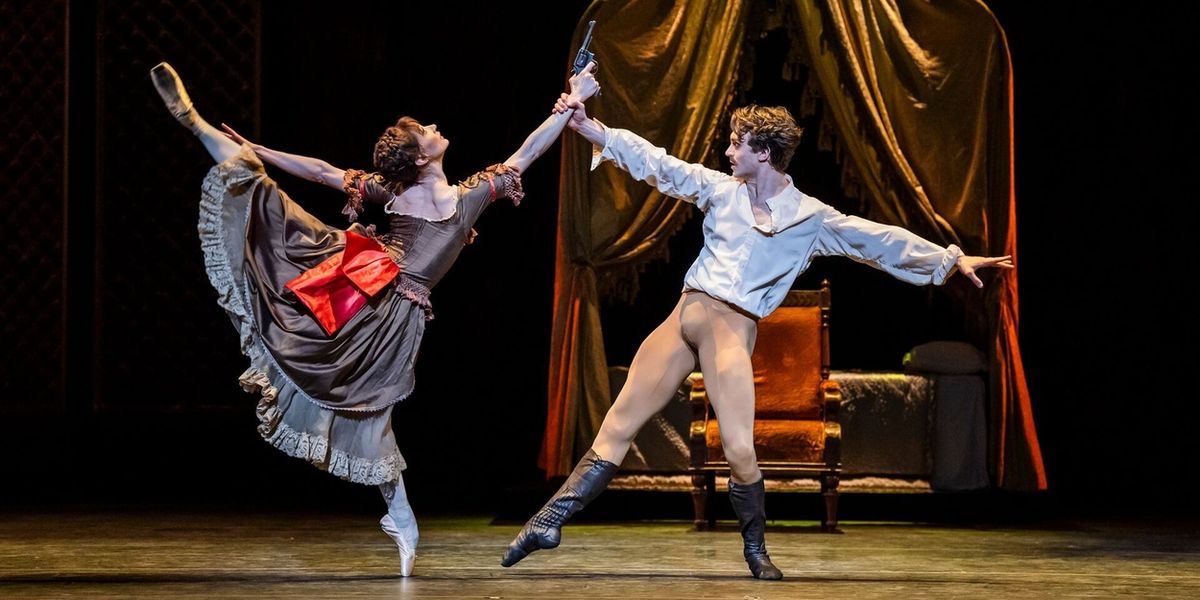
 Mayerling is an experience - let no one tell you otherwise. Kenneth MacMillan’s 1978 ballet delves into the true story of the 19th century Austro-Hungarian court, and specifically the experience of the heir apparent; Crown Prince Rudolf.
Rudolf is an ideal MacMillan protagonist as he was a troubled soul surrounded by huge pressure, addictions and ultimately demise. The narrative also allows for a male dancer to be the lead character. Yes, the ballet sees Rudolf engage with the women in his life, but ultimately, it's Rudolf we follow as the central figure.
In my humble opinion the work is a masterpiece from the meteorological-style Liszt score, the opulent yet stifling Nicholas Georgiadis designs and of course, MacMillan’s expressionist choreography. And there's so much dancing! Endless emotional pas de deux and humming crowd scenes - MacMillan keeps offering original movement to carry the complex story. The piece is a working example of modern, narrative ballet.
The roles are understandably desired, and this run of performances sees six different casts between now and the middle of May. Leading opening night was Matthew Ball as Rudolf. Like the ballet, his despair grew as matters progressed, and by Act 3 his interpretation was wild, vivid and convincing. The Rudolf role is difficult as it begins with a bang in Act 1 with an extended, emotionally charged solo. This needs a little more work from Ball as it currently lacks pliability and profound projection - but elsewhere things are good indeed.

Photo Credit: Tristram Kenton
Another key character is Countess Marie Larisch; a Lady-in-waiting to Empress Elisabeth and ex-mistress of Rudolf. MacMillan uses Larisch as the thread that binds the different aspects of Rudolf’s existence, and if performed well is undeniably important. Mayara Magri did a stellar job. Her Larisch is the ideal balance of care and corruption and the epitome of FOMO (fear of missing out) in action. Magri is becoming more and more of a serious, dramatic artist to consider.
The other main woman in Rudolf’s demise is his young mistress Mary Vetsera. Mary was only 17 when she died, and Melissa Hamilton's dancing has an ease that suggests both youth and inexperience. The pas de deux between Rudolf and Mary are extreme and Hamilton has the ideal, pliable body type to make MacMillan’s excessive positions come to life. Elsewhere I feel there's room for more dynamic range and depth of character, but the current interpretation absolutely has promise.
Rudolf has met some kind of a match with Meaghan Grace Hinkis playing the role of his new wife Princess Stephanie. Their wedding night pas de deux sees Rudolf terrorise Stephanie both physically and mentally, and MacMillan, more than once, crosses the boundary from dramatic dance into violence. Regardless, Hinkis brings the much needed resilience and frenzy to her account of Stephanie, and it's grippingly uncomfortable to watch.
Kristen McNally as Empress Elisabeth is a cold presence and Elizabeth McGorian as Baroness Helene Vetsera, Mary’s mother, predicts her daughter's demise with chilling subtlety. Mariko Sasaki as Mitzi Caspar (a high-class prostitute and Rudolf’s regular mistress) has some work to do in the Tavern scene. MacMillan’s choreography for Mitzi is all enticing and incidental - but at the moment it just feels a bit step heavy. The character and her intention need to initiate proceedings.

Photo Credit: Tristram Kenton
I'd also like to give a nod to all other supporting characters, including the corps de ballet. All scenes feel alive and necessary, especially through the dancing of the male members. A prime example being Luca Acri in the role of Bratfisch (Rudolf’s private cab-driver and entertainer) - Acri, as always, brings presence and precision to everything he does. Some of the females however, need to work on the believability of their debauchery - I for one wasn't convinced 100 percent of the time!
Considering the recent rhetoric discussing ballet I can confirm the art form felt very much alive during this performance of Mayerling. MacMillan’s work is tantamount to the power of the genre, and specifically to the notion of emotional communication without words. Imagine a two hour film with no script - how would that fare? Award-worthy? Who knows…
Mayerling continues at the Royal Ballet And Opera until 18 May
Photo Credits: Tristram Kenton
Prefer BroadwayWorld in Google Search?
Add us as a preferred source so our stories show up more often in Top Stories and Google’s AI answers — for you.
Sign up for all the news on the Fall season, discounts & more...
.jpg?format=auto&width=300)
.png?format=auto&width=365)





Reader Reviews
To post a comment, you must register and login.