


Interview: Theatre Life with Suzy Eddie Izzard
The very talented performer/writer/marathon runner and author on her solo show The Tragedy of Hamlet and more.
.gif)
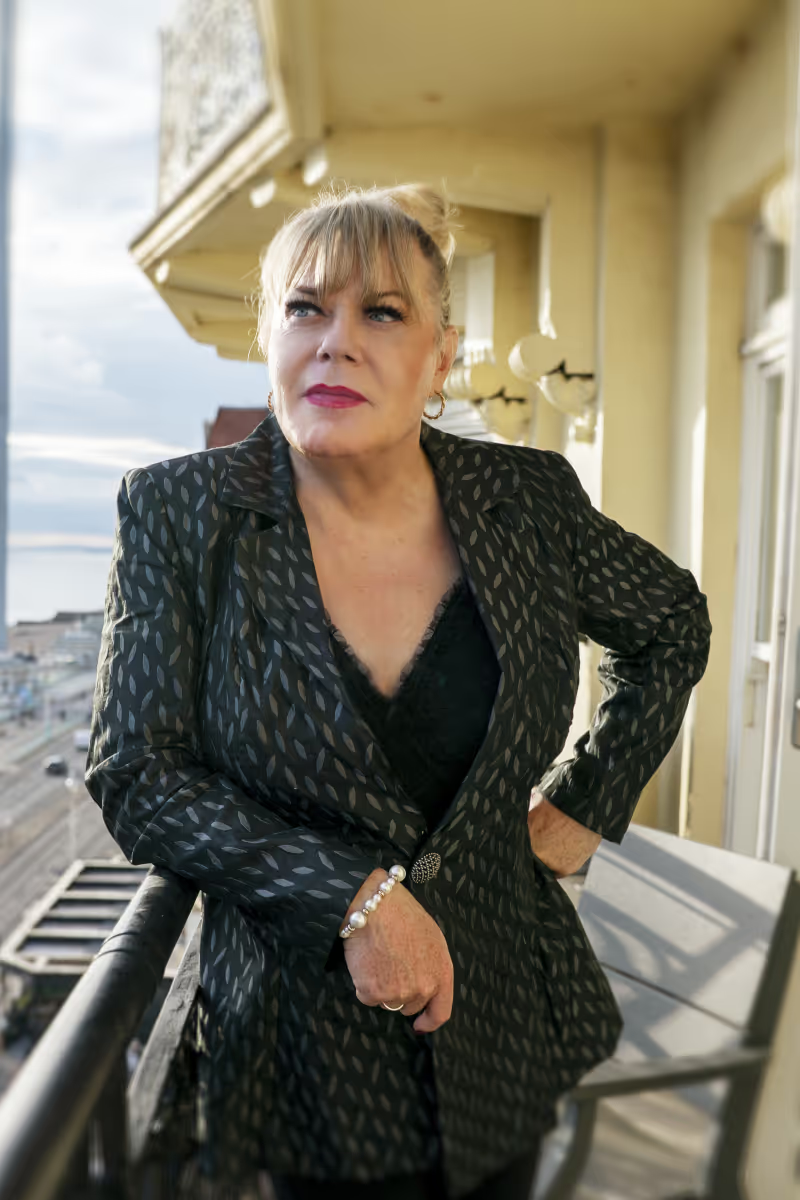
Today’s subject Suzy Eddie Izzard is an award-winning performer, marathon runner, and author. Her tour de force solo show The Tragedy of Hamlet will be seen right here in DC at Shakespeare Theatre Company (STC) from March 27th to April 11th. The show will be performed in STC’s Klein Theatre.
Izzard has been seen onstage on both sides of the pond. Her performances have garnered praise from audiences and critics alike. On Broadway she was seen in A Day in the Death of Joe Egg (Tony Award nomination) and Race.
In the West End she has performed in The Cryptogram, Edward II, 900 Oneonta, A Day in the Death of Joe Egg, and Charles Dickens’ Great Expectations.
Her many film credits include Stephen Frears’ Victoria & Abdul opposite Dame Judi Dench (read on to see what that experience was like), Valkyrie, Ocean’s Twelve, Ocean’s Thirteen, Julie Taymor’s Across the Universe, Mystery Men, Shadow of the Vampire, The Cat’s Meow, Six Minutes to Midnight and the recent Doctor Jekyll in which she plays Dr. Nina Jekyll and Rachel Hyde.
Suzy is the recipient of two Emmy Awards (for Dress to Kill) and an Emmy Award nomination for the documentary, Believe: The Eddie Izzard Story. Her autobiography Believe Me entered the top ten in The New York Times and Sunday Times bestseller lists.
She performs her comedy shows in four languages and since 2009 has run 131 marathons to raise money for Sport Relief and her “Make Humanity Great Again” fund.
Suzy is by far one of the most innovative and talented performers working today. If you have ever seen one of her solo shows,or seen her in a play on Broadway or elsewhere, you know what I am talking about.
Assuming there are still any tickets to be had, grab your tickets to see Suzy Eddie Izzard in The Tragedy of Hamlet at STC. It’s a performance that both lovers of Shakespeare and lovers of solo performance artistry can enjoy and marvel at together.
Suzy Eddie Izzard is truly living her theatre life to the fullest.

Photo courtesy of the artist.
At what age did it become apparent to you that performing was going to be your chosen profession?
Seven, the month before I turned eight. I did play a Raven when I was about six, and that didn't have any impact on me, but when I saw this play, The Boy With a Cart, by Christopher Fry in January of 1970. There was one person in particular on stage who was getting a lot of positive reaction from the audience. So, I thought, I want to do this.
My mom had died two years before. I think I was swapping my mother's love for the audience's love. Something like that. As long as you do a good piece of work, I it's not too twisted an idea.
Where did you receive your training?
On the streets of London, Covent Garden as a street performer for four years. That was training by audiences, which is very similar to how Shakespeare's actors could well have been trained because they had no drama schools.
And then through performance, through films, through television, drama and film drama. And also, a little bit of standup on the way.
What was your first professional job as a performer?
My first professional one I think was probably in London's Covent Garden. It was for people who were not necessarily wanting to watch you in the first place. I think it was in late eighties on the streets of London.
.JPG?format=auto&width=800)
Photo by Carol Rosegg.
How did The Tragedy of Hamlet come to be?
Saxo Grammaticus is the Danish historian who wrote about it in the early 1200s. Um, this legendary story about Amleth, which was either turned into a play that Shakespeare copied, or Shakespeare copied that story and put that story into the story of Hamlet.
I had wanted to do it. I'd been intimidated by Shakespeare when I was a teenager due to dyslexia and very had great difficulty taking words which were Elizabethan and poetic into my brain and out of my mouth and making sense of them. Later on when I started getting Tony nominated for Best Actor on Broadway and really getting my feet under the table dramatically, I wanted to do Shakespeare.
When I did Great Expectations by Dickens as a solo performance, I realized I could do Hamlet also as a solo performance. And so, I did.
The Tragedy of Hamlet is shorter than the full Shakespeare play, so when you started putting this show together, how did you decide what was going to be cut from the original text?
The adaptation was done by my brother, but the truth is that Shakespeare’s writing is in the first quarter, the second quarter, and the first folio so, Shakespeare has three different versions. So, you have to choose it. I don't believe anyone was doing the four-and-a-half-hour version. I don't believe they were standing out there for four and a half hours. I think scholars now believe that was him adding and saying this is my director's cut
We wanted to serve the play. We wanted the story to work as best it could.
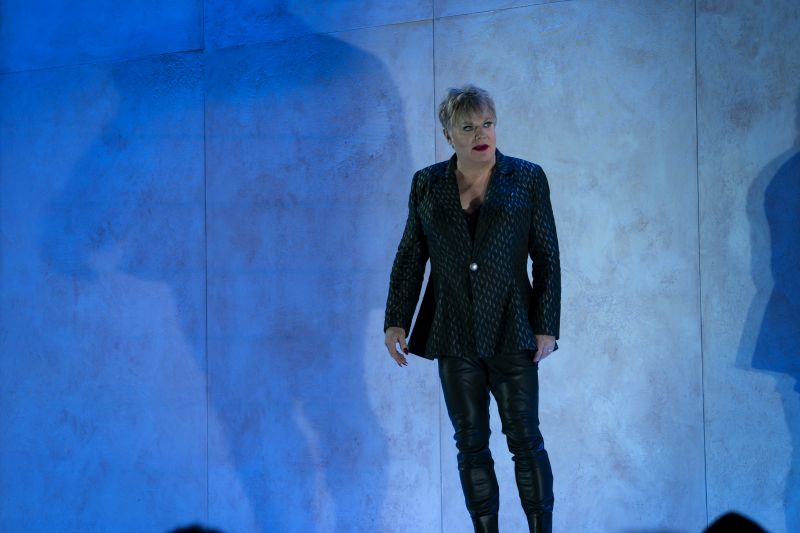
Photo by Amanda Searle.
Having performed The Tragedy of Hamlet both on the West End and now in the States, what would you say is the biggest difference between UK and American audiences?
I'd say American audiences are slightly more distanced from Shakespeare because America's heritage is all across Europe and all across the world from people having come in as immigrants into America. In Britain, I think Shakespeare is seen more as a fearful figure.
I think the audience in America can take a step back and can look at it and appreciate the best parts and, and say, these parts are too opaque. These parts are too obtuse. I don't understand it. There's just more distance. In Britain, we're almost brought up with it as something you are forced to have to do. He is seen as a God in Britain and probably more like a great playwright in America.
Some would say performing a solo show is like running a marathon. You have literally run in over 130 marathons for charity. Can you please tell us how you got involved in doing this?
I felt running the marathons for charity was good training, good to keep one's body active and could help other people by raising money for charities in the UK and around the world.
I've done 43 marathons of 51 days and people would say I’ll give you five pounds or five dollars for that. It seemed to be difficult enough that people would hopefully donate money and that it could help people. It was helping me in the adventure, the health, but also it helped raise money, which I thought was a good thing to do as well.
You have had the great privilege of performing with Dame Judi Dench in the movie Victoria and Abdul. Can you, can you please talk about the experience of working with arguably one of the greatest actresses in the world?
It is wonderful work with Judi. She's a very giving person. She's a very friendly person. Some actors, as people will know, will pull things towards them. That's not Judi She’s just a very welcoming person and very relaxed. And so that is the, the wonderful thing about playing with her. I was playing her son and Edward the seventh. The Edward who became Edward the seventh did not get on with his mother, Queen Victoria.
I knew her from before because she came to my comedy shows. She liked my comedy and then suddenly I was in a film with her. Not because of that, but because Steven Frears the director, chose me. So suddenly I was playing her wayward son.
Are there any other Shakespeare plays you would like to turn into a solo piece for yourself?
I would consider Richard The Third. That is a role that I wanted to play before I wanted to play Hamlet. But at the moment, I'm just enjoying doing Hamlet and there's 196 countries in the world, so I've now played in three of them so, I've got a lot more to do,
Besides The Tragedy of Hamlet, what does the rest of 2026 hold in store for you work-wise?
Just The Tragedy of Hamlet tour at the moment. There are certain films that I will be doing. I can't announce that yet because they have to tell me whether I'm allowed to announce it. Um, but also, um. Touring, uh, maybe a certain amount of comedy in Spanish will be happening soon, if not this year, then next year.
I speak four languages, German, Spanish, French and English. I would love to play in Germany again but for now, Spain is definitly on my radar.
Special thanks to Shakespeare Theatre Company's publicity goddess Heather C. Jackson for her assistance in coordinating this interview.
Theatre Life logo designed by Kevin Laughon.
Prefer BroadwayWorld in Google Search?
Add us as a preferred source so our stories show up more often in Top Stories and Google’s AI answers — for you.
Sign up for all the news on the Fall season, discounts & more...
|
Brian Henson's Puppet Up! Lincoln Theatre (9/30-9/30) |
|
GARBO: EL ACTOR QUE SAVÓ AL MUNDO (Garbo: The Actor Who Saved The World) GALA Hispanic Theatre (9/03-9/27) |

|
Mr. Burns: A Post-Electric Play Clarice Smith Performing Arts Center (10/09-10/18) |

|
Special Event: ARTS By George!: Jeff Goldblum and the Mildred Snitzer Orchestra Center for the Arts (10/03-10/03) |

|
The Second-Best School Shooting NextStop Theatre (9/17-10/11) |

|
Coming to America: An Immigrant Cabaret ExPats Theatre (9/30-10/18) |

|
Some Like It Hot Bernard Family Theatre, Olney Theatre Center (9/18-11/08) |
|
Stonewall's Bust The Writers Center (10/09-10/25) |

|
Hamlet Folger Shakespeare Library (3/02-4/11) |

|
Come From Away Ford's Theatre (9/10-10/18) |
