
Review: Klaus Nomi - Still Hovering Somewhere Between the Opera House and Outer Space
Peter Danish’s Klaus Nomi Concert on Sunday was Benefit for Broadway Cares/Equity Fights AIDS
Klaus Nomi—born Klaus Sperber in Germany in 1944—was an otherworldly countertenor who materialized on New York’s downtown scene in the late 1970s. He always seemed to be conducting an improbable musical experiment: Could Saint-Saëns, Purcell, electronic pop, cabaret, rock and performance art somehow inhabit the same body?
At Peter Danish’s Klaus Nomi Benefit Concert on Sunday, Aug. 30, benefiting Broadway Cares/Equity Fights AIDS, the answer was a surprisingly emphatic yes.
The concert combined songs associated with Nomi with new material written for “Do You Nomi?” a musical in development about the singer’s extraordinary life. Rather than presenting a conventional tribute concert, the program, conceived and hosted by Danish, was roughly as a musical biography. Short pieces of narration carried the audience from Nomi’s emergence in 1978 through his growing celebrity, reinvention, isolation and, finally, his illness and death from AIDS in 1983.
It was an effective structure because Nomi’s life already possesses the contours of opera: the outsider arriving in the great city, the invention of a new identity, sudden fame, betrayal, illness and premature death.
And appropriately, opera provided the concert’s musical bookends.
The evening began at New York’s Irving Plaza’s New Wave Vaudeville, on November 2, 1978, introducing an unsuspecting downtown audience to the strange creation called Klaus Nomi.
Countertenor David Sabella then opened the musical program with “Mon cœur s’ouvre à ta voix,” Dalila’s great seduction aria from Saint-Saëns’s SAMSON ET DALILA. It was an inspired way of establishing the evening’s terms. Written for mezzo-soprano, the aria inevitably acquires another dimension when sung by a countertenor, but Sabella resisted turning that reversal into novelty. Instead, he approached the music for its long, sensuous vocal line.
That seriousness was important. Nomi’s countertenor voice was often discussed as though it were another component of his costume: as exotic as the triangular tuxedo, painted white face and sharply peaked hairline. But the concert repeatedly reminded listeners that opera was not decoration for Nomi. It was fundamental to his conception of himself as an artist.
A particularly poignant connection to Nomi himself followed when Joey Arias, his friend and collaborator, was spotlighted in the audience and offered brief words of remembrance.
From there, the evening left the opera house and plunged into the stylistic free-for-all that Nomi made his natural habitat.
Tony D’Alileo brought appropriately exuberant theatricality to “They’re All Gonna Nomi” and later returned for “Falling in Love Again” and the considerably more introspective “Simple Man.” Rita Harvey and Liz Byrne shared “Weird & Wonderful,” while Jordan Rutter Covatto supplied some of the concert’s harder-edged energy in “Lightning Strikes Again,” “Total Eclipse” and, later, “After the Fall.”
The variety was not accidental. Nomi’s career was built upon collisions — classical and electronic, beautiful and grotesque, sincere and camp — and the program was strongest when it allowed those contradictions to coexist.
The new theatrical material also began to reveal what Danish and his collaborators had seen in Nomi’s biography as the basis for a stage musical.
“Man’s Country,” performed by Sabella and Covatto, turned one episode in Nomi’s rise into a deliriously theatrical excursion, while Kristian Hoffman’s “No Sex in Heaven,” sung by Hoffman himself from the piano, provided a wicked comic interlude. Hoffman’s presence carried particular weight: he was not simply an interpreter looking backward at Nomi but an original collaborator who helped create the musical vocabulary surrounding him.
Gradually, however, the afternoon darkened.
Covatto’s version of “No Place Feels Like Home,” performed as an intimate ballad for voice, piano, shifted attention away from Nomi the extraterrestrial spectacle and toward Klaus Sperber, the German-born man underneath the makeup. That distinction became increasingly important as the concert progressed.
That idea had already been suggested in Danish’s introduction to “Simple Man”: underneath the alien was someone decidedly human — fallible, vulnerable and increasingly alone.
Then came “G.R.I.D.,” performed by d’Alileo as a haunting dark ballad. The title itself evokes the early name for AIDS, when the disease was still poorly understood and fear was spreading almost as quickly as the illness itself. Within the concert’s dramatic architecture, it marked the point when the story ceased to be primarily about artistic ambition and became something considerably more ominous.
“After the Fall,” another of the pieces sung by Covatto, pushed the narrative further into this darker territory, suggesting an artist still performing while what was happening around and within him was changing.
By the time Eric Buckley arrived for “Must the Show Go On?”, the concert had reached what musical theater traditionally calls “the Eleven O’Clock Number.” Accompanied by solo piano, the song posed the question implicit in Nomi’s final chapter: what happens when the identity an artist has created collides with the mortality of the person underneath it?
And then the program returned to opera.
Sabella reappeared for Henry Purcell’s “The Cold Song” from King Arthur, accompanied simply by keyboard and framed by icy blue light. Few pieces of classical music are as inseparable from Nomi as this one.
His interpretation transformed Purcell’s 17th-century aria into something startlingly modern, as an invocation from a frozen being summoned reluctantly into life. Heard in the context of Nomi’s biography, its repeated pleas to “let me freeze again” acquire an almost unbearable resonance.
Sabella wisely did not attempt an impersonation. Instead, his countertenor returned attention to Purcell’s strange musical architecture, complete with the halting phrases, repeated notes and gradual intensification that had attracted Nomi to the aria in the first place.
The moment also completed the concert’s musical argument that Nomi was more than an eccentric artifact of downtown New York — more than the alien-looking singer who appeared with David Bowie, sang impossibly high notes and seemed to have arrived from another planet.
Indeed, there was more to him than that: a seriousness beneath the spectacle. What Danish’s concert demonstrated was that Nomi’s radicalism lay not simply in looking strange or singing pop songs in a countertenor voice.
It lay in his refusal to acknowledge the borders that the musical establishment had constructed. Opera could exist in a nightclub. Purcell could coexist with synthesizers. Saint-Saëns could belong to a countertenor. Camp could be sincere, and theatricality could reveal rather than conceal.
More than four decades after Nomi’s death at only 39, those ideas no longer seem quite so strange. In some respects, popular culture has caught up with him.
The challenge for any future for “Do You Nomi?” will be to preserve that strangeness and to resist turning an artist who defied categories into the subject of a conventional show-business biography.
Sunday’s concert suggested that Danish and his collaborators understand that challenge. Klaus Nomi did not merely bring opera downtown. For a brief, dazzling and ultimately tragic moment, he made downtown New York feel like an opera.
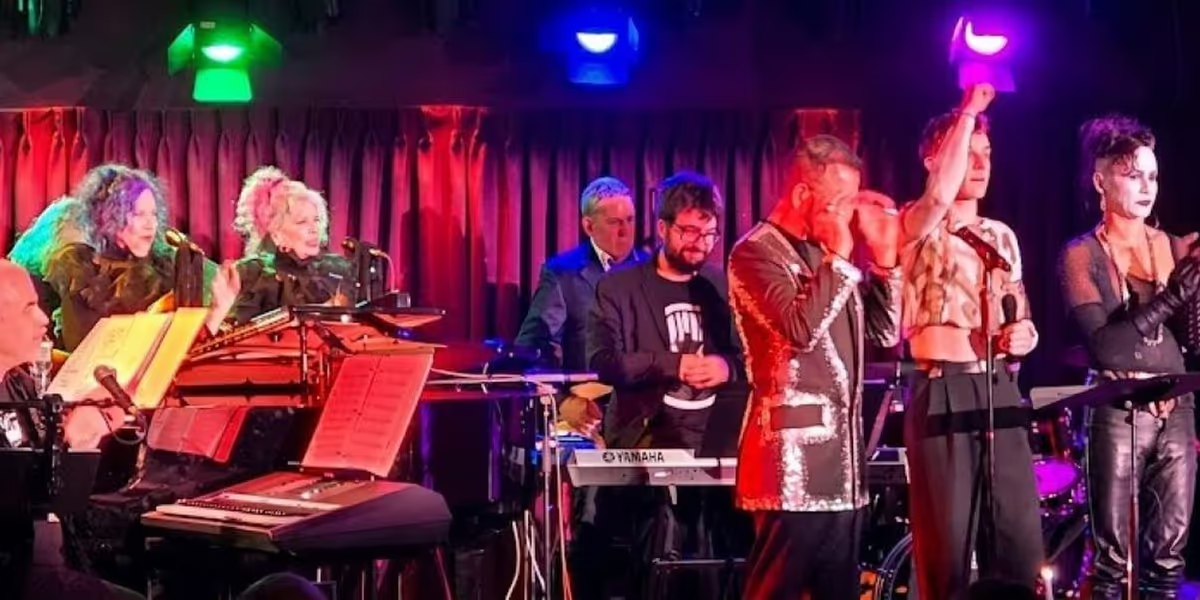
Caption: (from left) Peter Danish (with microphone), Rita Harvey, Liz Byrne, (front right) David Sabella, Tony D'Alileo, Jordan Rutter Covatto.
Credit: Nick Eck
Sign up for all the news on the Fall season, discounts & more...

Reader Reviews
To post a comment, you must register and login.