

The Night Before the Concert: Ju Hyeon Kim and the Art of Stepping In
Looking ahead, Kim's focus going forward is on deepening her presence across the East Coast orchestral circuit.
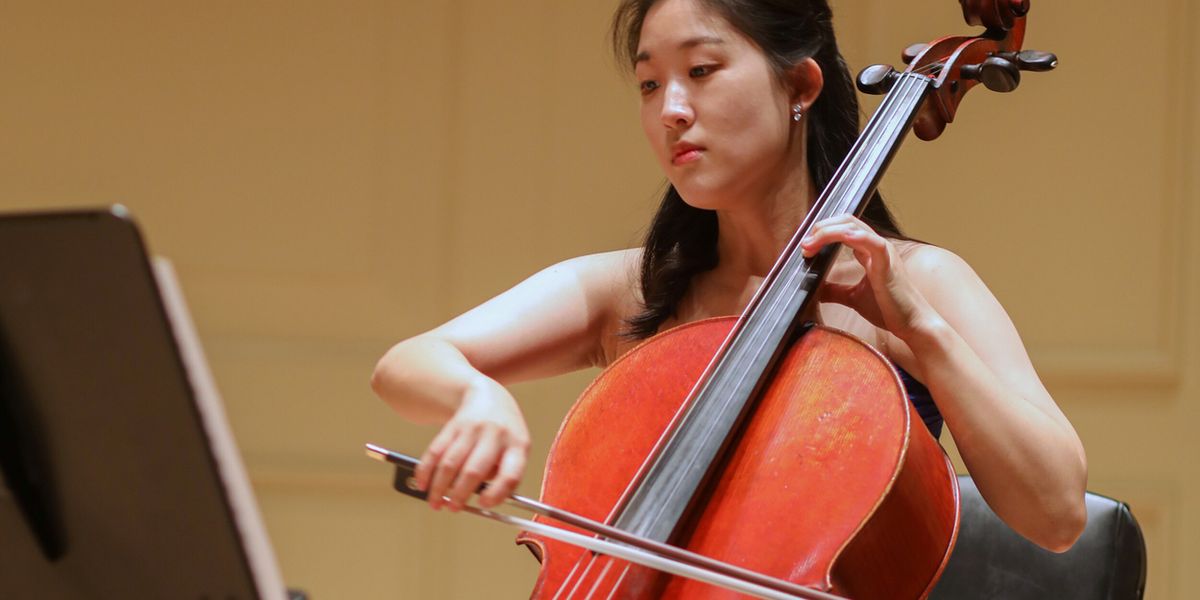
Written by Nia Bowers
A Phone Call After Rehearsal
The Delaware Symphony Orchestra had already run through its rehearsals. The production was set, the chairs were arranged, and the musicians had gone home for the night. Then the principal cellist fell ill.
By the time the call reached Ju Hyeon Kim, there were roughly eighteen hours until curtain. She was being asked to move up to the Associate Principal chair. No additional rehearsal. No preparation buffer. Just a performance at full professional standard, in a leadership role, the following evening.
She took the position. The concert went on. Nobody in the audience knew anything had changed.
This is the reality of orchestral substitute work at the professional level, and it is a reality that Ju Hyeon Kim has built her career around. As a permanent section cellist with the Delaware Symphony Orchestra and an active substitute with the New Jersey Symphony Orchestra, Kim occupies a rare position in the American classical music world. She carries the responsibilities of a full-time orchestral musician while simultaneously remaining available for high-pressure engagements where the margin for error is essentially zero.
What Substitute Work Actually Demands
There is a version of orchestral substitute work that sounds straightforward on paper. A musician learns the repertoire, shows up, and fills a seat. The reality at the professional level is considerably more demanding than that.
Walking into an established cello section as a substitute means absorbing the section's collective sound almost immediately. Bowing choices, phrasing, intonation tendencies, the way the section follows a particular conductor's beat, all of it has to be read and matched in real time. There is no rehearsal with the specific ensemble beforehand. There is no margin to find your footing over the course of a few performances. The standard expected on the first night is the same standard expected of musicians who have played together for years.
For Kim, this demands what she describes as deep musical intuition built through rigorous preparation. Sight-reading ability at the professional level is not simply reading notes off a page. It is the capacity to process musical information, make stylistic decisions, and execute technically demanding passages simultaneously, in front of a live audience, under world-class conductors.
The Delaware emergency tested all of that at once. Moving up to the Associate Principal chair mid-production meant taking on a leadership function within the section, not just blending into it. The intonation, the bowing, the presence within the ensemble all shift when you are in that chair. Kim executed the performance without a preparation lag that anyone could detect.
How She Got to the NJSO Roster
The New Jersey Symphony Orchestra does not take substitute musicians casually. Getting onto that roster requires more than strong credentials. It requires the kind of personal validation that comes from people already working at that level.
During her doctoral studies, Kim came to the attention of Jonathan Spitz, the Principal Cellist of the New Jersey Symphony Orchestra. Spitz, who has held that chair through decades of the orchestra's history, personally recommended Kim for the NJSO substitute roster. That recommendation opened the door to active participation in the orchestra's recent season.
In the orchestral world, that kind of endorsement carries specific weight. It is not a general compliment about someone's playing. It is a professional vouching, from a figure of established authority, that a musician can be trusted to maintain the integrity of a section at the highest level. For Kim, the NJSO work became a parallel track running alongside her permanent duties in Delaware, each role reinforcing the other.
The Broader Picture
American orchestras depend on substitute musicians in ways that rarely get discussed publicly. When audiences buy tickets to a symphony performance, they are buying a promise of consistent, professional execution regardless of what personnel shifts happen behind the scenes. The substitute roster is part of what makes that promise possible.
Kim's view of her own role fits directly into that picture. She frames what she does as solving a concrete problem for major musical organizations: personnel instability in high-stakes productions. When a key player cannot perform, the ensemble needs someone who can arrive, read the room, and deliver. The ability to do that reliably, across different orchestras and different repertoire, is a specific professional skill set.
It is one that takes years to develop and very few musicians can offer at the level the major orchestras actually require.
Looking Ahead
Kim's focus going forward is on deepening her presence across the East Coast orchestral circuit, continuing both her permanent role with the Delaware Symphony and her work on the NJSO substitute roster. She has also spoken about eventually mentoring emerging orchestral musicians, particularly around the realities of substitute work and what professional adaptability genuinely demands.
For now, though, the work speaks clearly enough on its own. When the call comes the night before a concert, Ju Hyeon Kim answers it.
Photo Credit: Ju Hyeon Kim