


Review: THE MET OPERA ORCHESTRA MAHLER 4TH at Carnegie Hall
What did our critic think of THE MET OPERA ORCHESTRA MAHLER 4TH at Carnegie Hall?
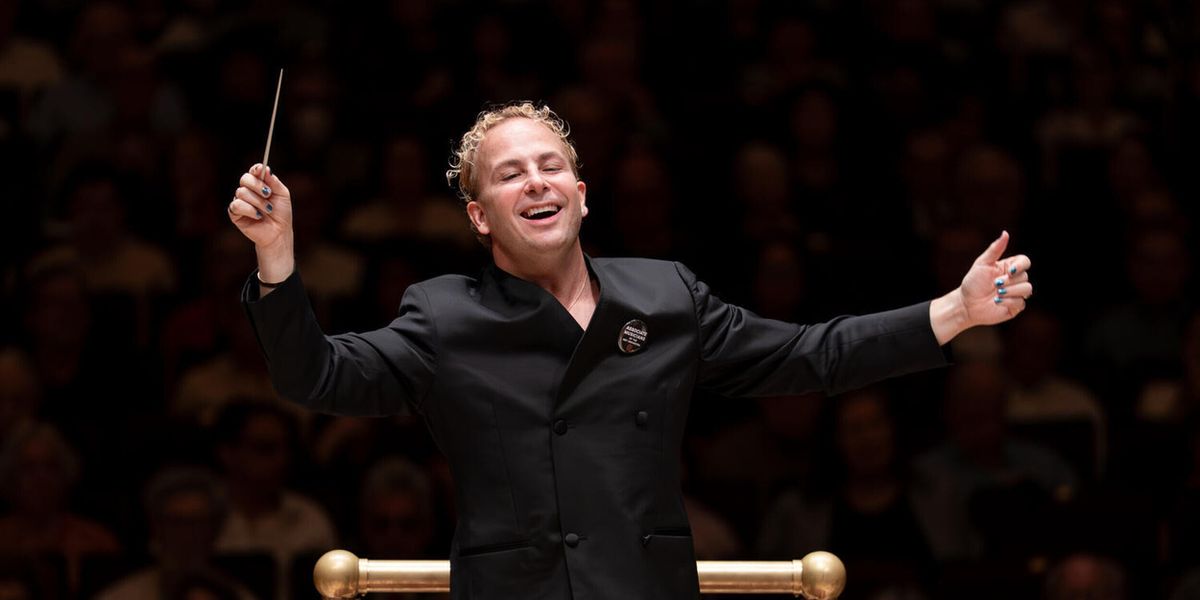
The final Carnegie Hall appearance of the season by the Metropolitan Opera Orchestra under the direction of Yannick Nézet-Séguin proved to be one of the most satisfying orchestral evenings New York has heard this spring. In a program devoted almost entirely to Mahler—featuring the *Rückert-Lieder* and the Fourth Symphony with mezzo-soprano Joyce DiDonato—the Met Orchestra demonstrated once again why it has become one of the city's most consistently rewarding ensembles. The program paired Mahler's inward-looking songs with his most luminous symphony, creating an evening of remarkable cohesion and emotional depth.
For those who heard Nézet-Séguin's recent performance of Bruckner's Eighth Symphony two weeks earlier, this concert offered a striking contrast. While the Bruckner often felt episodic and somewhat diffuse, Mahler seemed to fit the conductor like a glove. The Canadian maestro's instinctive feel for theatrical pacing, color, and emotional narrative served this music magnificently. Mahler's abrupt shifts of mood, his chamber-like transparency, and his uniquely human blend of irony and tenderness all emerged naturally under Nézet-Séguin's guidance. Where the Bruckner occasionally lacked cohesion, the Mahler unfolded with an unerring sense of purpose.
The evening began with Saariaho’s orchestral piece, Lumière et Pesanteur. Saariaho’s compositional language avoids many of the cues that traditionally help orient an audience. Climaxes emerge without much preparation, and large-scale structural shifts often occur with little warning. Admirers may find this unpredictability compelling and atmospheric, while others may occasionally wish for a firmer sense of direction and destination. At its best, this approach creates a fascinating sense of unpredictability; at other times, it can leave the music feeling elusive and difficult to grasp; the latter was the impression of this reviewer.
Mahler's “Rückert-Lieder,” was next, sung by mezzo Joyce DiDonato with a level of artistry that only deepens with time. These songs demand not merely vocal beauty but profound textual insight, and DiDonato brought both in abundance. Her voice has acquired a richer, darker patina over the years, yet it retains its remarkable flexibility and communicative power.
Particularly memorable was the final song, *Ich bin der Welt abhanden gekommen* ("I am lost to the world"), one of Mahler's most moving meditations on solitude and transcendence. Here DiDonato achieved something extraordinary. Her phrasing seemed to suspend time itself, floating above the orchestra with a serenity that never became detached or mannered. Every word carried meaning, every phrase felt inevitable. The audience sat in rapt silence as the song faded into Mahler's magical final pages. It was one of those rare performances that reminds listeners why live music remains irreplaceable.
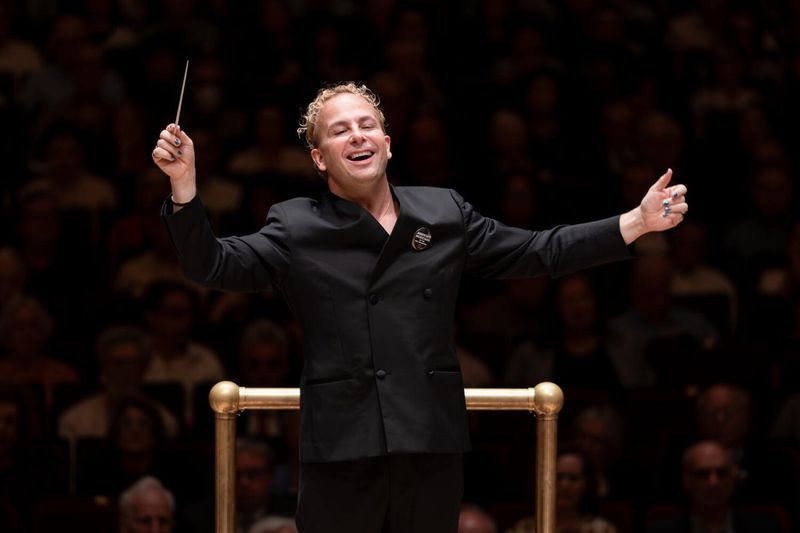
Throughout the cycle, the Met Orchestra accompanied with exceptional sensitivity. The woodwind principals, in particular, contributed countless moments of refinement, while the strings produced a warm, luminous cushion beneath the vocal line. DiDonato's performance alone would have justified the evening.
After intermission came Mahler's Fourth Symphony, arguably the composer's most deceptively difficult orchestral work. Its apparent innocence can easily become sentimental, while its humor can descend into caricature. Nézet-Séguin avoided both traps, offering a reading notable for its elegance, clarity, and affection.
One of the first things visible to the audience was the unusual stage configuration. The double basses were positioned on the far left side of the stage, opposite the percussion section on the far right. This arrangement created a fascinating stereo effect, allowing inner orchestral details to emerge with unusual clarity. The bass lines possessed unusual presence and definition, while the percussion—especially the sleigh bells and delicate rhythmic punctuation—registered vividly without overwhelming the texture.
Most impressive throughout the symphony was the sheer beauty of the Met strings. Carnegie Hall audiences have long admired the orchestra's principal winds and brass, but on this evening the strings were the undisputed stars. The violins played with remarkable unanimity and warmth, producing a glowing, almost vocal quality in the slow movement. The violas and cellos brought richness and character to Mahler's inner voices, while the bass section anchored the entire performance with depth and authority despite its unconventional placement.
The first movement danced along with buoyant charm, its rustic humor balanced by moments of genuine mystery. The second movement, featuring Mahler's famous "Death fiddle," a solo violin that represents "Friend Hein," a figure from German folklore who acts as a skeleton playing a fiddle (or Totentanz). The instrument is tuned a whole step higher than normal to create a shrill, almost eerie sound. It was both playful and unsettling, with concertmaster David Bowman and conductor Nezet-Seguin relishing the movement's grotesque waltzes without exaggeration (even if they chewed the scenery a bit while doing it!).
It was in the great Adagio, however, that Nézet-Séguin truly distinguished himself. Here the conductor displayed precisely the qualities that seemed less evident in the earlier Bruckner performance: patience, long-range architectural vision, and an instinctive understanding of how to build tension over extended spans. The movement unfolded in one long, beautifully shaped arc. The climactic eruption near the end arrived with overwhelming force, made all the more powerful by the restraint that preceded it.
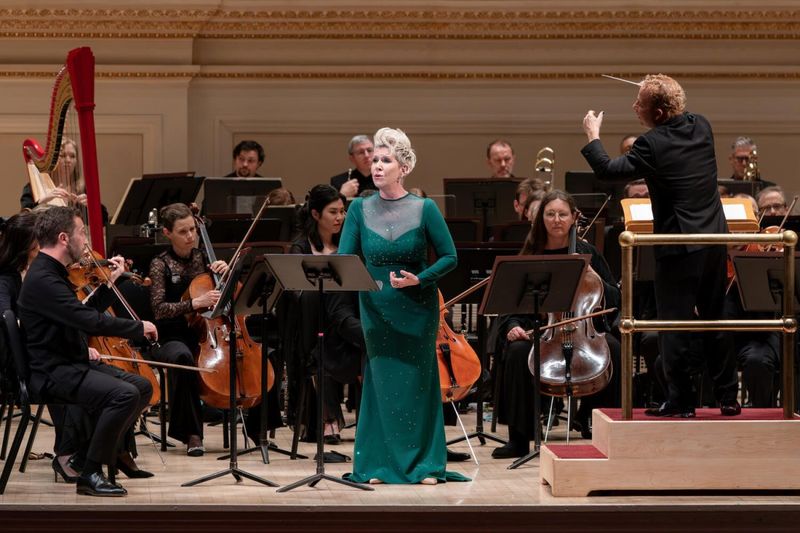
DiDonato returned for the symphony's final movement, Mahler's setting of “Das himmlische Leben” ("The Heavenly Life"). Her singing captured precisely the childlike wonder the music requires without ever becoming precious. The voice floated effortlessly above the orchestra, even if her voice’s darker quality sounded a bit mature for the character of the tune. Still, her splendid storytelling instincts brought vivid life to Mahler's vision of heaven as imagined through the eyes of a child.
Nézet-Séguin kept the orchestral accompaniment light and transparent, allowing every detail of Mahler's orchestration to register. As the music gently dissolved into silence, one sensed a collective reluctance among the audience to break the spell.
What most distinguished Nézet-Séguin’s interpretation was his decision to emphasize the symphony's lyricism, grace, and sense of wonder over its more shadowed and slightly darker undercurrents. While Mahler's music often contains hints of anxiety and existential unease—qualities that can surface even in the brightest passages—Seguin chose instead to focus on its warmth, innocence, and humanity. The result was a performance that left the audience not weighed down by introspection, but uplifted and genuinely happy, a perfectly valid and deeply satisfying perspective on the work.
Peter Danish
Photo credit: Jennifer Taylor
Prefer BroadwayWorld in Google Search?
Add us as a preferred source so our stories show up more often in Top Stories and Google’s AI answers — for you.
Sign up for all the news on the Summer season, discounts & more...
|
NYFOS Next: A Perfect Rose: Dorothy Parker Songs The Theater at 150 W 17th Street (9/27-9/27) |
|
American Composers Orchestra: New Virtuoso: Low End Theory at Carnegie Hall Carnegie Hall (3/18-3/18) |
|
New York Festival of Song: First-Name Basis New York Festival of Song: First-Name Basis (10/20-10/20) |
|
American Composers Orchestra: Hello, America: We Gather Here at Carnegie Hall Carnegie Hall (10/27-10/27) |

|
NYFOS Next: This Now Naked Life The Theater at 150 W 17th Street (11/15-11/15) |
|
Carnegie Hall Presents: Santiago Cañón-Valencia and Victor Santiago Asuncion Carnegie Hall (11/10-11/10) |
|
Grand Choral Opening: War & Requiem Church of the Ascension (10/29-10/29) |

Reader Reviews
To post a comment, you must register and login.